




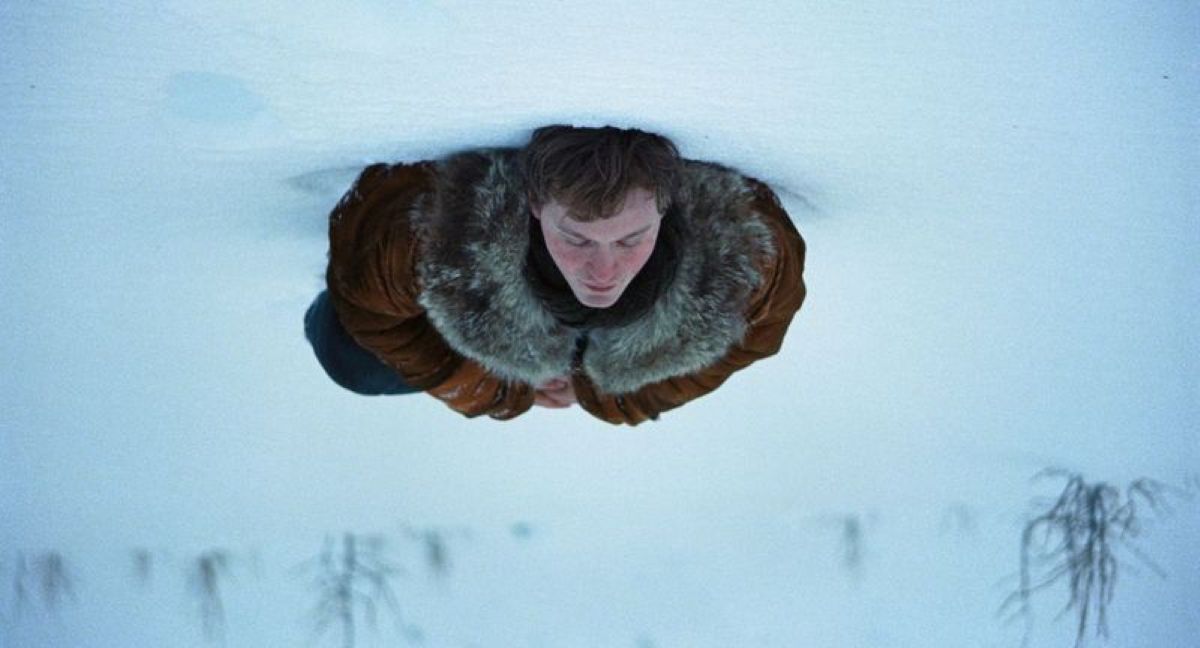
TELLURIDE – We are unabashed fans of Andrew Haigh. Whether it’s “Weekend,” “All of Us Strangers,” or “45 Years,” we have often found his films emotionally nuanced and remarkably grounded. He’s an auteur whose themes and characters may resonate with you for weeks on end. That’s why we’re somewhat perplexed over Haigh’s latest drama, “A Long Winter,” a loose adaptation of Colm Tóibín’s short story originally set in Spain. We’re not sure why Haigh decided to do this, but he transposed the story to 1951 and the Rocky Mountains of Colorado, a state that also happens to be the home of the Telluride Film Festival, where “Winter” had its world premiere this weekend. And, much to our disappointment, it all feels a bit off.
The scenario will feel somewhat familiar. Lester (Ebon Moss-Bachrach) and Louise (Caitríona Balfe) have raised their two sons, Mike (Fred Hechinger) and Tommy (Kit Connor), on a small farm high in the mountains, far from a nearby town with a burgeoning population. The family doesn’t have a television or some of the “modern” comforts you would expect from even a standard suburban home in 1950s America. In many ways, this has been a cage for Louise, who dreams of living a life she sees in Cosmopolitan magazine. Her husband, having escaped New York City, enjoys the relative quiet of this tranquil life.
READ MORE: 2026 Telluride Film Festival Preview: 17 Must-See Movies To Watch
After spending a year working in Montana, Mike has come back home, and things are not going well. Louise has been an alcoholic for quite some time, and either Lester has somehow covered this up, or Mike never wanted to see the signs of his mother’s addiction right in front of him. We are told that his parents have been together for 25 years, so as the oldest son, one has to assume he’s in his early 20s, but he has a childlike naivety for his age (let alone the fact that he had a whole life out of state). Tommy is going off to war in South Korea and is gone in the blink of an eye. Narratively, he’s there to show how close the two brothers are, to question why his brother would want to come back home in the first place, and to demonstrate his skills as the one son who can convince the hens to lay eggs and charm the rabbits into, well, not dying. Two skills we soon learn Mike doesn’t have (he is quite good at chopping wood, though).
During a trip into town, Louise asks Mike to do grocery shopping as she heads toward the hardware store. Mike catches her having a drink at the local bar. When she reunites with the family, she makes excuses for not being able to pick up the heating oil they needed. After Tommy leaves, the tension increases with Louise unable to hide her disdain for her husband and the life she chose with him in front of Mike. One morning, the men wake up to discover that Louise has walked out of their home with their family dog. All while a severe winter storm enters the fray.
For a moment, Haigh teases that the townspeople and police might see Lester as a suspect, but it’s a red herring. Even Louise’s brother Frank (Martin Freeman) knows of his sister’s alcoholism, her affairs, and her rebellious nature, effectively letting Mike know everyone in town knew, but him (Haigh makes it clear early on Mike’s a mamma’s boy, but his blindness to everything around him is a bit hard to fathom). As the weeks pass, Mike continues to hike the now snow-clad mountains looking for any signs of life, but everyone realizes they will never find her in the long winter. Instead, they must wait till spring. And when the vultures appear in the sky, that will be a sign her body has appeared in the melting snow.
While they wait for these unloving creatures to circle, Ellen’s, brings on a boarder, Jimmy (“Reservoir Dogs'” D’Pharaoh Woon-A-Tai), to basically do women’s work that neither his son nor he wants to do. There’s not much to the role, and Woon-A-Tai has probably five lines in the entire film, but he fits as a means for Fred’s character to project his romantic yearnings. Mike also has a flirtatious connection with a young police officer, who clearly might be interested in something more, but they seemingly never act on it.
If the film is meant as a character study of a young man trying to find himself over this long winter, a young man who has lost a foothold he could hold on to, Haigh is simply too vague in his intentions. The only hint of a different road for Mike is when his father volunteers, if you need to leave, “I’ll be O.K”. But there’s no sign that Mike ever wants to leave. Ever. There’s no sign he wants to go anywhere else like his brother. He did that and returned. He also never acts on his attraction to the young men in his life, and his only goal is to keep his mother’s remains from being eaten by the vultures (granted, an admirable dream). But the vultures are not coming for him (or his father either). His true nature is seemingly invisible to everyone who encounters him (that one police officer notwithstanding). He generally seems somewhat content as a closeted man living in the mountains (no, we can’t believe we typed that either). Is that what Haigh wants us to think? Maybe so.
Hands down, the best performance in the entire movie is Balfe’s, and “Winter” only truly comes alive when she’s on screen. She’s so good you wish the movie focused on Louise’s life story instead of Mike. Unfortunately, she’s only around for a good 30 minutes or so. Hersingler is a talented actor who’s been fantastic in everything from “The White Lotus” to “Thelma.” He has an inherent empathy that we’ve seen many times in a wide range of projects, but this role gives him nothing. Or he can’t convey what Haigh wanted to say with the character. We hate to go there, but it feels like he was either miscast or Haigh’s screenplay somehow failed him.
From a production aspect, André Turpin’s cinematography is beautiful. He does a wonderful job of capturing the Canadian side of the Rocky Mountains, which, for anyone who has spent even a minuscule amount of time in Colorado, gives Calgary and Alberta way more than Colorado. But production designer Emmanuel Fréchette’s period details in the small town are spot on. Overall, it’s a fine production, but the movie leaves you wanting. What about this young man’s story is so compelling that it needed to be put to film? What did Haigh aspire to say with this story? When you have to hunt down the production notes to find out why, that’s usually not a good sign. The result almost feels more like a quiet echo of a film you’ve seen before than anything that can stand on its own. But Balfe is fantastic, and Haigh and his colleagues are talented folk. We’ll know he’ll make something else that will resonate, that will inspire. Next time around. [C+/C]
Follow along with all our coverage of the 2026 Telluride Film Festival.
Follow Gregory Ellwood on Bluesky
Follow Gregory Ellwood on Threads
Follow Gregory Ellwood on Instagram
Follow Gregory Ellwood on TikTok
Sign Up For The Breakdown Newsletter

Editor-at-Large Gregory Ellwood is one of the entertainment industry's most respected journalists and critics. Based in Los Angeles, he's the only current awards expert who previously worked on Oscar campaigns at a major movie studio. Over the years, he has written for the LA Times, Variety, The Hollywood Reporter, and Vox, among others. He also co-founded the entertainment news site HitFix, which spawned a legion of influential Emmy and WGA Award-winning alumni.


