





Oscar winner Siân Heder might be one of the greatest allies disabled people have in cinema today. She follows her Best Picture-winning “CODA,” which centered on Deaf characters and culture, with a biographical drama about Judith Heumann, the pioneering disability-rights activist. “Being Heumann,” adapted by Heder and Rebekah Taussig from Heumann’s eponymous memoir, is a rousing chronicle of a defining civil-rights moment. However, it remains familiar, didactic, and beholden to cinematic convention. Nevertheless, Heder and Apple Studios deserve credit for mounting Hollywood productions that foreground the dreams, needs, and accomplishments of disabled people and, more importantly, give disabled performers leading roles and the silver-screen limelight.
READ MORE: TIFF 2026 Preview: 30 Must-See Movies To Watch
“Being Heumann” isn’t a traditional cradle-to-grave biopic. Much like Steven Spielberg’s “Lincoln,” it focuses narrowly on a legislative victory that altered the course of civil rights in America. The film concerns Section 504, slipped into the Rehabilitation Act of 1973 by enterprising congressional staffers without floor debate, which dramatically expanded accessibility and accommodation rights for disabled Americans. The conflict hinges on Joseph Califano, Secretary of HEW (Health, Education and Welfare, the predecessor to HHS), who, even by April 1977, had refused to sign the implementing regulations into effect. What ensues is the pressure campaign mounted by Heumann and fellow disability-rights activists to force the Jimmy Carter administration’s hand, ultimately transforming the lives of millions of Americans with disabilities.
Heder introduces Heumann with an energetic 1972 prologue in which she barrels through a busy intersection in her wheelchair, stopping a 20-wheeler dead in its tracks as she raises awareness about Section 504. Five years later, we find ourselves in a busy, buzzy San Francisco office where disability activists are planning their campaign against Califano. These early sections strongly recall Gus Van Sant’s gay-rights activism drama “Milk.” Heder quickly introduces most of the major players, including Heumann (Ruth Madeley), Kitty Cone (Madeline Delp), Brad Lomax (Antwan Tolliver), Hale Zukas (Andrew Pilkington), and Ed Roberts (Michael Patrick Thornton), among many others. It’s gratifying to see an entire ensemble of disabled characters leading a film, all played by disabled actors, no less.
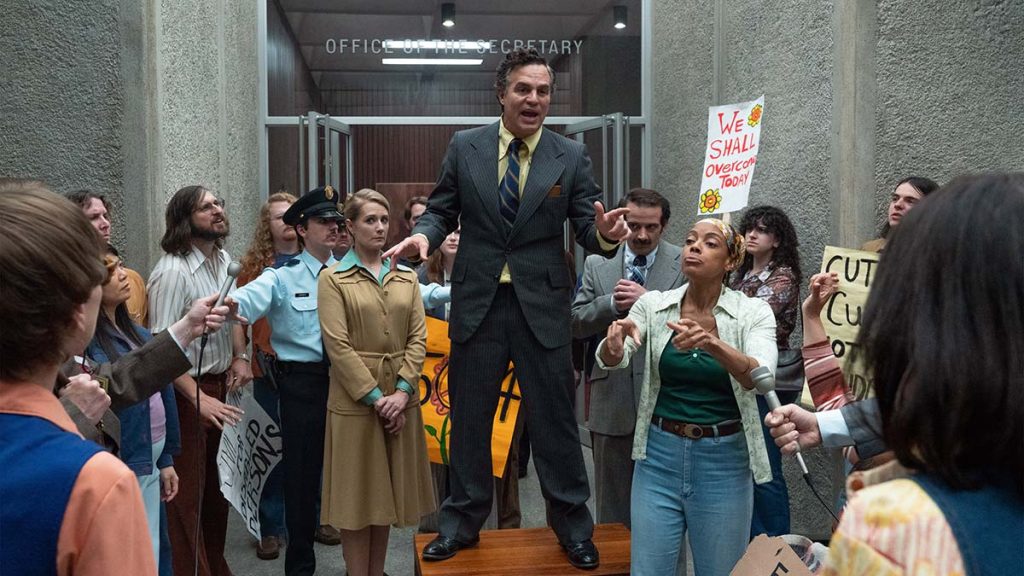
“Being Heumann” then moves into its central dramatic spine: the nonviolent occupation of the HEW building in San Francisco by Heumann and her fellow activists, which became the longest sit-in at a federal building in U.S. history. The scenes of protest and occupation crackle with the spirit of rebellion and ’70s counterculture as the protesters improvise accommodations, tear down bathroom walls to make them wheelchair-accessible, and commandeer vending machines for nourishment. Soon, the Black Panthers and the mayor become involved, mattresses arrive along with food, weed, and music, and the protesters even construct a sex tent so occupants can enjoy some privacy.
This is where Heder’s hand is most evident, portraying disabled characters completely removed from the patina of misery and deprivation that Hollywood has so often imposed on them. Her characters joke, swear, get high, and, yes, enjoy sex while piling political pressure on Washington. Heumann gets a love interest of sorts in Jim Pechin (Jon Beavers), which leads to some erotic fulfillment of her own. Heder also carefully documents the day-to-day needs of the protesters, including those who must be lifted from their wheelchairs onto mattresses and turned during the night. They need assistance peeing and bathing, charging wheelchairs and breathing apparatuses, cooling medications, and more. These are not able-bodied people roughing it for a few weeks; occupying a building without even a wheelchair ramp comes at an enormous physical cost.
The overarching tone, however, is lighthearted and, yes, that dreaded word: crowd-pleasing. Heder leavens the dramatic stakes with plentiful humor, zingers, and visual gags. Her desire to create dimensional parts for disabled performers also means this isn’t quite a Heumann hagiography, even though her estate participated in the film. Madeley carries the movie ably, and her Heumann can be domineering, stubborn, and bossy. Still, the flaws she exhibits tend to resemble the kind of weaknesses you offer during a job interview—strengths strategically disguised as shortcomings—and that exposes some of the limitations of Heder’s approach.
She clearly wants to paint with a broad brush and create an educational, entertaining experience accessible to the widest possible audience. But she’s preaching to the choir a little. Heder’s primary intended audience is unlikely to require much persuasion that people with disabilities deserve equal rights. The movie might have been more daring had it discussed accommodation in cooler, more provocative, rational-minded terms rather than through the expected heartwarming register, or adopted a form as challenging and radical as the people it portrays. Some of the dialogue is extremely didactic, explicitly dramatizing principles so morally self-evident that few viewers are likely to dispute them. Hollywood convention turns these ideas into arguments and debates between characters, but the impression of a dramatized PSA sometimes lingers.
“Being Heumann” also runs a little long at 127 minutes, and during its final act, the film’s energy begins to flag just as the protesters’ does. Historical fidelity has value, but compressing the Washington portion more might have yielded a more potent finish. The concluding passages have a start-and-stop quality leading toward an anticlimactic victory that largely happens off-screen. There was always a danger that focusing too heavily on Califano deciding to do the right thing could turn “Being Heumann” into an able-bodied savior story. But Heder and Mark Ruffalo err somewhat in the opposite direction, rendering Califano as such an exaggerated antagonist that he occasionally borders on cartoonish. A few other recognizable faces appear in key supporting roles, including Ray Fisher as an important ally and Dylan O’Brien as a news reporter covering the protest.

The period recreation is convincing, particularly the costumes and hair, as is some of the era’s vocabulary: “handicapped” and “cripples” are casually used to describe the main characters, language that now makes you wince. “Being Heumann” is slick and thoroughly Hollywoodized, with dramatic beats landing almost on metronomic cue even though its central events remain largely faithful to history. At times, you wonder whether a nonfiction film might have served this material better.
But as a juiced-up, souped-up Hollywood version of Heumann’s story, “Being Heumann” lands on the right side of schmaltz—just about. For all its conventionality and occasionally overinsistent messaging, Heder’s film understands something essential about its subjects: disabled people need neither pity nor sainthood to deserve autonomy, dignity, pleasure, and full participation in society. Those rights were not simply granted. People fought like hell for them, and “Being Heumann” makes an effective, stirring case for remembering who did the fighting. [B]
Follow along with all our coverage of the 2026 Toronto International Film Festival.


Ankit is a writer and film critic who has spent more than a decade chasing bold, provocative cinema across festivals from Cannes and Berlin to New York and Toronto. Drawn to films that take risks and break molds, he covers everything from adventurous arthouse discoveries to major releases—and is always looking for a story that does something unexpected.


