




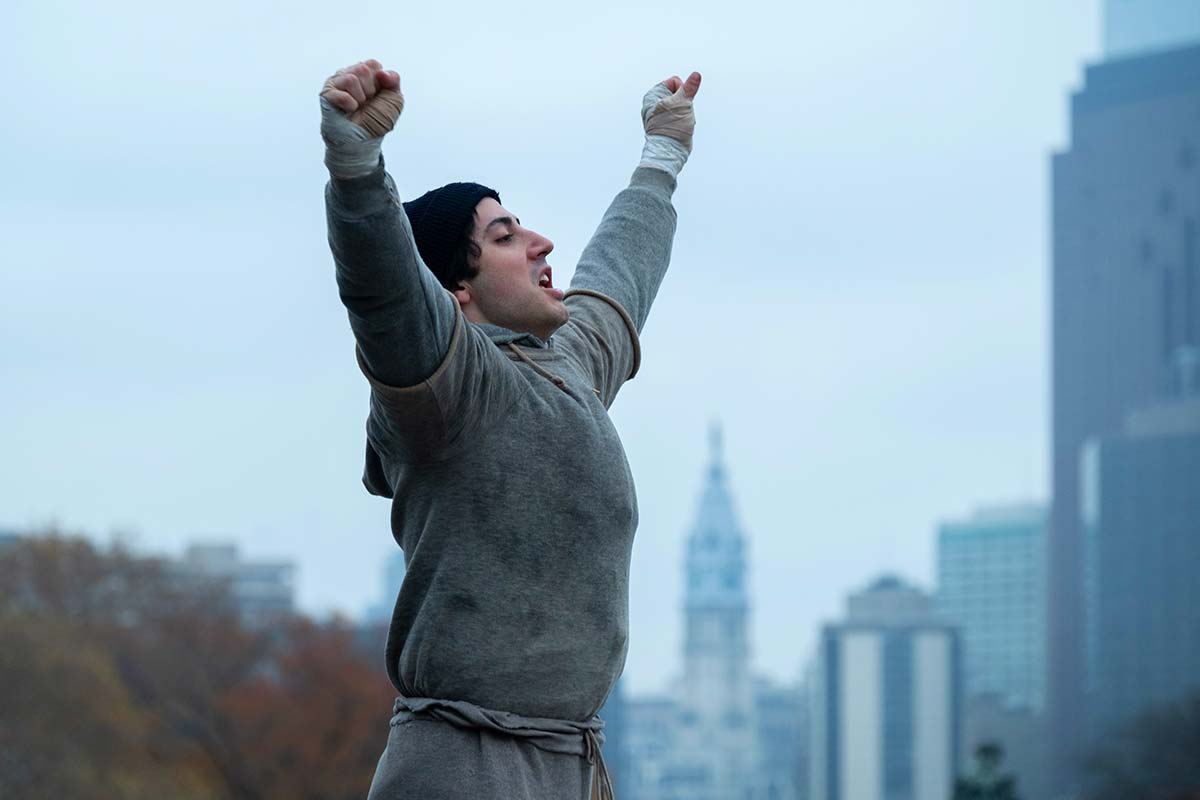
Making-of movies are a curious subgenre, with notable examples including “Saving Mr. Banks,” about the making of “Mary Poppins”; “Mank,” about “Citizen Kane”; “Hitchcock,” about “Psycho”; and “Nouvelle Vague,” about “Breathless.” These movies mine beloved classics for audience affection, generating pathos and appreciation through recognition and association. To that list, we can now add Peter Farrelly’s “I Play Rocky,” repeatedly misnamed by TIFF audiences as “I Love Rocky.” “Rocky” is, after all, the ultimate Hollywood underdog story—“Obsession” before there was an “Obsession.” Farrelly recreates the, well, rocky road to its conception with verve and gusto, employing all manner of reenactments, callbacks, and familiar iconography to pack the movie to its crowd-pleasing gills. Seen with a game audience, as it was at its world premiere in Toronto, “I Play Rocky” could practically blow the roof off the cinema, expertly weaponizing the audience’s love for “Rocky” and redirecting that affection onto itself through some sly, unabashed nostalgia-baiting.
READ MORE: Toronto International Film Festival 2026 Preview: 30 Must-See Movies To Watch
“I Play Rocky” is three movies rolled into one, and not all of them work equally well. Its extended first act plays like a Sylvester Stallone biopic, following Mike Stallone (Anthony Ippolito), as Sly called himself in his early days, through a string of failed auditions in New York, a stint in soft-core porn, homelessness, and assorted odd jobs. Peter Gamble’s script dutifully checks off the formative struggles, while also introducing Sasha (AnnaSophia Robb) in a meet-cute before she becomes his wife only a few scenes later. The pair eventually relocate to Hollywood, where Stallone works as a restaurant valet by day and churns out half a dozen scripts in his spare time, still waiting for the break that will change everything.
It isn’t until Stallone lands a meeting with producers Irwin Winkler (a terrific P.J. Byrne) and Robert Chartoff (Toby Kebbell) that “I Play Rocky” truly comes alive. From there, it’s off to the races, as the movie transforms into something closer to a workplace farce, built around Byrne, Kebbell, and Tracy Letts as a deliciously smarmy, nasty studio boss. The producers love Stallone’s “Rocky” screenplay but are gobsmacked by his titular proclamation: “I play Rocky.” In other words, they only get the script if he comes attached as its star. What follows is a hilarious, protracted negotiation between the untested “kid” and increasingly exasperated studio brass, as the offer climbs from $25,000 to more than $350,000—an outrageous sum for a spec script today, let alone in 1976.
The third act turns to the actual filming of “Rocky” in Philadelphia, and boy does Farrelly harvest the low-hanging fruit with a mercenary scythe. Nearly every scene you expect is here: Rocky running through the streets of Philly, shadowboxing in sweats, charging up the Philadelphia Museum of Art steps, the ice rink, the meat locker—you name it. “Rocky” was made as a “dog picture” in 1976, essentially a B-movie programmer produced on the cheap, and arguably still carries some of that scrappy DNA today. But it is also inarguably a classic: a monumentally beloved audience movie, a commercial phenomenon, and a Best Picture winner. “Rocky,” needless to say, has admirers in the gazillions, and Farrelly aims squarely for their sweet spot with relentless insistence.
If your audience is anything like the world premiere crowd at TIFF, it will burst into hoots and applause at several points during “I Play Rocky.” Therein lies the rub: it’s all just so easy. Farrelly is essentially shooting a goldfish in a fish tank with a nuke. His energetic, propulsive staging and the enjoyable hustle of his game cast might almost convince you that the picture they’re making is somehow doomed to failure. But we know what “Rocky” became, and “I Play Rocky” offers little insight into its making that wasn’t already self-evident in “Rocky” itself.
This isn’t Richard Linklater’s “Nouvelle Vague,” which at least offered the remarkable proposition that great art needn’t always be born from adversity—you can also just be a genius, you know. That idea was embodied by its central figure, Jean-Luc Godard, who could also be an insufferable, condescending asshole. “I Play Rocky” is after something much simpler: the pleasure of watching a legend become a legend, with the audience already primed to cheer every familiar step along the way.
The central figure in “I Play Rocky” is hollow and vapid by comparison. Ippolito might be the casting achievement of the year in one sense: his resemblance to Stallone, and his approximation of the actor’s physique, gait, mannerisms, and mumbled drawl, are uncanny. Disconcertingly so. It is an AI performance rendered without AI. It moves like Stallone, sounds like Stallone, and looks astonishingly like Stallone, but it isn’t Stallone. And one of the reasons “Rocky” works in the first place is Stallone’s charisma. Ippolito demonstrates that you can pastiche nearly everything else, but the intangible qualities that make movie stars movie stars can remain stubbornly beyond reach. His performance ultimately collapses the distinction between Rocky and Stallone so completely that “I Play Rocky” can start to feel alarmingly like the biopic of a fictional character.
Fortunately, it’s the colorful supporting cast that eventually carries the day in “I Play Rocky.” Once Byrne and Kebbell enter the picture, they become its de facto co-leads, and they’re a riot to watch—especially Byrne. A gifted character actor who has long impressed in smaller parts, including his roughly 15-minute showcase in “Babylon,” Byrne cuts loose here and becomes the source of innumerable laugh lines. He’s shamelessly enjoyable and deserves his flowers. Letts, meanwhile, is imperious and blustery, channeling the archetypal studio suit to perfection. Add Jay Duplass as “Rocky” director John G. Avildsen, and you’ve got a company of comedians whipping up a storm of gags around the straight-man singularity of Ippolito.
Almost all of “I Play Rocky” plays broad, but some of it might make “Saturday Night Live” blush. Stephan James makes a grand entrance as Carl Weathers, shirt open and abs glistening during his audition scene, complete with the famous zinger about Stallone needing to get better at acting. But the movie soon pushes Weathers into outright pantomime during the filming sequences. Watch “Rocky” and “I Play Rocky” back to back, as this reviewer did, and nearly every memorable element of the original gets called back in one form or another, right down to drinking raw eggs from a glass.
The same goes for Bill Conti’s iconic theme. When the producers hear an early recording, one of them remarks, “I’m not feeling it.” Cue roaring audience laughter. Again, it’s just too easy. “I Play Rocky” often feels less like a movie than a stand-up routine built around recognition, willing to reach for virtually anything if it can squeeze out another laugh.
For all of that, “I Play Rocky” is awash in inside-Hollywood baseball and, once the actual “Rocky” portion kicks in about 30 minutes into the film, consistently and undeniably entertaining. It’s breezy, undemanding, and diverting, and sometimes that’s not a bad thing at all. You might not learn much about filmmaking from “I Play Rocky,” nor discover anything particularly revelatory about how “Rocky” became “Rocky.” But for admirers of the original, Farrelly’s expert weaponization of nostalgia lands exactly as intended: like a right-hook knockout. [B]
Follow along with all our coverage of the 2026 Toronto International Film Festival.

Ankit is a writer and film critic who has spent more than a decade chasing bold, provocative cinema across festivals from Cannes and Berlin to New York and Toronto. Drawn to films that take risks and break molds, he covers everything from adventurous arthouse discoveries to major releases—and is always looking for a story that does something unexpected.


