


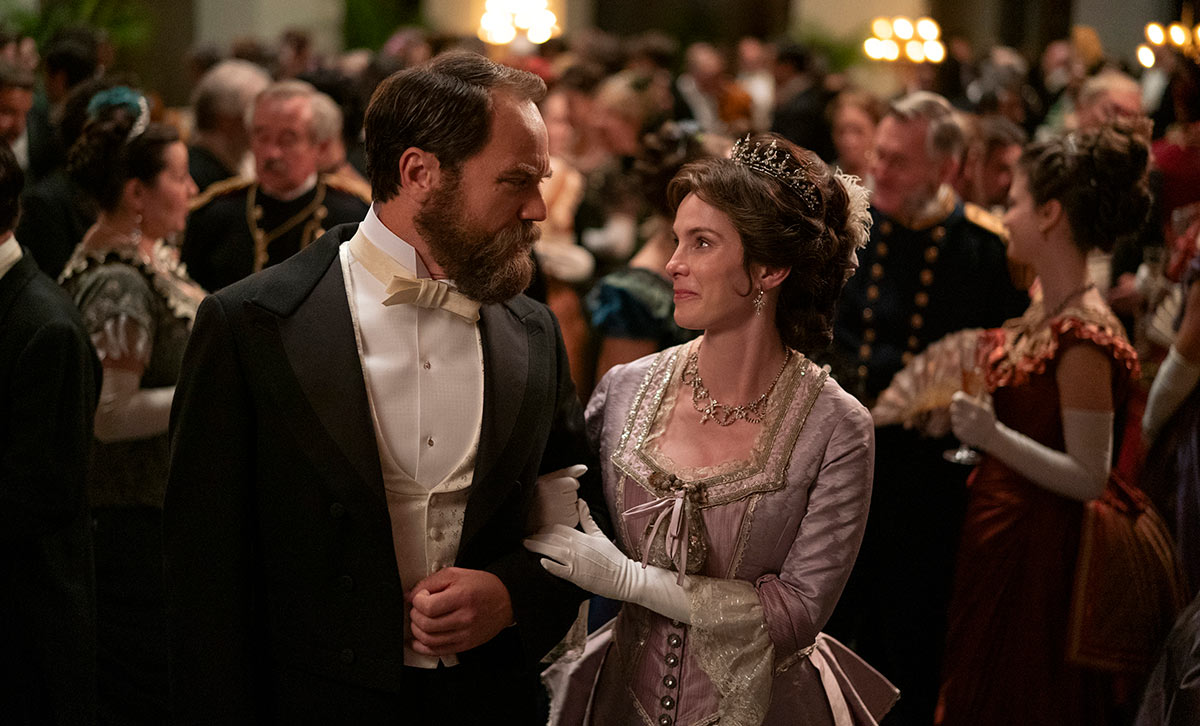
Mike Makowsky was told flat out his proposed limited series about the long-forgotten assassination of a long-forgotten, barely in office U.S. president would never get made. But there was something about the story of James A. Garfield (Michael Shannon) and his obsessive assassin Charles J. Guiteau (Matthew Macfadyen) that he felt needed to be told. Thankfully, he found allies in producers David Benioff and D.B. Weiss as well as a Netflix executive who was skeptical before reading Makowsky’s spec pilot. A script that has now earned him an Emmy nomination for Outstanding Limited or Anthology Series Or Movie.
Granted, we think “Lightning” should have landed a ton more Emmy nominations beyond Nick Offerman‘s fantastic turn as Chester Arthur, Cinematography, and Editing. That being said, the past 9 months have been kind to Makowsky and his creative team. The “Bad Education” screenwriter won a USC Scripter Award, earned a Peabody Award nomination, saw Shannon win a Gotham Award, and has a pending TCA Awards nomination (fingers crossed).
Over the course of our conversation, Makowsky did a deep dive on how the series got across the greenlight finish line, the difficulty in chopping a proposed eight-episode story into just four chapters, what he wished he could have kept, his love for episodic television, and much, much more.
This interview has actually been edited for length and clarity. Really.
_____
The Playlist: Congratulations on the Emmy nod.
Mike Makowsky: Oh, thank you.
Were you watching? What was your reaction?
I try to power off of that stuff as much as possible because I think that the second you start weighing your self-worth or the worth of your show based on whether or not it’s this discreet point in time you get a nomination for an award. It’s the cherry on top, but it’s definitely not the culmination of that journey, nor should it be. I’m honestly just so grateful that we got to make the show, the show that people told me would never in a million years get made, that I got to make it with this incredible group of people, and that I got to premiere it on Netflix and the people who have found it. I obviously feel very, very fortunate that it’s been received the way that it has by really nice journalists and critics and just fans and history buffs and people who are quite certain at the onset of the journey that they did not give a f**k about James Garfield to begin with, that those people found something to latch onto with it is just the greatest. That’s what matters.
Why do you think a show that you just said was so hard to get made actually did get made? Was there someone who deserves credit either at Netflix or one of your producing partners who got it across the finish line?
It was a spec pilot. I had read this book called “Destiny of the Republic” by Candice Millard, which I had picked up at the Buy Two Get One Free table at The Grove, Barnes & Noble, seven plus years ago now. I think I might have known that James Garfield had been assassinated, but it was not something that was expressly on my radar or a subject that I believed that I would frankly care much about. And I wound up reading the book in one sitting, and it blew me away, and I immediately tried to get on the phone with Candice and pitched my heart out. I was just like, “Listen, I have no idea if the marketplace will sustain an idea like this, but I just feel like I know how to tell this story.” And in a million years, it was never my ambition to adapt history. Although I consider myself a student of history to some extent- certainly not in any super significant way- I read a lot of historical nonfiction. I guess the first heroes are David Benioff and Dan Weiss, the producers of the show, because they read the script and [producer] Bernadette Caulfield and just really connected with it. And Dan Weiss paid me the best compliment I’ve ever received in my career, which was, “It took me a while to read this script just to get to it because I didn’t think I wanted to read a script about James Garfield of all people. And then at the end of the script, I needed to go spend three hours on Wikipedia and learn everything there was about James Garfield because I couldn’t believe the s**t actually happened.” And that very much mirrored my experience reading Candice’s book. I found myself laughing a lot, often at very inappropriate moments. I found myself in tears. I found myself putting the book down every other page to go on Wikipedia to make sure that this historian in Kansas didn’t make all this s**t up because it seemed way too crazy to have actually happened and for basically no one to know about it.
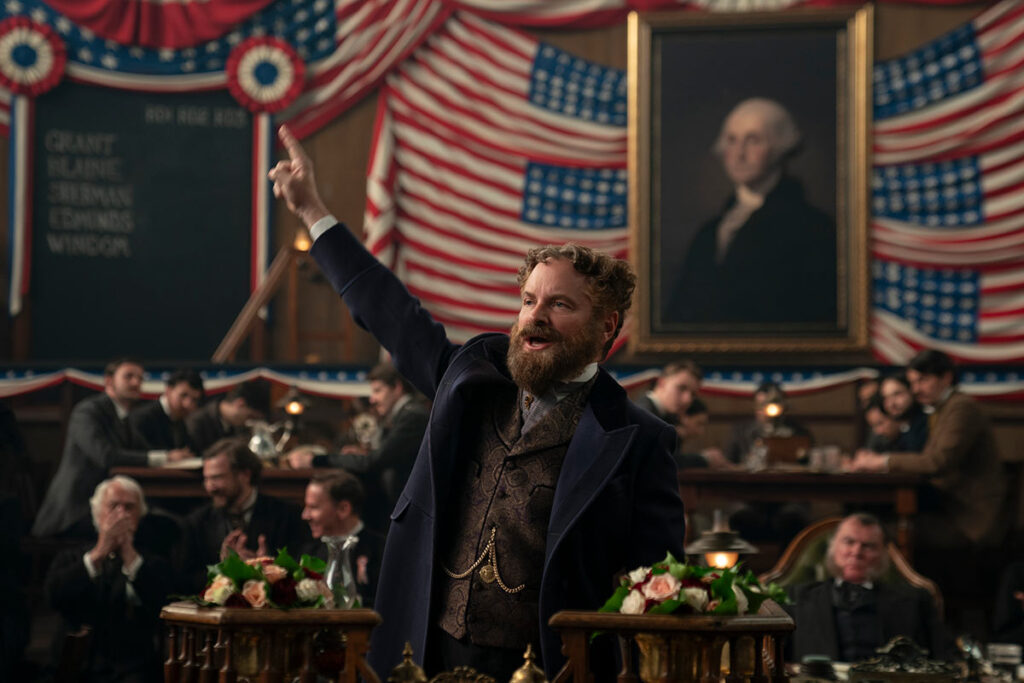
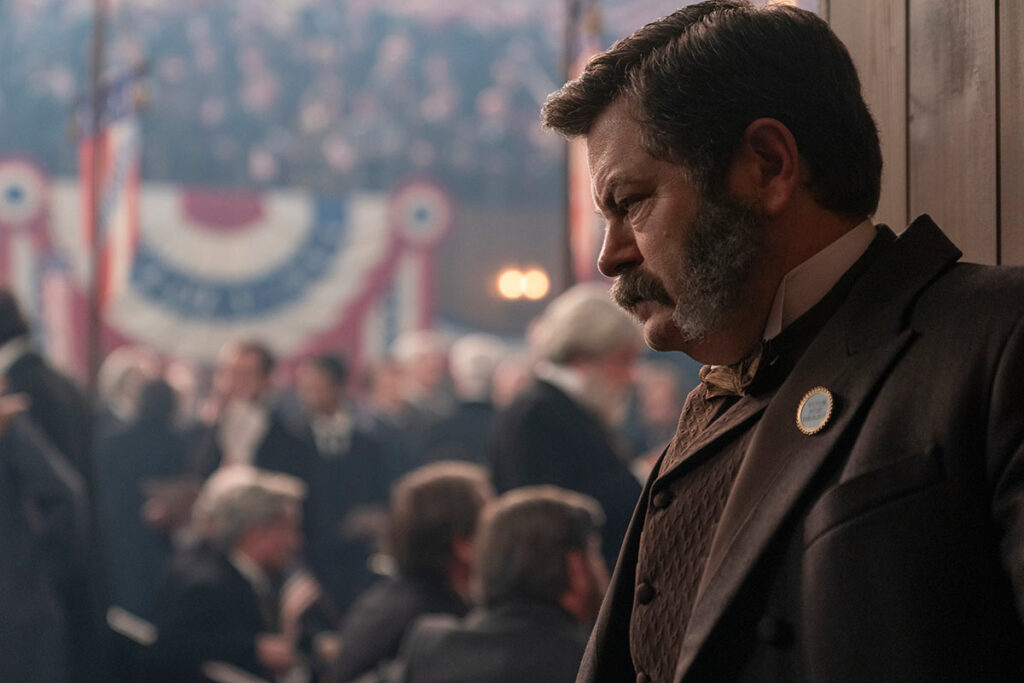
David and Dan had a deal at Netflix. I don’t think they had explicit designs on producing other people’s work, but they were like, “If we were ever going to take a shot on something and bring something in here, we’d want it to be something as weird and left of center as this.” And they made a lot of noise over there about this. And I think Netflix initially was like, “Why a show about James Garfield?” and eventually, reluctantly let me write a second episode. And I was very fortunate that by the time that I wrote the second episode, I knew what a heavy lift it was going to be, and I knew what an uphill battle it would be even internally at Netflix. And fortunately, I think my saving grace in episode two was that it ended up being the big Chester Arthur episode. And he was an ace I had in the hole that I didn’t really want to play in episode one by design, which was just like you want to elevate the least likely person, a person that you basically receive as an extra at this crazy convention and you elevate that man, the person that you would assume is least likely to become vice president, let alone president, and he ends up becoming kind of the hero of the entire story. And to have an actor like Nick Offerman, who was very, very patiently sitting out of focus in the background for 12 days of shooting the convention, because it makes the payoff that much richer, where you’re just like, “Wait, that f**king guy’s going to end up being president?” It was actually my executive, Blair Fetter at Netflix, who really, really believed in the show from the outset. Once he read episode two, he called me up, and he was like, “I know I was skeptical at first. I think that this might be my single favorite project I’m working on right now.” And then it just became his pet project. And we all just went on the journey together. Yeah, very fortunate that the powers that be at Netflix were willing to follow all of us on this crazy endeavor and that I get to have conversations like the one I’m having with you right now.
When you were structuring it out, was it always meant to be four episodes or was Netflix like, “This is how much money we’ve got, this is what you can do?”
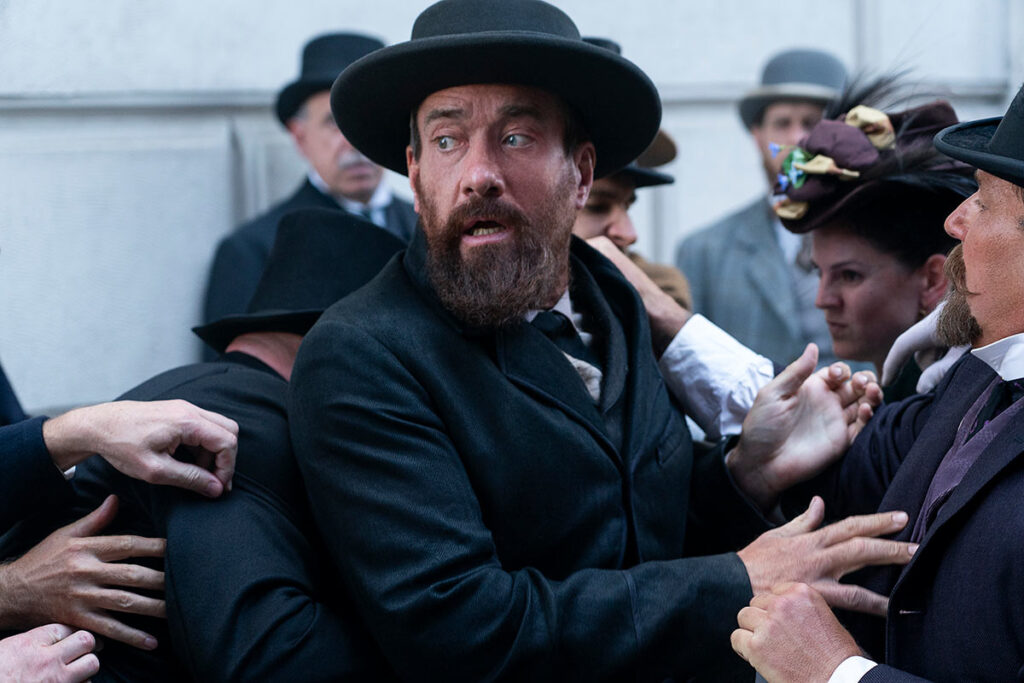
I think originally I pitched eight. I had a bunch of crazy ideas that the assassination at the train station could play essentially like the train station sequence from ‘The Untouchables.” That it could all just be real time. I wanted to have an entire episode that took place in the past. It was from the perspective of Betty Gilpin’s character, Lucretia Garfield. And also in parallel, Guiteau’s wife, Annie Bunn, who gets nary a passing mention in the final edit of the show because that’s its own crazy side story and I was told very gently and then very firmly, “You should really try to tell the story as expediently as possible because this is going to be a very heavy lift to get anyone to let us actually make any version of this.” I wrote six episodes initially, and it covered a lot of Guiteau’s trial, but it was very weighted on the backend. And the trial only ever took place after Garfield had been assassinated. So, it was very much like the Charlie Guiteau Power Hour, which was definitely fun to write, but didn’t necessarily have as much of a dramatic engine to it. The show weighs these two men in parallel with one another, and then once one of them is removed from the equation, the other kind of becomes less interesting just on his own. What I love about the show is that it is very much these two men in contrast in conversation with one another. I pared it down to four episodes before the show was ever greenlit.
Did they ask for four or were you like, “O.K., if I have to cut it down…”
I think we looked at the budget and what we thought [about what] we would be able to accomplish with the money that had been afforded to us. And we were like, “O.K., how do I actually make this the leanest cut of meat possible?” And ultimately, I think it ends up paying surprising dividends because, listen, I don’t know that most people would see a six-episode James Garfield show and want to click on it. I recognize that there is that implicit hurdle to, I don’t think I care about James Garfield unless I’m a massive history nut. Is a four-episode buy-in any more enticing? If I can tell the story concisely and quickly and in a way that hopefully moves and never feels boring and doesn’t luxuriate, will that make modern audiences more likely to engage with it?
Outside of “Adolescence,’ which was on a whole different timeline – I mean, you came right after it. You were basically shooting almost at the same time – Netflix rarely does four-episode shows. The minimum is usually six.
And people now more, especially given the success of “Adolescence” and to a slightly lesser extent, our show.
You’re being very humble. Your show was in the top 10 for a while. I saw it on that list for weeks on end.
It did O.K. We were very, very proud of how the show was received. But yeah, I mean, listen, do you remember “A Very English Scandal”? The first season was that was just Hugh Grant and Ben Wishaw, and it was two episodes. And to me, it’s one of the most effective limited series I’ve seen in a really long time. And I think that the story tells you how long it’s supposed to be. I don’t like to overstay my welcome. I’m grateful we got four episodes, but I genuinely believe at the end of the journey that that ended up being the best possible structure for that show.
When you were breaking it down, you said you had a rough idea of how to work the storyline over eight episodes. Let’s say it was really six for the main story. What was the toughest structural change you had to do to make it narratively work?
In terms of darlings I had to kill almost?
Sure, or where you had to place plot points per episode?
I mean, for me, I mean ultimately episodes four through six ended up becoming episode four. And the episode is a little bit longer than the other three episodes, but it’s not crazily inflated. It really did come down to certain story points that had to be streamlined out for us to make those four episodes and entire subplots and things. I would’ve loved to talk about Guiteau’s wife, for instance, and his backstory. She testified against him at trial, and I read the trial transcripts, and it is one of the most devastating things you will ever read. And I hated that we had to lose it, but I understood why we had to do it. It may have ultimately made the journey of the show more effective, but I would encourage anyone who has even a passing interest to dig deeper and go within the margins of the story that I feel like I barely even got to the service of. There’s so much there.
Guiteau’s trial, I mean, it was one of the first insanity defenses in the country, and he essentially ended up representing himself. His poor brother-in-law, who was played by Ben Miles on the show, was a patent lawyer with no criminal defense experience and was the only lawyer in America who would agree to represent him at trial. It is so bizarre and tragic and farcical that it was just an indelible set piece that I really wish that we’d had time to explore. Garfield’s infidelities early in his tenure as a congressman, 15 to 20 years prior, including with the character Tuppence Middleton plays, Kate Sprague, who’s Roscoe Conkling’s paramour, which we make passing nods at. Yeah, it would’ve been really fun to dig into what that was. But for just a four-episode structure, it couldn’t sustain those brief interludes into the past, let’s say. I could stay very rooted in the present and what these characters are experiencing in the present rather than litigating things that happened 20 years ago.
Are there darlings you are relieved that you were able to keep in? Are there any specific scenes you’re most proud of in the show itself from a writing perspective?
I read Candace’s book. There was never any question to me how the show should open. I always wanted to open it with the brain in the drawer in 1969. Because just hearing that little detail in Candice’s book, you hear that you’re going to watch a show about James Garfield and you have certain assumptions about the sort of pomp and pageantry and stuffiness and beards. And to open the show on Sly and the Family Stone and a forgotten brain emulsified in a Mason jar in 1969, I wanted to be able to signal to the audience immediately that this is not your grandfather’s period story or period pieces. I definitely fought at a lot of different junctures about whether or not that was the most effective opening of the show. I sort of forced us to shoot it. And I am very, very, very glad that that is the opening of the show versus some sort of version of Garfield getting shot at the train station or ending at the beginning or the beginning at the end. I continue to feel like it is one of my proudest moments as a writer and as a creator and the showrunners that that was the hill that I died on.
Are there title cards at the end of the show? I haven’t watched it since November…
Yeah, we have some. There’s definitely an epilogue sort of montage of where these five surviving main cast members or main characters ended up. Specifically, Conkling Shea Williams’ character walking home on foot in the Great Blizzard of 1888, or that Chester Arthur passed landmark civil service legislation in Garfield’s honor and then left after a single term and died the next year. There are some details in there.
But also, wasn’t Chester Arthur known as one of the worst presidents? Am I wrong?
No, I mean he’s definitely known as one of the least memorable, for instance. Or maybe not known at all, frankly. Like Garfield, unfortunately, is very much just like a bearded portrait on a wall, sends any real context, which then gives you so much latitude as a storyteller to be able to tell that story. We’ve all heard the names at some point in our lives after we grew up in the American school system. Chester Arthur, James Garfield. But I think for most Americans, it wouldn’t really have any resonance beyond just a name and a beard, or in Chester Arthur’s case, a pair of mutton chops. Yeah, Chester Arthur passed the Pendleton Civil Service Act in large part in response to Garfield’s murder, which in theory is civil service reform legislation that endures to this day and practice. The limits of it have certainly been tested and challenged in recent years. He also did, I mean, it’s a subject that gets passing mention in the show, but he did also pass the Chinese Exclusion Act. He wasn’t a prince by any means. He was very much a man of his era. I don’t think that the show endeavors to claim that he is some transformational leader. He was odd. He was very much a transitional leader, but he was a leader.
Since you’ve done so much research on it, you’ve made this series, why do you think Garfield got lost to history? We’ve had only four presidents who’ve been quote-unquote assassinated or murdered.
I mean, it was a sort of very lost, forgotten period. They all had beards, which was immediately disqualifying in our modern rhetoric. But when you’re talking about Benjamin Harrison or Rutherford Hayes or Grover Cleveland, it’s just like these names just blend into one, or Garfield. It was a sort of transitional time. And in our politics, it was a hundred years after essentially we won our independence. Literally, it was the 100-year mark. But I think specifically in Garfield’s case, he was, to my understanding, the most progressive politician that had ever been elected president up until that point. He espoused all of these views that were pretty radical for a man of his era during that period. And in terms of his positions on civil rights and universal education was an early position of his. He was born into abject poverty and rose above his station a myriad times over to become the highest office in the land, ostensibly against his own will. I mean, there’s something so apocryphal and staggering about that journey. Unfortunately, he was shot in the back a hundred days into his term. A lot of the promises and positions that he had espoused during his campaign and throughout the course of his entire legislative career, he was not able to action by virtue of having his tenure cut short so tragically.
This is the first television program, at least publicly, that you’ve worked on. You may have had other projects that didn’t happen. Do you want to continue working in this medium or is your next goal another film?
I love working in this medium. I feel that coming from the independent film world, I’ve had very variable experiences in my career in terms of just how much you are valued as the writer on a set. Some really wonderful, some maybe where they’re like, “Get the f**k out of here.” What’s nice in TV is, especially when you originate something, and it wasn’t like I was paid ludicrous sums of money to adapt a show about James Garfield. This was a pipe dream passion project in every sense of the word. And I felt like this crazy person screaming at Hollywood parties like it was my Roman Empire about James Garfield for so long to be afforded not just a seat at the table, but to actually have the ability to showrun and be responsible for these key decisions going into production and post. Once you get a hit of that, it’s hard to want to go back to that kind of subjugation that you were in before. Yeah, I would love to continue to do more television. I’m definitely working on other stuff and hopefully sooner rather than later.
“Death by Lightning” is available to stream on Netflix
Follow Gregory Ellwood on Bluesky
Follow Gregory Ellwood on Threads
Follow Gregory Ellwood on Instagram
Follow Gregory Ellwood on TikTok
Sign Up For The Breakdown Newsletter

Editor-at-Large Gregory Ellwood is one of the entertainment industry's most respected journalists and critics. Based in Los Angeles, he's the only current awards expert who previously worked on Oscar campaigns at a major movie studio. Over the years, he has written for the LA Times, Variety, The Hollywood Reporter, and Vox, among others. He also co-founded the entertainment news site HitFix, which spawned a legion of influential Emmy and WGA Award-winning alumni.


