




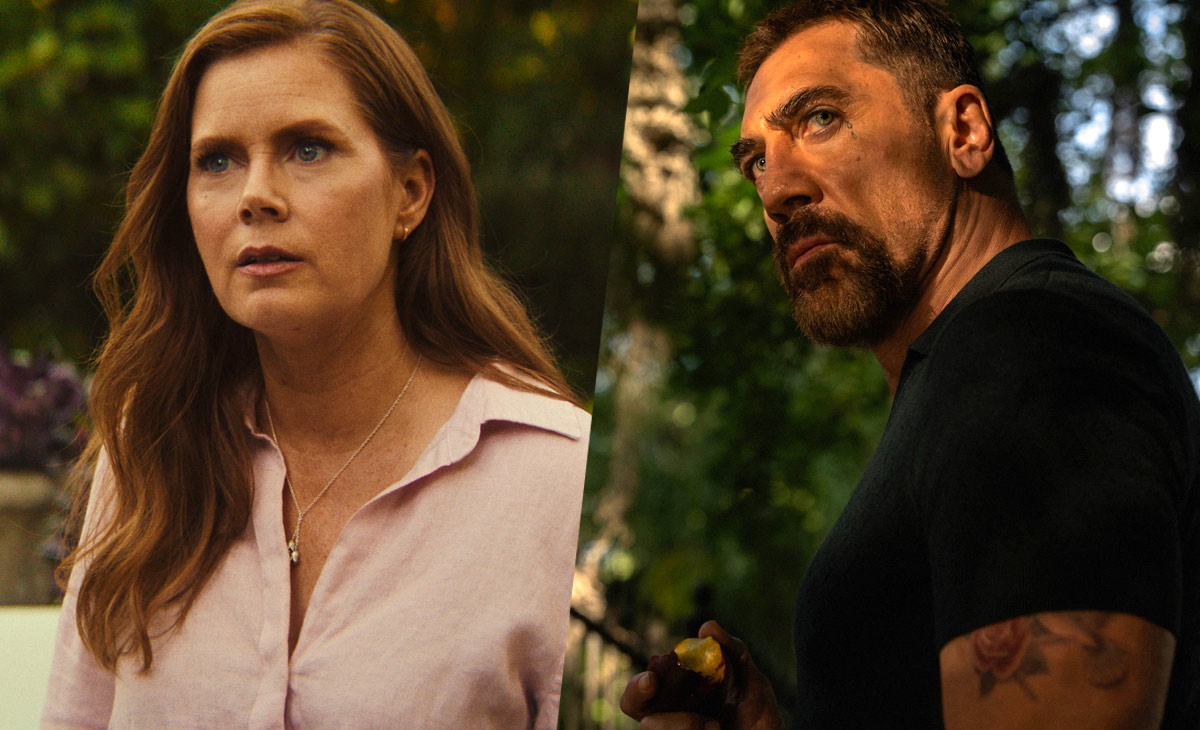
There was no reason to make another polite, faithful version of “Cape Fear.” Thankfully, Creator/Showrunner Nick Antosca had no interest in one.
Apple TV’s “Cape Fear” is sweaty, violent, emotionally ugly, and pitched somewhere between a domestic thriller and a full-blown hyper-violent fever dream. The show takes the basic machinery of the 1962 film and Martin Scorsese’s operatic 1991 remake, pulls it apart, and rebuilds it as a ten-hour nightmare about privilege, resentment, marriage, and the strange gravitational pull of a charismatic monster.
Or, as Antosca rather happily described it during his recent appearance on The Playlist’s Bingeworthy podcast, “It is the lurid nightmare that we set out to make.”
Mission accomplished!
The limited series stars Javier Bardem as Max Cady, a convicted killer who is released after years in prison and returns to torment married attorneys Anna and Tom Bowden, played by Amy Adams and Patrick Wilson. Unlike previous versions of the story, both Bowdens were involved in Cady’s original case, and the comfortable life they have built may rest on a far shakier moral foundation than either wants to admit.
The cast also includes Lily Collias, Joe Anders, Jamie Hector, Malia Pyles, Anna Baryshnikov and a few familiar faces best discussed much later. Created and showrun by Antosca, the series is executive produced by Martin Scorsese and Steven Spielberg and is now streaming in its entirety on Apple TV.
Antosca has spent much of his career bouncing between true-crime dramas like “Candy,” “The Act” and “A Friend of the Family,” and stranger, more expressionistic horror stories like “Channel Zero” and “Brand New Cherry Flavor.” “Cape Fear” feels like those two sides of his work finally met in a dark alley. That was not necessarily some calculated career move, however.
“I’m not really that strategic about what I do,” Antosca said. “I just do stuff I’m excited to do, and I’m interested in. And that feels like, you know, that’s where the heat is creatively. So I just moved toward it.”
The project had actually been circling Antosca for years. He began discussing a potential television adaptation while finishing “Channel Zero” and working on “The Act,” after producing partner Alex Hedlund asked whether he was a fan of the earlier movies.
“They really go back for me,” Antosca explained. “I saw them when I was young. They have a kind of special place in my nightmare-loving psyche.”
What interested him was not stretching one of the movies into ten episodes or simply placing another actor inside Max Cady’s tattoos. It was using the extra room to complicate the story and update its anxieties.
“For me, an adaptation, I don’t want to do exactly what the previous one did,” he said. “I want to take some of the things I love and the feelings that it gave me and then explore and play.”
The one element that had to survive was Max Cady himself.
“It has to be a boogeyman for its time,” Antosca said. “At the same time, you can’t do the same thing. What De Niro did is so different from what Mitchum did, and what we were going to do had to feel different from both of those while carrying the mantle.”
Bardem became central to that reinvention before Antosca had even finished the first script. The two began talking about how to preserve Cady’s iconic menace while leaving some genuine uncertainty around his guilt, his motives and what he might have become had his life gone differently.
“It was really important to both of us that this Max Cady have some more mystery and complexity in terms of, is he fully evil? Is he the villain all the way through?”
Elements of Bardem’s own background were incorporated into the character, including Cady’s Spanish and Basque heritage. Bardem also suggested replacing the Biblical fixation associated with Robert De Niro’s version with Cady’s warped interpretation of Santería, based partly on research into how religious practices can mutate inside prisons.
“The idea that Max Cady would kind of take things from this religion and make his own version of it that is tethered to his specific desires for revenge was really interesting,” Antosca said.
Bardem’s natural magnetism also allowed the series to play a dangerous little game with the audience. This version of Cady may have actually been wronged. Anna and Tom are hiding things. For a stretch of the series, it is possible to wonder whether Max is the monster in the story or merely the one willing to tear the curtains off everyone else’s behavior.
Antosca knew viewers might remain on his side longer than they should.
“We were curious to play with the audience’s sympathy for bad guys and fascination with villains and the charisma of the monster,” he said. “Are you a monster if you have a legitimate grievance? I think that’s a modern take on the story.”
The series also retains Bernard Herrmann’s thunderous score from the 1962 film, which Elmer Bernstein previously adapted for Scorsese’s remake. Composer Jeff Russo reorchestrated Herrmann’s material while building an original score around it.
According to Antosca, using the theme was never really in doubt.
“Scorsese and Spielberg were both like, ‘This is part of the DNA of “Cape Fear,” and we’ve got to use it,’” he recalled. “Ultimately, we decided to just go for it. It just felt like the spirit of ‘Cape Fear.’”
Having Spielberg and Scorsese attached was not merely a matter of placing two enormous names in the credits. Both remained involved, and Scorsese became particularly hands-on while Antosca was editing the prison fight that opens Episode Two.
The scene presented a tricky problem. It needed to establish Cady’s capacity for frightening violence without crossing the invisible line that makes an audience turn away entirely.
“Marty got on FaceTime with me and went over that scene,” Antosca said. “He was talking about how, when they smashed the head in ‘Casino,’ this is how they calibrated it so that you got the impact and you saw what you saw on screen, but at the same time, you were able to put it out there for audiences.”
Scorsese was not speaking in vague terms about atmosphere or intensity, either.
“He was talking about literally specific frames,” Antosca said. “That was really cool.”
The show’s biggest structural change is making both Anna and Tom responsible for Cady’s conviction. Rather than having Max return as a barely remembered client, his imprisonment becomes the event that brought the Bowdens together and helped create their successful, deeply insulated life.
“I wanted his suffering to be the foundation of their life,” Antosca explained. “All the trappings of privilege and success and comfort, none of it comes together unless he went to prison.”
That change also lets “Cape Fear” become a marital drama without ever taking its foot off the thriller pedal. Anna and Tom love one another, but they are competitive, evasive and carrying enough submerged resentment to fill a second swimming pool. Max does not create those fractures. He arrives with a crowbar and starts prying. Antosca wanted the audience’s relationship with the Bowdens to remain uneasy as well.
“There is an instinct on the part of the audience to want to see comfortable people suffer or be punished or brought down,” he said. “I want you to be asking at certain points, ‘Do they deserve what’s happening to them? How much do they deserve?’”
That tension gives the series its teeth. Cady may have a real grievance. The Bowdens may have built their lives on a terrible act. None of that makes what follows justifiable, but the show is willing to let everyone sit in that discomfort rather than racing in with a tidy moral verdict.
MAJOR SPOILERS FOR “CAPE FEAR” BELOW.
One of the show’s best surprises arrives late in the season with the appearance of Juliette Lewis, who played Danielle Bowden in Scorsese’s 1991 film. Rather than handing Lewis a ceremonial cameo and sending her home, Antosca casts her as Cady’s sister, a troubled figure with her own obsessive relationship to Max. Antosca always wanted Lewis involved, although the eventual role did not exist when the project first began.
“I was actually with Juliette on set on ‘The Act’ in 2019, where she guest-starred in one episode, when we started talking about ‘Cape Fear,’” he said. “I knew that it would be very special to have her.”
After spending years untangling the rights while making several other shows, Antosca and the writers eventually arrived at the question that unlocked Lewis’ character: What if Max Cady had a stalker of his own?
“It was just the right idea for it to be Juliette,” he said.
The finale also reveals the extent of Cady’s buried family history and delivers a particularly cruel final judgment on the character. Max unknowingly murders his own son, destroying the person who might have represented the only uncorrupted connection left in his life.
For Antosca, the moment forces the central question surrounding Max into the open. Was he transformed by what was done to him, or was the darkness always waiting?
“Max was wronged,” he said. “But is it true that, as he says, ‘Whatever I am, you made me’? Or was he always carrying a darkness inside of him? Was it his childhood? Or does he have a narcissism and malevolence within him?”
“Bringing him to that point felt like the natural endpoint to his story.”
The Bowdens survive, but survival offers very little comfort. They attempt to return to normal life, knowing that whatever “normal” was before Cady arrived no longer exists.
Antosca saw that as a way of responding to the memorably strange ending of Scorsese’s film, in which Lewis’ Danielle explains that the family never discussed what happened again.
“You’re like, ‘Wait, what?’” Antosca laughed. “I always think as a viewer, ‘But I bet you thought about it. You were haunted by it.’”
The series makes that haunting explicit. Max remains alive, the family’s secrets remain lodged between them, and Natalie ends the season holding a mysterious unopened envelope with the details of her parentage.
Antosca knows what is inside it. Some of the cast apparently know too. He was not remotely interested in telling us.
As for whether the decision to keep Max alive leaves room for more “Cape Fear,” Antosca insisted that the ending was driven more by the Bowdens’ final moral choice than sequel engineering. In fact, he believes they may have made the wrong call by not killing Max in the pool.
“In my opinion, they should have killed him,” he said, only half joking. “But they don’t want to kill somebody in front of their kids.”
Antosca continued to call “Cape Fear” a limited series, although he followed that description with a conspicuously slippery “no comment” when asked whether the story could ever continue.
So, naturally, make of that what you will.
During the conversation, Antosca also discussed whether he might return to the “Chucky” franchise following the television show’s cancellation. He is not currently involved in another installment, but he remains close with creator Don Mancini and would gladly return if the opportunity presents itself.
“I know that there is an appetite out in the world for ‘Chucky,’” Antosca said. “And I know that Don has great ideas for a couple of different things. I’m not working on it right now, but I would love to be.”
“Cape Fear” is now streaming in its entirety on Apple TV. Listen to the full conversation with Nick Antosca on Bingeworthy, part of The Playlist Podcast Network, below.
Bingeworthy is part of The Playlist Podcast Network, which includes Deep Focus, The Discourse, and more. We can be heard on Apple Podcasts, Spotify, SoundCloud, and most places where podcasts are found. You can stream the podcast via the embed within the article. Be sure to subscribe and drop us a comment or a rating, as we greatly appreciate it. Thank you for listening. Be sure to subscribe and drop a rating.
Mike DeAngelo is a film writer, podcaster, and entertainment journalist whose work has appeared in Variety, The Hollywood Reporter, IndieWire, and beyond. He is the host of The Playlist's podcasts The Discourse and Bingeworthy.

