




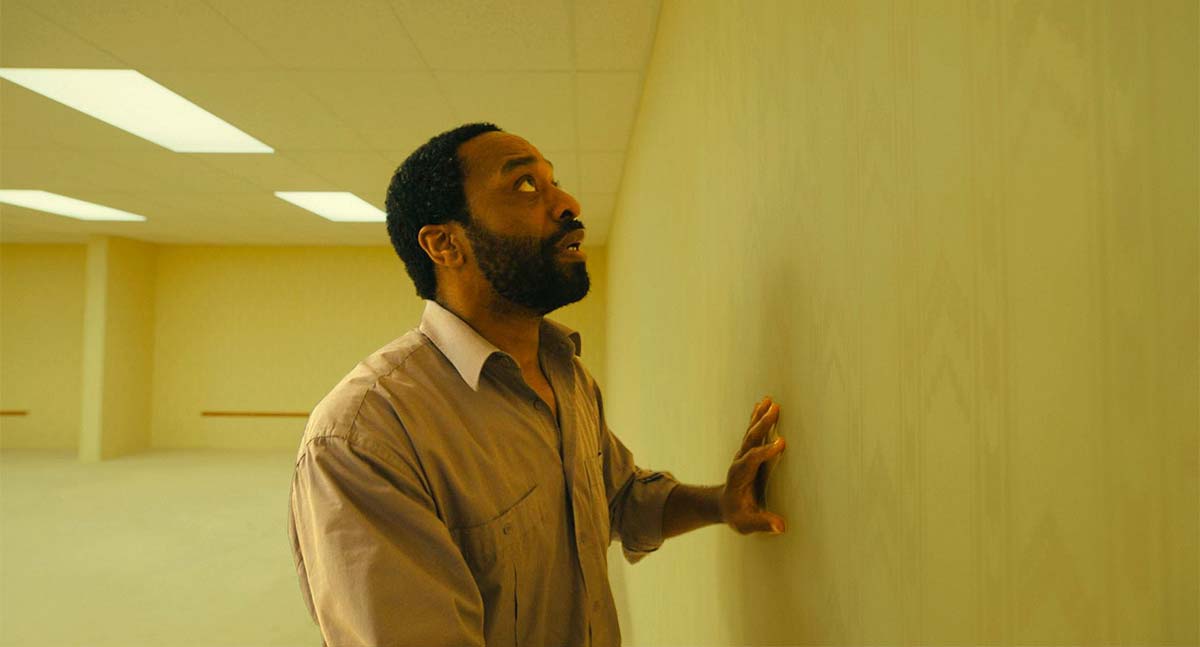
There’s something deeply odd about the fact that “Backrooms” is scary. On paper, they really shouldn’t be. It’s ugly wallpaper, bad lighting, office carpet, and the kind of room where some regional manager probably once gave a PowerPoint about missed productivity goals. Nothing about it screams “horror,” which is exactly why it works. Your brain recognizes the place before it understands the threat, and by then, the fluorescent lights and strange noises have already moved in.
The weirdest part, at least from this corner of the Midwest, is that the real place does not quite feel that way. The original 4chan image that helped launch the Backrooms phenomenon was taken in Oshkosh, Wisconsin, where this writer grew up and has seen the space firsthand. In person, it does not carry the same eerie, half-remembered yellow charge. It is a place. A real one. Strange in the way plenty of older spaces are strange, but not some automatic dread machine. The photograph and caption did something else. It trapped a feeling that the room itself does not necessarily give away for free.
That gap between ordinary space and psychological alarm is where Kane Parsons’ feature adaptation of “Backrooms” finds a lot of its power. The image was never only about a room. It was about memory turning sour. A familiar place becomes hostile because the brain suddenly cannot file it correctly. Parsons does not need to dress the concept up too much because the original idea already has a weird sickness to it. A space can feel haunted without ghosts. It can feel cursed without a deeply laid mythology. It can become threatening by simply refusing to end.
Yet, for a film that could have coasted on liminal dread and still sent plenty of people home uneasy, “Backrooms” has more on its mind than creepy architecture and analog-horror atmosphere. The film starts to feel like a horror movie about the patterns people get stuck in. Not in a tidy “here is the theme” way, but in the way a bad thought can become a routine if you keep walking it long enough. Trauma, stasis, the awful comfort of old damage, the hope that a person can change before the walls convince them otherwise. That’s the stuff humming underneath the film. The set may be massive, but the nastiest room is still the one inside someone’s head.
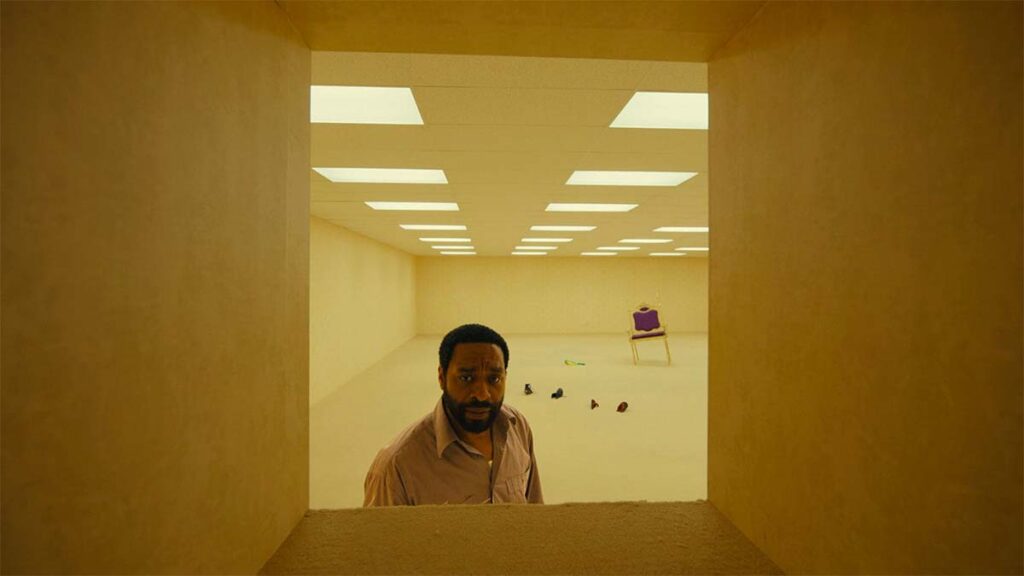
Starring Chiwetel Ejiofor, Renate Reinsve, and more, the film follows characters pulled into a liminal nightmare that operates by its own cold internal logic. During a new interview with The Playlist, Ejiofor spoke about stepping into Parsons’ world, the psychological grind of performing inside the enormous practical Backrooms set, working with a filmmaker who was 19 when they first met, and why he did not want to know too much before playing Clark.
The film’s larger practical achievement is its reported 30,000-square-foot Backrooms set, which brings the viral image’s strange familiarity into the physical world and twists it into unnatural shapes. For Ejiofor, that mattered. He had watched Parsons’ videos and assumed some physical version of the space already existed somewhere in the process. Then he walked onto the set and realized this was the first time the Backrooms had been created on that scale.
“Well, I didn’t know that it had never been a physical space before, apart from the original photograph,” Ejiofor explained. “When I had watched Kane’s work, Kane’s videos, I had assumed that somewhere in there, for sure, there was one physical space that had been created.”
That discovery changed his experience, especially after seeing Parsons react to the full realization of his own nightmare architecture.
“I didn’t know that until we walked on that first day when everything was there and on set, that that was the first time,” he continued. “Also, because Kane’s reaction to it all, he was buzzing. I didn’t realize until that moment that this was the first time that it had been created in this way, which I think was great for me, as well as everybody else, just because in terms of performance, being able to be in a physical space, to be lost in that, and to allow the space to do what it does, which is eerie.”
Ejiofor said the environment had a real psychological effect, partly because the horror of “Backrooms” is so aggressively ordinary. It is not a gothic house begging to be exorcised.
“It is a kind of psychological torment,” Ejiofor said. “You can definitely feel that disconnect with reality and that creeping dread when you’re in there, and that sense that if you were in here endlessly, just what that would mean to your mind. It’s not a place that is very forgiving for your psychology. So it’s very perceptive that people, from seeing that original photograph, just had that real sense of dread.”
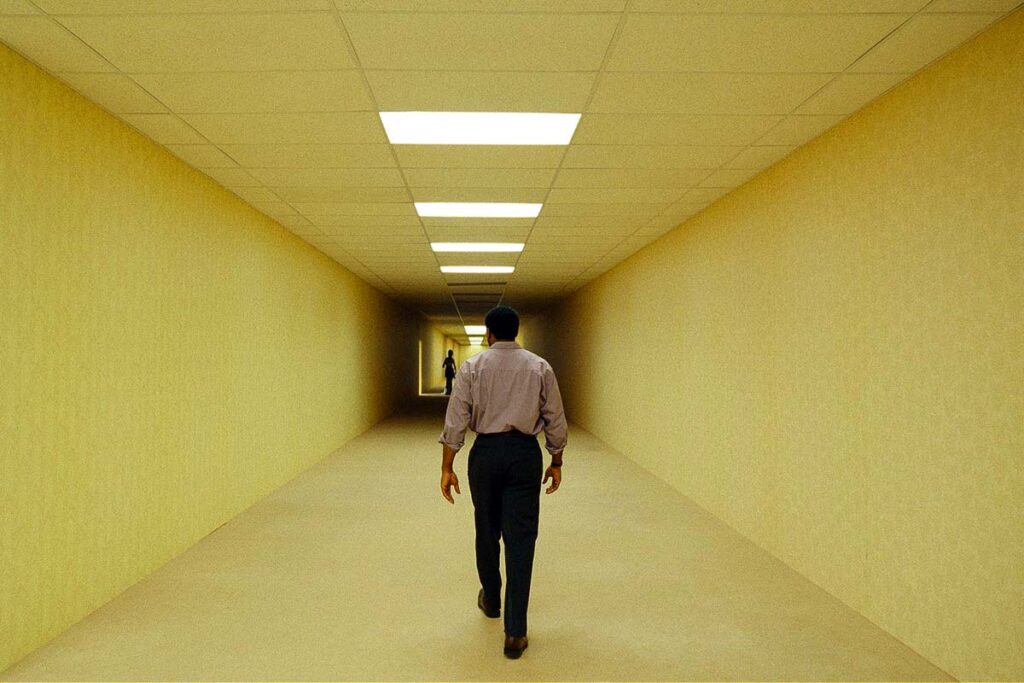
That is where the film becomes more interesting than a strong analog-horror exercise. The Backrooms are not just a location. They become a behavioral pattern with walls. Clark is not only trying to understand where he is. He is moving through a space that seems built out of repetition itself, where every turn feels like the mind returning to an old misremembered wound and calling it a shortcut.
Parsons’ age has been a major talking point around the film, but Ejiofor said that it faded almost immediately once he actually met the filmmaker. When he was first sent the material, people warned him that Parsons was only 19. Naturally, Ejiofor thought about himself at 19 and wondered how any of this was even possible. Then the Zoom began.
“I guess within maybe five minutes, maybe less than five minutes, I completely forgot about his age,” Ejiofor said. “He was so invested, his knowledge of this world was so rich. There were so many questions to ask, and he was so engaging with the answers to those questions.”
What surprised Ejiofor most was not just Parsons’ technical understanding of the Backrooms mythology, but his emotional instincts. For a film that could easily become an exercise in lore-mining, Ejiofor found a director who wanted to explore character, psychology, and how this space reflects someone’s inner spiral.
“His psychological interests in these characters were, to me, way ahead of what one would call a typical 19-year-old’s musings,” Ejiofor said. “I ended up just being engaged with wanting to discuss and sort through Clark’s journey. Clark is obviously at a completely different stage of his life than somebody like Kane is. Still, he definitely had a real intuition into what that sort of circular thinking might mean and how it plays into the psychology of the Backrooms itself.”
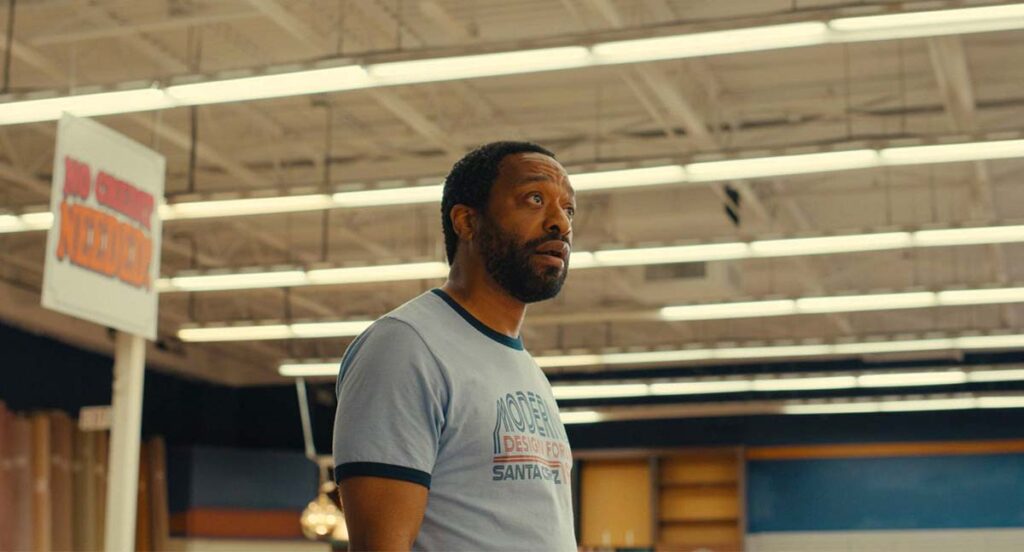
That sentiment aligns closely with the film’s deeper frequency. “Backrooms” deals with space and thought patterns. A hallway repeats until it becomes a prison. A memory repeats until it becomes identity. A person keeps trying to get out while following the same old routes through fear, guilt, and pain. The horror is not simply that Clark might never escape. It is that escape becomes harder to recognize when the trap starts to feel familiar.
Still, Ejiofor did not want every answer handed to him. Clark does not understand everything about the Backrooms, so the actor did not want to either. Instead, he wanted to know that answers existed somewhere inside Parsons’ head.
“I didn’t really want to find out everything about it, because Clark doesn’t know everything about it,” he explained. “But I was interested in knowing that the answers were there.”
It did not take long for Ejiofor to feel confident that Parsons had built a full internal logic for the world.
“Once you’ve watched all of the series, and once you are in conversation about it, even in general conversation with Kane, it doesn’t take very long to know that his knowledge of it is complete and profound,” Ejiofor said. “It is something that he has dedicated literally all of his young adult life to. It’s obviously occupied more or less every waking moment.”
That confidence allowed Ejiofor to focus less on memorizing the mythology and more on sharing Clark’s disorientation with the audience. In fact, once production began, he tried to strip away some of what he knew.
“I loved watching the series, but in a way, when we started shooting, I really wanted to try and just forget everything that I’d ever seen about it,” Ejiofor said. “To go back to when I hadn’t encountered any of it. Because that’s most of the audience’s experience at this point, a lot of people are coming into it really fresh, and that’s incredibly exciting, knowing how deep it goes and how deep you can fall.”
Ejiofor also touched on another major horror project in his future: the new “Exorcist” film from Mike Flanagan, which also stars Scarlett Johansson. While he kept details close, he suggested the film is firmly in the horror space and carries the emotional weight audiences expect from Flanagan’s work.
“I don’t know how much to start to really reveal about it, but we’re still shooting,” Ejiofor said. “The tone, I guess, does sit in, as you can imagine, the horror genre, and comfortably in the horror genre. I think with Mike’s work, there’s a real depth and there’s a real emotionality to what he brings.”
Ejiofor pointed to Flanagan’s ability to ground scares in something human, which should be welcome news to anyone who likes their possession horror with bruised hearts under the blood and Latin.
“There’s a real human and humane quality to the work,” he continued. “I think that people are going to be really engaged with it. Look, there are going to be parts of it that you’re looking at through your fingers. But I think that there is also going to be a lot of it that feels true of the world we live in. I think that’s exciting. I think that’s what Mike really brings.”
Naturally, the conversation also turned to Marvel. Ejiofor’s Mordo remains one of the more conspicuously unresolved threads in the “Doctor Strange” corner of the MCU, especially after “Doctor Strange in the Multiverse of Madness” shifted directions from Scott Derrickson to Sam Raimi. Asked whether the door remains open for Mordo’s return, Ejiofor did not close it.
“I think the door is there,” Ejiofor said. “The door is open in its own way. So we’ll see. I think that it would be very exciting to walk into that world, into that character space again. We’ll have to see.”
As for how much he knew about Derrickson’s original plans for “Multiverse of Madness,” and how Mordo’s role may have changed, Ejiofor said he was not fully aware of the specifics. Still, he sees that flexibility as part of what makes that world interesting.
“I don’t know much about that,” Ejiofor said. “Obviously, there were conversations around that period of time. I don’t know how much of this was really set, but I think that it’s adaptable. It’s this kind of movable feast, and I think that is exciting. It is open to change, and characters do have that opportunity to be reinvented. So we’ll see.”
A24’s “Backrooms” hits theaters May 29. Watch the full interview with Chiwetel Ejiofor below.

Mike DeAngelo is a film writer, podcaster, and entertainment journalist whose work has appeared in Variety, The Hollywood Reporter, IndieWire, and beyond. He is the host of The Playlist's podcasts The Discourse and Bingeworthy.

