




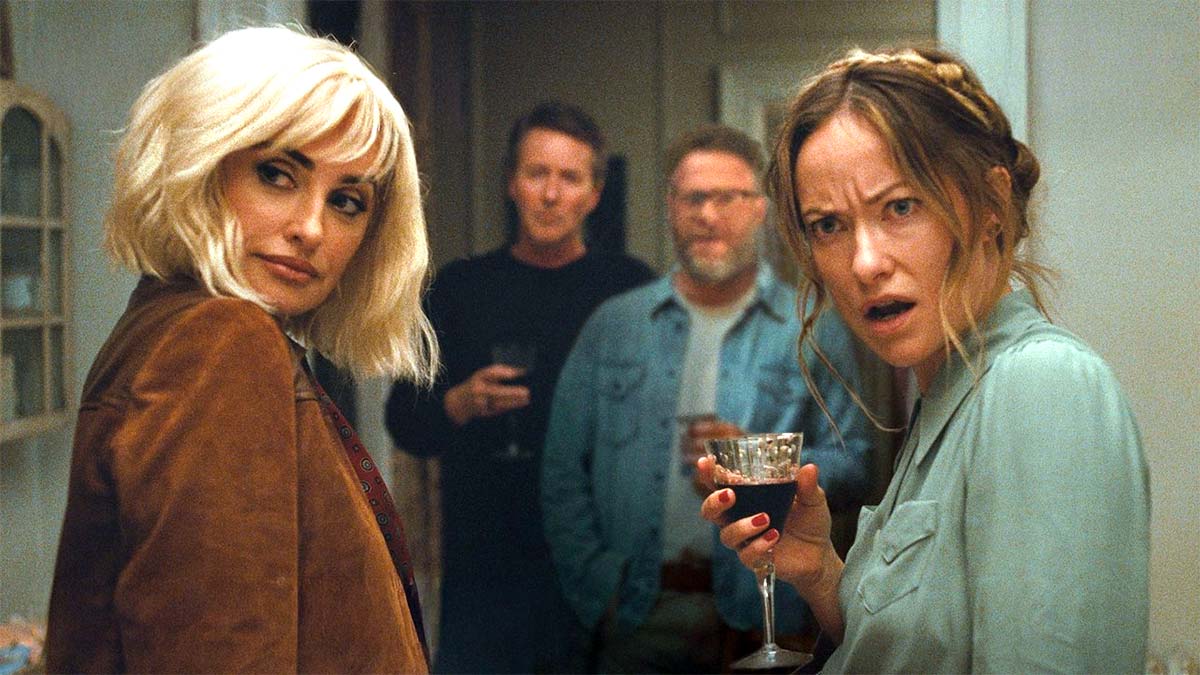
There is no graceful way to ask another married couple whether they would like to have sex with you. There are only varying degrees of disaster. That is the combustible premise behind “The Invite,” a sharp, funny, and increasingly bruising relationship comedy directed by Olivia Wilde. Wilde and Seth Rogen play Angela and Joe, a married couple who have become more like irritated roommates than romantic partners. Then their upstairs neighbors, Hawk and Piña, played by Edward Norton and Penélope Cruz, come downstairs for dinner and float a proposition that turns one awkward evening into an excavation of everybody’s marriage.
On this episode of The Discourse, host Mike DeAngelo is joined by screenwriters Rashida Jones and Will McCormack to talk about adapting the film, rewriting it with its formidable cast, and finding the hurt underneath a premise that could have easily become a much broader sex comedy.
Jones said one element that immediately resonated in the original film was the idea of a relationship ending with the same strange intensity with which it once began.
“One of the things that really resonated with us in the original is that there is this weird, bizarro-world funhouse mirror of falling in love,” she said. “It’s falling out of love and the process that it takes to give the respect and the time that it deserves to fall apart.”
Piña becomes the person nudging Angela and Joe toward a truth they have both spent years avoiding. The sexual invitation may start the evening’s trouble, but she is ultimately there to force the couple to acknowledge what happens after the polite evasions run out.
“Having Penélope Cruz’s character there is the controlled part of the demolition,” Jones explained. “You have this person who’s sort of a doula in the end, or the beginning, or whatever it is. We liked the idea of people being stuck with the reality of the next step of their life and having to push through it.”
A huge part of shaping that dynamic came during an intense eight-day workshop with the principal cast. Everyone sat around a table, shared personal stories, questioned character choices, pitched sharper insults, and helped Jones and McCormack dismantle and rebuild the screenplay before cameras rolled.
“There was a little bit of lightning-in-a-bottle otherworldliness guiding the process, because it was a lot to do in a very quick amount of time,” Jones said. “These are four very skilled actors and creators. They’re not just actors, and they know what they’re talking about.”
The task was to let all of that talent into the process without ending up with four different movies fighting within the same script. Jones said they had to make sure “the structure was sound,” and that “all those great ideas had a place to land.”
One major change that emerged from the workshop was the decision to split the characters into different pairings and let them interact away from their spouses. It gives the evening room to mutate beyond a single increasingly hostile group conversation and lets each character reveal things they would never admit in front of their partner.
“The one turn the actors really birthed was going further with the pairing off,” Jones said. “It sets it apart from the original because it doesn’t quite go that far. It’s the promise of the premise. You want to see it actually not work, or maybe you don’t want to see it work. You’ve got to get them intimate in other rooms to do that.”
Norton also pushed for a monologue that gives Hawk a fuller emotional history and keeps him from becoming merely the stock horny neighbor who wanders into the movie with a bottle of wine and a proposition.
“Edward had this great idea of having a monologue to really excavate his past and why he ended up in this position,” Jones explained. “All of a sudden, it’s not just some horny dude who’s psyched to have ten people over on Vanessa’s birthday. It’s somebody who’s really processing his pain.”
McCormack said the cast reshaped their roles during those eight days.
“Olivia brought this incredible physical comedy to her role,” McCormack said. “Seth brought this profound simplicity and horniness. Edward brought radical honesty, and Penélope brought this mystique and aura. Everyone brought themselves, and we were able to tailor it and craft it.”
That particular group came together quickly after the film had already passed through other cast configurations. McCormack admitted the speed initially rattled him, but it also gave the finished movie some of its nervous energy.
“This iteration came together very, very quickly, almost too quickly, at a moment where I was like, ‘Hold on,’” he recalled. “But I actually think that energy made it great because we were like, ‘Okay, we’re here. We’re in a room. We’re shooting in how many days?’ The train left the station, and it wasn’t stopping.”
Their years at Pixar writing “Toy Story 4” also helped prepare them for that kind of constant reinvention. Jones said animation taught them that a screenplay has to stay flexible once actors, directors, designers, and everyone else begin interacting with it.
“You have to be extremely flexible and rewrite and reiterate quite a bit,” she explained. “It’s not with actors, but it’s with story artists, a director, and animators. The process is living and breathing until it’s in the can.”
Even the old saying that a movie is made three times, during writing, directing, and editing, feels inadequate to her.
“It’s made a hundred times,” Jones said. “It’s made day to day. It’s made in blocking, lighting, rehearsals, alts, and improv. It’s made with so many ingredients that you have to keep it alive.”
Jones offered an even cleaner diagnosis of “The Invite.”
“Everything is about sex except sex,” she said. “This movie feels like that kind of journey. It’s so fraught, and there’s all this sexual tension, and then the actual sex is about pain. The foreplay is about pain here.”
Jones and McCormack also briefly looked back at “Celeste and Jesse Forever,” which turns 15 next year and shares some emotional DNA with “The Invite.” Jones joked that hearing the 15th anniversary made her “want to double over,” but both writers still view the film as a snapshot of who they were at the time. McCormack remains proud that it captured exactly what they wanted to say in that moment. “That is rare,” he said. “I hope to have that a couple more times in my career.”
Jones and McCormack are also working on a new animated “Tom and Jerry” movie, which McCormack has compared to “La La Land.” McCormack clarified that the famous enemies will remain silent.
“Tom and Jerry are definitely silent,” he confirmed. “It’s the romanticism of ‘La La Land.’ It’s a romance between a man and a woman, and Tom and Jerry are their respective pets.”
The film will feature plenty of music, but it also aims to dig into the emotional engine behind decades of frying-pan violence.
“Tom and Jerry are historically the greatest fighters of all time, and we love watching them,” McCormack said. “But this movie gets under the hood of why they fight. It’s because they want to be seen, they want to be loved, and they don’t want to be forgotten.”
So, yes, even Tom and Jerry are apparently dealing with intimacy problems now.
“The Invite” is expanding into theaters nationwide on July 10.
Listen to the full conversation with Rashida Jones and Will McCormack below:
The Discourse is part of The Playlist Podcast Network, which includes Deep Focus, Bingeworthy, and more. We can be heard on Apple Podcasts, Spotify, SoundCloud, and most places where podcasts are found. You can stream the podcast via the embed within the article. Be sure to subscribe and drop us a comment or a rating, as we greatly appreciate it. Thank you for listening. Also, remember to subscribe to The Playlist Newsletter for more conversations, reviews, and film and TV coverage.

Mike DeAngelo is a film writer, podcaster, and entertainment journalist whose work has appeared in Variety, The Hollywood Reporter, IndieWire, and beyond. He is the host of The Playlist's podcasts The Discourse and Bingeworthy.

