




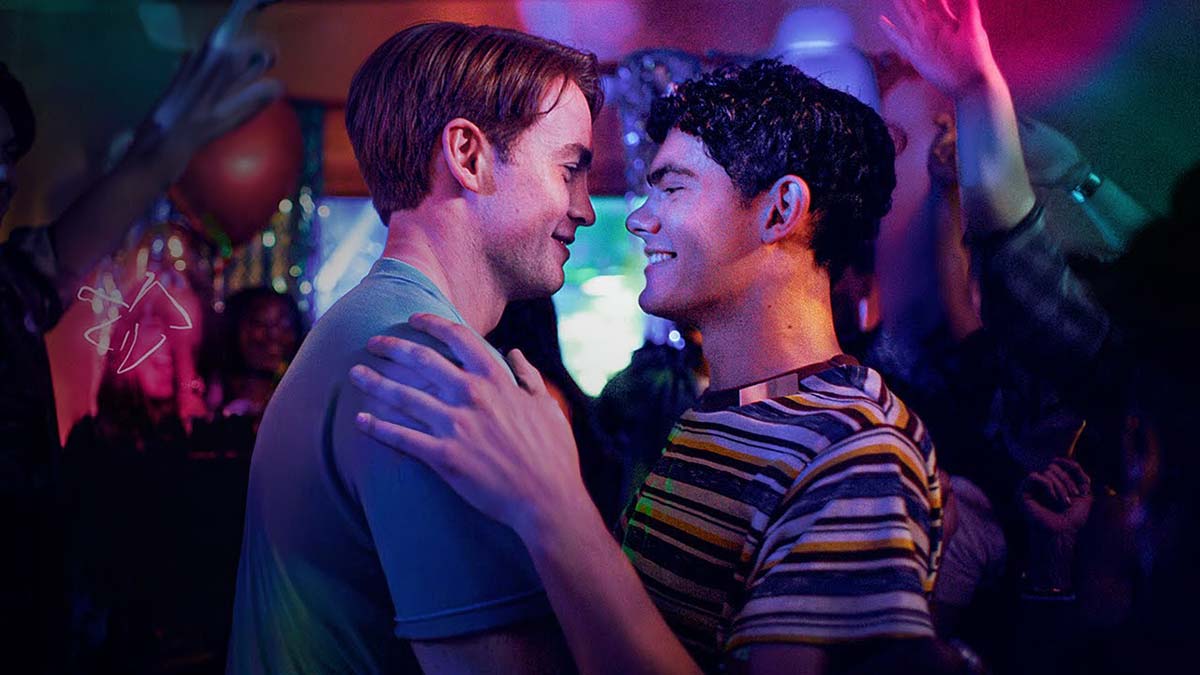
The world of the Netflix coming-of-age series “Heartstopper” has always existed on a removed, fairy-tale plane. Based on the graphic novels by creator Alice Oseman, that has always been the point: offering a haven for LGBTQIA+ viewers. In doing so, the series imagines an existence that, while still marked by bullying and homophobia, finds power through a vibrant, cotton-candy community—one that fizzes and sparks with bursts of color and storybook imagery, where friendship prevails and love is enough to ignite buried self-confidence and overcome any obstacle. It’s sweet, necessary, and a welcome balm in a world so mired in bigotry.
Despite its pastel aesthetic and perfectly curated adolescent whimsy, the series has always maintained its softly spoken but no less vital sense of urgency—a reminder of how easy it can be to be kind. “Heartstopper Forever,” the feature-length film that wraps up the wholesome love story of Nick Nelson (Kit Connor) and Charlie Spring (Joe Locke), reminds viewers what made the series so charismatic, its characters so lovable, and its message so poignant. The world is messy and scary. The series offers a compassionate lens for stories that will always need telling.
READ MORE: 53 Must-See Films To Watch Summer 2026
Directed by Wash Westmoreland, “Heartstopper Forever” picks up months after the events of Season 3. Nick and Charlie face new challenges as they set out on similar yet divergent paths toward their futures. Charlie, having battled his personal demons and an eating disorder in Season 3, is on the mend—for the most part. He wants to channel his struggles into something worthwhile and beneficial to others suffering the same hurt caused by casual and overt bullying. In typical series fashion, his loving group of friends rallies around his decision to run for Head Boy in almost wish-fulfillment fashion, and their efforts pay off. Charlie succeeds, and from there, the film speeds through several major moments in the couple’s lives.
Some characters, such as Elle (Yasmin Finney) and Tao (William Gao), suffer under this vignette-like, snapshot-style approach. While the film works as a wrap-up, its individual stories would clearly have benefited from an entire season to receive the closure the series had been working toward. Even then, Elle and Tao—seen through brief glimpses of their many, many breakups and reconciliations—are among the supporting characters best served.
Meanwhile, Isaac (Tobie Donovan), whose journey toward realizing and embracing his asexuality was one of the series’ more pleasant revelations, is relegated to being the voice of reason and a sidelined observer. Characters such as Tara (Corinna Brown), Darcy (Kizzy Edgell), and Imogen (Rhea Norwood)—all of whom played more prominent roles in the previous three seasons—are effectively afterthoughts, mainly deployed in group scenes where everyone gives themselves over to the euphoric throes of adolescence.
This is largely fine because the film really is about its central romance and the growing pains Nick and Charlie must endure as they try to find their paths in life. Nick plans to attend university and, in doing so, realizes how much of his life—and his sense of comfort—revolves around being Charlie’s boyfriend. He knows he’s a good boyfriend, having offered Charlie endless support during his most trying moments.
But Nick becomes so entangled in what he thinks Charlie needs that he loses his sense of self along the way. Or, rather, he has yet to firmly establish who that “self” is. His naivety and the way he battles old wounds while wading through humiliating moments of public self-sabotage—that first time you get too drunk in front of other people is the worst—are central to what makes the series as a whole so effective. Here are a group of individuals on the cusp of adulthood who are simply trying to figure it all out, not yet realizing that life as a whole is an exercise in figuring ourselves out.
As “Heartstopper Forever” breezes through university acceptances, holidays, milestone birthdays, breakups, reconciliations, and more, Nick’s storyline anchors it all, even when certain notes fail to ring with the same easy authenticity as others. Charlie is justifiably annoyed when Nick refuses to share his own inner monsters despite constantly asking Charlie to do the same. This becomes especially urgent as Charlie shows signs of relapse while healing from his disordered eating. But so many of us have been where Nick is, frustrated by our inability to articulate how the world hurts us and how, in turn, we internalize that hurt.
How the two navigate these deeper explorations of personal hardship gives the film its anchor and heart. While it would have been nice to see more of the greater ensemble, whose characters were key to creating the warm, wholesome energy the series thrived on, Connor and Locke continue to demonstrate why their stars are rising. Connor, in particular, handles the youthful complexities of Nick’s struggles with delicacy, never letting us forget why he would be so resolute in holding on to this relationship—his first love—with such unmoored desperation. It was through Charlie that Nick came to terms with his sexuality and found a place to belong among a group of like-minded queer people.
As always, viewers’ tolerance for this saccharine sincerity will vary, and “Heartstopper Forever” leans heavily on melodrama and twee orchestrations of tension. Despite the heavy-handed effort to signal the characters’ increased maturity—they’re more intimate now, and the film wants to make sure we know it—the movie carries over the series’ use of fuzzy imagery and line work to emphasize the characters’ emotionally heavy days, along with cartoon animations for their brighter ones. Regardless of the deeper storylines, the visual narrative maintains its sunny disposition.
“Heartstopper Forever” is imperfect and struggles to make the leap into more mature material, but it retains enough of its signature compassionate warmth to sell even the clumsier moments. With refreshing inclusivity that stands firm in the belief that everything is better with community and friendship, its sweetness threatens cavities, but the sugary rush of comfort is worth it. As Nick and Charlie struggle to determine who they are together and apart, the story tugs on nostalgia and imbues this final outing with youthful curiosity about what comes next—and, by all accounts, they’re going to be all right. [B]
“Heartstopper Forever” is out now on Netflix.

New England-based Tomatometer-approved film and television critic. Ally is a member of the Boston Society of Film Critics, the Boston Online Film Critics Association, and the Online Film Critics Society. Her writing has also appeared at RogerEbert.com and The Mary Sue.


