




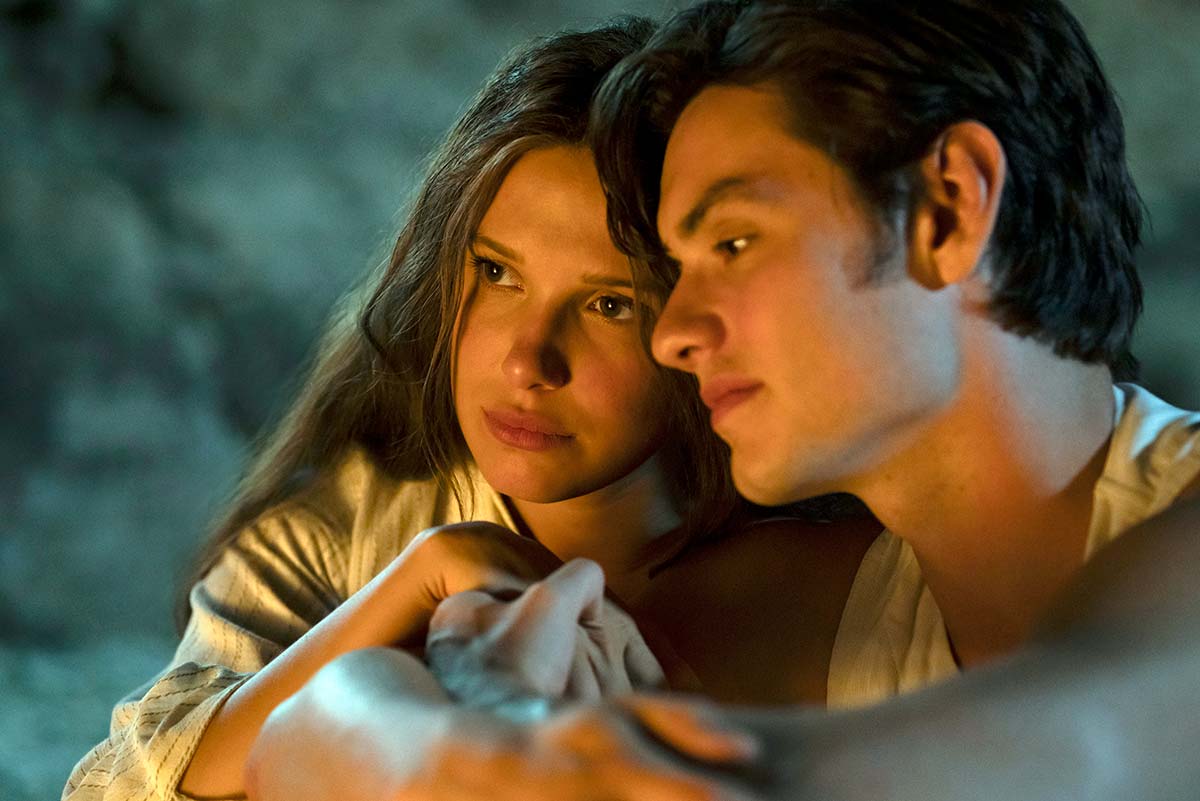
The “Enola Holmes” films have never been short on charm and wit, but “Enola Holmes 3” gives the franchise a little more room to grow up. The mystery, cheeky banter, and Enola’s knack for starting fires and solving crimes are still intact, but the new film heads to Malta, where Enola and Tewkesbury face a case tied to legacy, family names, and buried history.
On this episode of The Discourse podcast, host Mike DeAngelo speaks with director Philip Barantini and stars Millie Bobby Brown and Louis Partridge about the film, which hits Netflix July 1. Brown returns as Enola Holmes, with Partridge back as Tewkesbury. The film also features Henry Cavill, Helena Bonham Carter, Himesh Patel, Sharon Duncan-Brewster, and more.
For Barantini, “Enola Holmes 3” was a chance to work on a bigger canvas after projects like “Boiling Point” and “Adolescence.” It was also personal: for once, he could make something his daughter could watch.
“For me to sign on to this was to challenge myself differently, because the budget’s huge, the scale of this thing is huge, and I’ve never done that before,” Barantini said. “I also never made anything that my nine-year-old daughter can watch, and she loves the ‘Enola Holmes’ franchise, as did I, and we’d watched it together. When the opportunity came about, I was like, yeah, I’m going to do that because I want to make something for her, but also I want to challenge myself in a different way.”
That sense of growth also lines up with where Enola and Tewkesbury are in the third film. Brown said she was not interested in simply replaying the same “will they or won’t they” dynamic from the first two movies. The kiss already happened. Now the relationship needed to feel more lived-in.
“Maturity,” Brown said when asked what she wanted from their journey this time. “My big thing was, let’s not do the long-awaited kiss thing anymore. Let’s live in the fact that they’ve been together, that they trust each other, that they talk, that they’re in a relationship. I don’t want to keep that. Now it’s probably going to be less about the leaning in to kiss, are they not, are they going to, as opposed to actually trying to emulate as true a relationship as possible.”
For Partridge, the film gives Tewkesbury more weight to carry. He is not just Enola’s ally or love interest this time. He is wrestling with his family name, his responsibilities, and what kind of man he wants to be.
“Jack Thorne’s writing started to take it in this direction and was an opportunity to evolve the character,” Partridge said. “A bit more weight on his shoulders, a bit of responsibility. He has a wife, or wants to have one, and it’s like he’s changed. As an actor, I imagine his center is dropping a little bit, and he’s less up here and more down here. That might mean absolutely nothing to you, but for some reason, it works in my head that he might be a bit lower down in his body somehow in the later films. More grounded.”
Barantini credits Thorne with building many of the film’s bigger ideas into the script, especially the way the mystery digs into empire, buried money, family names, and history. Still, the director said the film’s structure posed challenges, especially because Sherlock spent less time in the story.
“One of the challenges with this movie was that Sherlock was not in it as much. He gets kidnapped,” Barantini explained. “We wanted that to be the story of him getting kidnapped because we wanted Enola to be independent and to be able to do this alone. But with that brought challenges because we didn’t really want to cut back to Sherlock locked away in the prison, because there’s only so much you can do. He’s tied to a wall, you know what I mean?”
Barantini said he had no interest in walking onto set and pretending he understood Enola better than Brown, especially since she is not only the star of the franchise but also one of its producers.
“When I first had my first meeting with Millie, the first thing I said was, look, you are Enola Holmes,” he said. “I’m not going to come in and tell you how to be Enola Holmes. I’m not going to tell you how she walks, how she talks, how she does this, how she does that. You know that better than anybody. My job here is to support you and to make this the best film it can be.”
The film also undergoes a major visual shift when the story moves to Malta. Brown and Partridge said shooting there was beautiful, but difficult, with heat, terrain, and logistics complicating the work. Still, Brown liked that the film used Malta as Malta, instead of having the island stand in for somewhere else.
“What was really cool about working in Malta is that we shot it for Malta,” she said. “A lot of films shoot there, trying to shoot somewhere else. I think it’s really cool that we’re able to leave the architecture and culture as is and embrace it.”
Asked whether they would return for more “Enola Holmes,” Brown made it clear that she is game, as long as the team is still there.
“I’m there if Netflix is there and Louis is there,” Brown said, before Partridge jumped in: “Would you do it without me?” Brown answered, “No, I’d never do it without the team. I think there’s an audience for it, and we’re very grateful.”
The conversation also made room for a few detours outside of “Enola Holmes 3.” With “Stranger Things” recently coming to an end, Brown was asked what actually happened to Eleven at the end of the series. Brown kept things playful, but did not exactly slam the door on the character.
“I mean, honestly, I don’t even know,” Brown said. “Objectively, she looks like she’s dead. But then there’s this ending that potentially opens the door, and maybe she’s smarter than everyone thinks, and she got out. I’m the only one who knows. The Duffer brothers and I are the only ones who know the real truth.”
And if Eleven somehow did survive, Brown would be interested in seeing her later in life.
“Oh, I would love that,” she said. “I’m not finished with Elle. I love her so much. I was very pleased with the ending, but it was a hard pill to swallow. I would love to see what she could be doing in her 30s. I’d be interested to see that. I hope everyone else would be, but that’s if she’s alive.”
Partridge also spoke about stepping into “Pride and Prejudice,” another story that comes with a lot of expectation from readers and viewers.
“I loved it,” Partridge said. “I had respect for it. In the recent months since filming, a lot of people have said, I can’t wait to see what it’s about and know my character, and that’s a little bit daunting because they know how he works and they have expectations. But I think I know who that character is as well. Maybe they know the whole story better than I do, but I think I understood where he was coming from, which is the most important thing.”
Barantini also gave a small update on the future of “Adolescence,” saying the team wants to work together again, but likely not with the same central family.
“We all want to work together again as a collective,” he said. “But we think the Miller story has probably been told. Yes, it wasn’t tied up in a bow, but life is not tied up in a bow. Down the line, there might be something where we do something else in a similar format and with the same team, but a different story, maybe.”
He also teased his upcoming Netflix series “Rabbit Rabbit,” starring Adam Driver, Will Poulter, and Regina Hall, which he described as a thriller built around a hostage standoff. For that project, Barantini and the team built a full-scale truck stop in New Jersey that apparently looked a little too real.
“We’ve had so many people come in,” he said. “We were rehearsing something the other day, and someone came in the door, and we were like, ‘Oh,’ and they were like, ‘I just wanted to buy something.’ And we were like, ‘It’s not real.’ It’s happened so many times, people pulling in because we’ve got the gas prices up on the gas sign.”
You can watch the interview with Millie Bobby Brown and Louis Partridge below, or search “The Playlist Podcast Network” on your podcast app of choice, or click the embed below to listen to our interview with director Philip Barantini.
The Discourse is part of The Playlist Podcast Network, which includes Deep Focus, Bingeworthy, and more. We can be heard on Apple Podcasts, Spotify, SoundCloud, and most places where podcasts are found. You can stream the podcast via the embed within the article. Be sure to subscribe and drop us a comment or a rating, as we greatly appreciate it. Thank you for listening. Also, remember to subscribe to The Playlist Newsletter for more conversations, reviews, and film and TV coverage.

Mike DeAngelo is a film writer, podcaster, and entertainment journalist whose work has appeared in Variety, The Hollywood Reporter, IndieWire, and beyond. He is the host of The Playlist's podcasts The Discourse and Bingeworthy.

