



TORONTO – Claire Denis’ “The Fence” sees the celebrated director return to explore the issue of colonialism in Africa, a theme she’s covered in earlier movies like “White Material” and “Chocolat.” However, “The Fence” presents a theatrical style that paralyzes the film into a tense but frustrating checkmate for much of its running time. Based on Bernard-Marie Koltès’s play “Black Battles with Dogs,” this somber drama adapted for the screen by Denis, Suzanne Lindon and Andrew Litvack stays close to its stage roots, keeping the story constrained and claustrophobic.
READ MORE: Toronto Film Fest 2025 Preview: 35 Must-See Movies To Watch
In West Africa, a large construction project swallows the landscape and some of the souls that work on it. A man named Alboury (Isaach De Bankolé) appears at the fence around the property demanding the body of his brother, one of the men killed on the construction site. The site’s manager, Horn (Matt Dillon), furiously argues with him to go away, that he will give his grieving family money and will hand over the body the next morning. Alboury rejects the deal as it is important for him to get the body back to his family as soon as possible. A cocky engineer named Cal (Tom Blyth) arrives with Horn’s new wife Leone (Mia McKenna-Bruce), whom he met while seeking medical care abroad. Now enveloped in this drama and the mystery surrounding the death of the man’s brother, Leone must decide if she is to stay with her new husband or return home.
Reuniting with her “White Material” and “Chocolat” star De Bankolé, Denis once again revisits outsiders’ impact on the continent. Now, colonialism and capitalism are intertwined in a supposedly beneficial project for the region. But beneficial to whom? Not to the men who are losing their lives from cruel taskmasters, not to their families likely miles away, not to the men watching the violence inflicted on people who share their skin color, standing aside to avoid becoming the next casualty. There are a few lines of dialogue indicating that white men like Cal and Horn are making way for a new country to step in to exploit the land and its workers, China, as one of them jokes about the conditions deteriorating once the project’s new owners take over. The project looks nowhere near over, hinting at the never-ending state of exploitation.
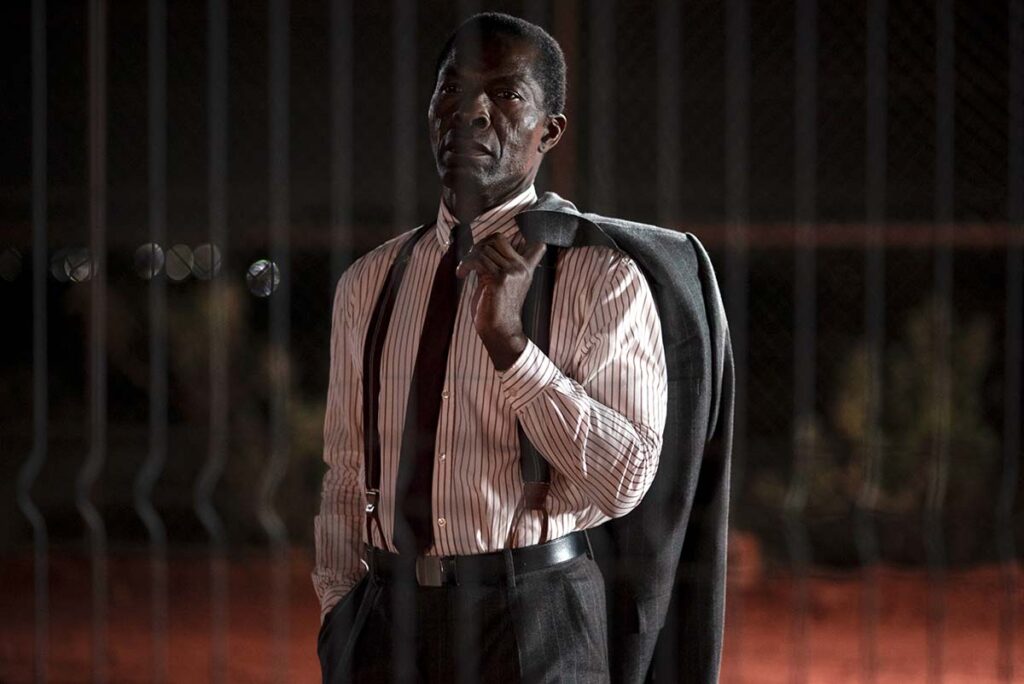
De Bankolé’s character Alboury can be seen as a representative of the grief over violence that will not go away. When Alboury talks with the guards in Yoruba, the white men in charge don’t understand and grow uncomfortable. Theirs is a fitful rule, one held by control, violence, and resentment. They intimidate the local men working on their site with guns and the knowledge that they can get away with their crimes in a way that the Black guards cannot. These unspoken tensions interest Denis most, especially as the story unravels and the true reason behind Alboury’s brother’s death is revealed. As most of the story occurs at night, Denis and cinematographer Éric Gautier plunge their characters into darkness, with only the ugly industrial fluorescence of the site’s makeshift living quarters lighting for contrast. Leone’s journey to the site with Cal takes place at sunset, casting her and Cal, tasked with picking her up from the airport, in a golden light that feels deceptively magical for what awaits her. It’s her last moment of romantic idealism before confronting what her husband does for a living.
While the narrative is rich with meaning, there is a sense of visual malaise as the movie gets stuck at the argument through the fence, leaving the events feeling cold and stilted. The characters seem to be held hostage at the site because of this disagreement between Horn and Alboury, and the story cannot move until the characters physically do. Unfortunately, De Bankolé’s commanding performance as Alboury feels narratively limited as he stands for more ideas than actions. He clashes repeatedly with Dillion’s Horn, but while the manager loses his temper many times, Alboury is calm and determined, stronger than the fence between the two men. His tone is polite but damning, and as Horn grows more and more unreasonable, we see Dillion vacillate between begging the stranger to leave and angrily demanding it.
With his jealous, lustful actions and drunken speeches, Blyth’s wild card role of Cal is the only presence that shocks the story into movement. Meanwhile, Leone won’t give up the trappings of her past feminine life, insisting on wearing heels through the dirt and dressing in short dresses like she’s on her way to the club, not a rural construction site. She doesn’t seem to have much of a say in things than what men say about her, but she is the first to see Alboury as a person, which Cal and Horn never truly do. “The Fence” is not quite about Alboury and his brother, but of the strangers who have come to their country to seek riches and instead found the worst side of themselves. [C-]
Follow along for all our coverage of the 2025 Toronto International Film Festival,