


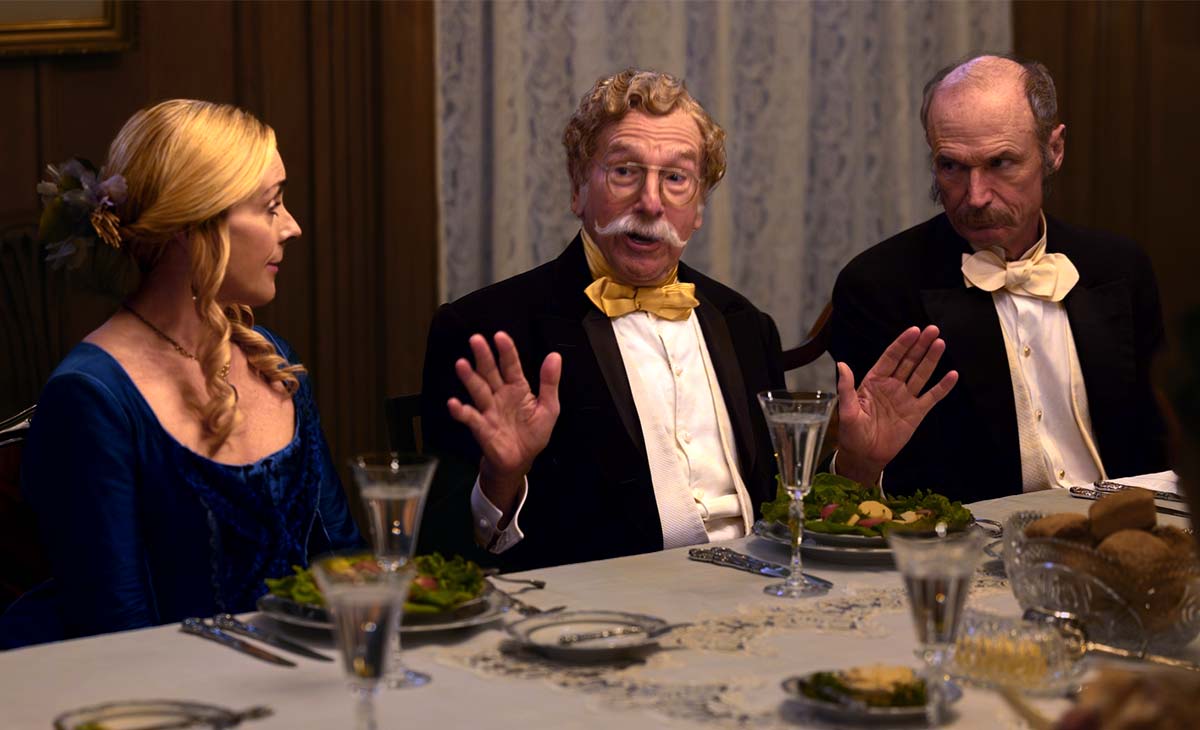
Has Larry David’s misanthropic charm worn off, or is it misapplied in “Life, Larry, and the Pursuit of Unhappiness”? Imagine the history of these United States, interpreted through sketch comedy and narrated by Samuel L. Jackson, where every scene orbits important figures from our nation’s antiquity, or ordinary participants in it, and where David plays a handful of those figures. Abstractly, that sounds hilarious. Who better to bring to life the crusty geezers a not-insignificant number of Americans still revere as bureaucratic deities than our greatest crank?
Compound that question with another: who better to set up the show’s premise than our 44th president, Barack Obama, who kicks off the pilot monologuing about, in keeping with his brand, the promise of American democracy? It’s a pretty good speech. America, he tells us, is a work in progress, and that is part of what makes the country special. But “Life, Larry, and the Pursuit of Unhappiness” is a Larry David show, so there David stands in the background, a less waxy figure stooping among a trio of literal wax figures, his face contorting with increasing perplexity through Obama’s remarks. “We’re not perfect. We can be irascible, petty, selfish, and cheap. And let’s face it, some of us will always find something to complain about.”
The moment ends with David cutting Obama off, offended and irritated by the former leader of the free world improvising his lines, especially as they grow ever more pointed and, dare we say, personal. “Hey, none of that’s in the script!” It’s a gem of a bit, at least as bits go, when they hinge on a non-comic presence taking the piss out of the star. But the sketches that follow take for granted the fundamental importance of thoughtful writing and, on a rotating basis, presume that the basic conceit of “Life, Larry, and the Pursuit of Unhappiness” alone is enough to carry each segment. Sometimes, the idea works. Other times, it makes you root against David, and not in the way he and his director-cowriter, Jeff Schaffer, intended.
Take the retelling of Rosa Parks’ famous refusal to cede her seat to a white man on a fateful bus ride home. “Life, Larry, and the Pursuit of Unhappiness” imagines a prior, similar incident on another bus ride, except that David is her co-passenger, too lazy and reluctant to move from his seat when she is asked to vacate hers. Parks, played by Jurnee Smollett, stays put on account of his obstinacy, then eventually climbs out of the row to get away from his boring, fussy, nonstop chatter. This is a great idea for a stand-up routine, and theoretically, it should make great television, too. But a comic on stage can glide past a scene’s granular details in a way that “Life, Larry, and the Pursuit of Unhappiness,” as short-form narrative comedy, cannot. Nothing about the exchange between Smollett and David is funny. The sketch assumes that the notion of Parks choosing to vacate her seat to escape this random dullard is innately amusing. It isn’t.
Frankly, the same holds for David’s role as Robert Livingston, an oft-neglected member of the Committee of Five responsible for drafting the Declaration of Independence. The series envisions him as a grouch and a codger more concerned with legislating sins like breathing too deeply outside, fanning oneself in the heat, or sharing umbrellas. He’s a prick. That’s the gag. It’s the kind of baffling minutiae David tends to get his undies in a bunch over on his other projects, especially “Curb Your Enthusiasm,” which makes up half the genetic material from which “Life, Larry, and the Pursuit of Unhappiness” is spliced. The rest appears to be “Drunk History,” a superior show where comedians and actors get sloshed and recount yesteryear’s legends, then played in sketches by other comedians and actors, who may or may not also be sloshed.
You’d think a Larry David property where improv is part of the routine, and the subject is the blunt-force stupidity of U.S. history, would run like a well-oiled machine, needing little more than for its cast to show up. But “Life, Larry, and the Pursuit of Unhappiness” eclipses history with an overemphasis on David’s own crabbiness. There is plenty for us all to be crabby about in the present. David remains one of our best documenters of contemporary inanity, pairing petty grievance with the unnerving sensation of being caught in the wake of life’s passing parade.
Observing the changing times as they march ahead of you is a uniquely prickly experience. There’s no sense of that here, though, and surprisingly little effort to meaningfully grapple with the past. Instead, there’s just naive optimism that David doing what David does best—ranting about indignities none of us could dream of—will suffice in the absence of sharp comedy. [C-]

Bostonian culture journalist Andy Crump covers movies, music, television, politics,, and way too many other subjects for way too many other outlets, perhaps even some of yours: JoySauce, The A.V. Club, Pop Heist, Time, Men's Health, and more. You can follow him on Bluesky and find his collected work at his personal blog. He’s composed of roughly 65 percent beer. Right now, he desperately needs a haircut.

