

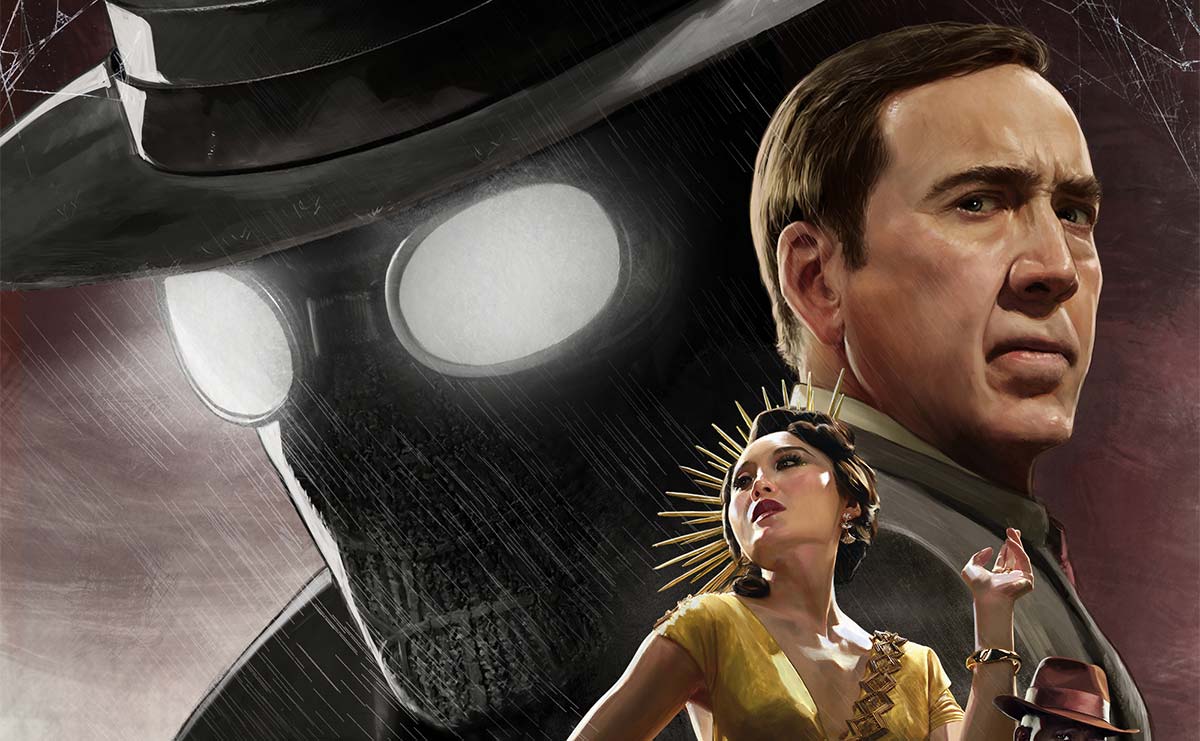
Just when you think Spider-Man has lost all novelty, “Spider-Noir” finds its spark by going backward into smoke, shadow, bruised conscience, old Hollywood fatalism, and one very committed Nicolas Cage. It’s still a comic-book story, complete with masks, villains, superpowers, and a hero trying to outrun the thing he was built to become, but its real trick is tonal. The series treats noir not as a costume rack, but as an emotional statement.
On this episode of Bingeworthy, host Mike DeAngelo is joined by writer, producer, and showrunner Oren Uziel to talk about Season 1 of “Spider-Noir,” the live-action Marvel/Sony series starring Cage as Ben Reilly, a washed-up private investigator in 1930s New York forced to confront his past as the masked vigilante known as The Spider. The series, which is now streaming on Prime Video after its MGM+ debut, also stars Lamorne Morris, Li Jun Li, Karen Rodriguez, Brendan Gleeson, Jack Huston, and more.
For Uziel, who previously worked on projects like “22 Jump Street,” “The Lost City,” and “Mortal Kombat,” the appeal began with the character’s breakout appearance in the “Spider-Verse” films and Cage’s performance within them.
“I think it starts with the Spider-Verse and the success of those movies, and then the way Spider-Noir and Nic’s performance of it popped,” Uziel said. “People really responded to it.”
Uziel already had a long history with some of the creative forces involved, including Phil Lord, Christopher Miller, and Amy Pascal, but the project also hit a very specific pleasure center for him. “They know that I love film noir,” he said. “So, live action, New York, Spider-Man, film noir, it was like, yeah. This is exactly what I should be doing.”
One of the earliest decisions was aging up the character, moving away from the younger comic-book version and into something more weathered, broken-in, noir-friendly, and built for Cage. “The character in the comics is younger, so one of the first things I said was, ‘Can we age him up?’” Uziel explained. “We’ve seen the high school getting bitten by a spider story several times at this point.”
That shift also helped explain why the series centers on Ben Reilly rather than Peter Parker. Uziel acknowledged that “there are rights issues involved,” but creatively, he found the choice liberating.
“For me, it was also extremely freeing,” he said. “He’s in a noir setting, he’s going to smoke and drink. It’s beyond rights. People have emotional reactions to the names, and I think calling him Ben Reilly is going to be a little bit less of a shock that he’s a grown man who’s been through some things.”
Of course, none of that works without Cage saying yes, and Uziel made it clear that his involvement was never assumed. “Because he’s never done TV, it was a big ask,” Uziel said, noting that Cage was number one on the call sheet for roughly 100 days. “It requires a lot of stamina and a real dedication, which, it turns out, he’s the most professional, hardworking actor I’ve ever worked with.”
Cage also arrived with a deep well of references and instincts. Uziel recalled an early lunch at The Smoke House, where the actor had already begun shaping the character before cameras rolled.
“As soon as you give him a script, he’s off book,” Uziel said, remembering Cage launching into an Edward G. Robinson-inspired scene from Episode 3 “like a four-minute monologue over garlic bread.” For Uziel, that was the point of working with Cage. “The character I wrote and the character that’s in the show are two different things,” he said. “He pushed me in directions that I wouldn’t have gone otherwise. Thank God.”
That kind of stylization could easily tilt into parody, especially with a character whose identity is partly built from Humphrey Bogart, Edward G. Robinson, German Expressionism, pulp detective fiction, and Cage’s own singular screen language. Uziel said the key was grounding every flourish in character rather than letting the show wink itself to death.
“You feel it,” he said. “You say, this might be veering too much into parody. This might be too subtle. You’re just minding it the whole time. Because it has a character-based motivation, it allows you to do a lot.”
The show’s dual-format release created another major challenge. “Spider-Noir” was designed to work in black and white and color, not simply converted after the fact. Asked how big of an “oh shit” moment that was for the production, Uziel didn’t sugarcoat it.
“There’s never been a bigger ‘oh shit,’ I think, in my career and possibly in TV,” he said. “It’s not been done before for a reason.”
The team wanted the black and white version to feel true to noir, with hard lighting and German Expressionist influence, while the color version needed its own heightened identity. That meant testing virtually everything on camera, from clothing to paint chips to whiskey.
“They would shoot every piece of clothing, every paint chip, the color of the whiskey,” Uziel said. “One would look like vodka in black and white. You had to find the right balance for everything.”
If Season 2 happens, Uziel said he would not be opposed to tackling the dual-format process again, partly because the team now knows how to do it. “It depends on what setting we end up in,” he said. “Maybe there’s a more ’50s-inspired version. Maybe there’s a more European or L.A.-inspired version. There’s a lot of different looks that we can go with.”
Cage’s physical performance also extended beyond the obvious close-ups and dialogue scenes. Asked how much of the masked Spider-Noir is actually Cage, Uziel said the actor was far more game than expected.
“You’re trying to get Nic to do as much as he wants to do, which was a lot more than I expected,” Uziel said. He added that Cage worked closely with stunt performer Solomon Brende so the masked movement would still feel specific to the character. “As much as possible, you want it to be Nic. He’s incredibly game.”
That Cage gravitational pull even extended to Morris, who plays Robbie Robertson and, in the finale, does a full-on Cage impression while dressed as Spider-Noir. Uziel knew Morris had the impression in him, but said the actor was cautious about pushing it too far.
“He would not do Nic to Nic,” Uziel said. “It’s a very delicate dance, and Lamorne’s an amazing actor.”
With Season 1 resolving many of its central conflicts while still pointing toward more story, Uziel said he prefers to focus on telling a complete season rather than holding too much back for a hypothetical renewal.
“I’m a big believer in telling the best story you can tell, and then you can sort things out after,” he said. “I loved working with all these people and the characters they created so much. I’m not close-minded about anything.”
As for who might remain central if the series continues, Uziel pointed directly to Rodriguez, Cage, and Morris. “Karen is just amazing,” he said, “and I can’t imagine anybody wanting more of the show without wanting more of Nic, Karen, and Lamorne.”
And while Uziel is keeping specific Marvel names quiet, he said there are definitely more characters he would love to bring into this world.
“The canon of Marvel characters is so vast,” he said. “There are definitely things I’m thinking about and people still on the bench that I’d love to get to.”
Beyond “Spider-Noir,” Uziel also gave quick updates on a couple of projects fans may still be tracking. Asked about his version of “Clue,” which he wrote for Ryan Reynolds with Rhett Reese and Paul Wernick before the rights picture shifted, Uziel said the project may still find its way back.
“One never knows, and things are never quite dead,” he said. “I love what I wrote. I think it’s really fun and crazy.”
And on “Fast Forever,” the apparent final chapter in the main “Fast & Furious” saga, Uziel said the goal is to go big while steering the franchise back toward its original emotional engine.
“You want to get back to your L.A. street racing roots, and cars doing car things, and the characters and their relationships,” he said. “It should and will be a big finale, but also it should bring us back to backyard barbecues.”
You can listen to the full conversation with Oren Uziel below.
“Spider-Noir” Season 1 is now streaming on Prime Video in both “Authentic Black & White” and “True-Hue Full Color.”
Bingeworthy is part of The Playlist Podcast Network, which includes Deep Focus, The Discourse, and more. We can be heard on Apple Podcasts, Spotify, Soundcloud, and most places where podcasts are found. You can stream the podcast via the embed within the article. Be sure to subscribe and drop us a comment or a rating, as we greatly appreciate it. Thank you for listening.

Mike DeAngelo is a film writer, podcaster, and entertainment journalist whose work has appeared in Variety, The Hollywood Reporter, IndieWire, and beyond. He is the host of The Playlist's podcasts The Discourse and Bingeworthy.

