


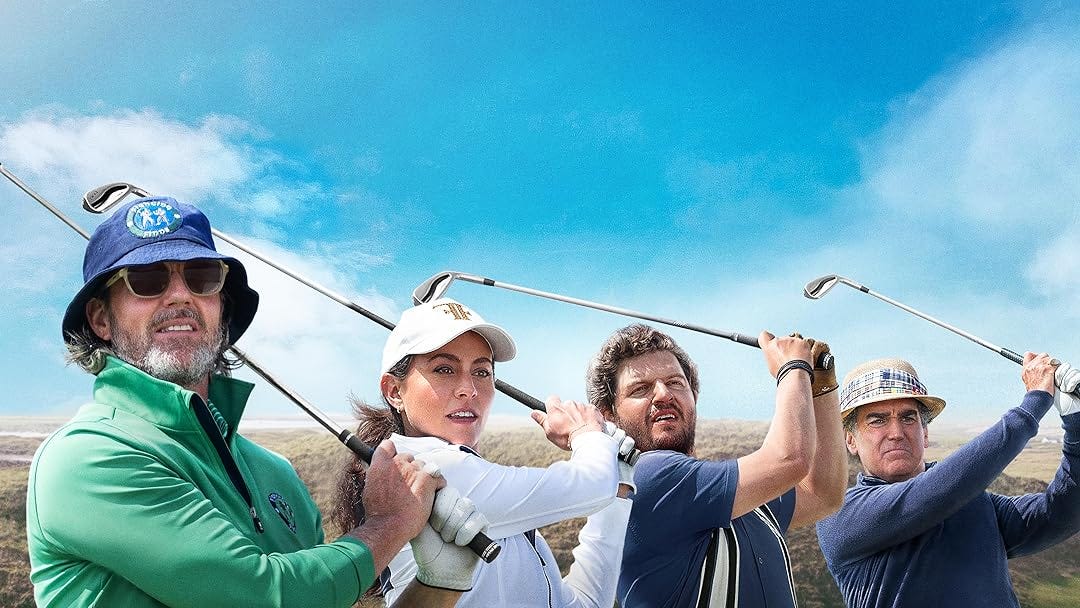
There’s a moment somewhat early into the experience that is watching “Finnegan’s Foursome,” Edward Burns’ latest dual directorial/screenwriting effort in which he again stars, wherein his character, Freddy, a golf apparel business owner with an inherited love of the game and a notoriously short temperament, takes a moment early into a familial golf outing tradition to announce to his brother, Teddy (Brian d’Arcy James) that he’s found some semblance of calm by simply taking a moment to breathe. He then proceeds to demonstrate. If only the film could do the same.
READ MORE: 53 Must-See Films To Watch Summer 2026
The setup is as simple as it is unoriginal. Following the passing of their deeply Irish former golf pro father Jack (Ian McElhinney) during the early moments of their annual family golf tournament carrying their namesake in the form of the Finnegan’s Cup, his two sons decide to honor their father’s last wishes by spreading his ashes in several of his most cherished spots back overseas, as a later revelation while visiting one such location answers why his boys lack their father’s Irish accent after being raised stateside. Though Teddy, a once successful author suffering from a five-year stint of writer’s block, carries no ill will towards Jack and even seems to carry the unofficial “Favorite Child” label, it’s Freddy who believes quite the opposite, still bitter over the endless days his father spent on the PGA Tour and his subsequent scattershot parenting as a result. Along for the ride are Freddy’s son Frankie (Brian Muller), a musician with his own days of glory seemingly behind him following the breakup with his girlfriend/bandmate, and Marie (Erica Hernandez), seemingly happy to be included in what had for years been a men-only event. Got enough backstory? Good, because not only will all of this be rehashed in rotation throughout the 141 (!) minute runtime, it’s but a runway for the film’s greatest crutch:
The insults.
This is one family who loves, potentially more than the game of golf itself, to joke, wisecrack, and overall offer a fair amount of gentle-to-personal jabs in the direction of their chosen target: more often than not, it’s Freddy vs. Teddy, and Frankie vs. Marie. No line of dialogue stands safe from such a handicap, which is a golf pun, and you’d better believe plenty of those exist as well. Burns’ accent, a mix of blue-collar New Jersey with Fuhgeddaboudit New York City, only succeeds at standing directly in the path of the intended impact of every line, rendering every line a groanworthy annoyance; it’s clear either Burns or Freddy thinks they’re funnier than anyone, which makes those moments when Teddy is allowed the final word all the more satisfying.
Make no mistake, this movie follows a pattern: a golf ball is struck, the golfer is criticized for the most recent shot, the golfer taunts in defense, another comment ensues, and golf again. That need for the screenplay to breathe had me desperate for a moment of reprieve; fortunately, there do exist several welcome detours, even if such moments ultimately represent the lightest of setting changes, with the first being their father’s former home, now occupied by their uncle, where an ash scattering point amongst several trees on the property sets up a conversation over drinks that serves to reveal what exactly transpired that led to Jack’s departure from Ireland with a new bride in tow. Could there have been some history between Jack’s brother and Jack’s wife? More discussion may follow, as one drink at their father’s estate soon leads to a local pub, where the back-and-forth continues unabated, accompanied by a persistent need for Burns to inject the script with another recurring element: wagers, be it the lowest performer on a certain hole needing to swap clubs with the winner, or another bet wherein the winner takes the cot as opposed to the hotel bed. These, almost always, happen between Freddy and Teddy. They, too, immediately lack any appeal. Don’t worry, impromptu Irish tavern singing is here to save the day! Would it surprise you to hear the beautiful voice emanating from Marie? In a story such as this, a flimsy tale taped together by relentless conversation disguised as wit, any chance to escape the slog feels like the breath of fresh air so needed, even if such a shift feels random at best.
At worst, it’s an irritating watch, with Burns’ accent here to remind us how much worse it can get as the industry veteran lets it fuel his rapport, much to his unwitting detriment. Even on the second string, Muller and Hernandez are allowed little more than to rise solely to this specific level, acting simply as clones of their parents while the script merry-go-rounds its way back to the beginning of the pattern. Any opportunity for the story to advance receives the shove to the side Edward Burns believes it deserves, only for him to fire up what he believes is comedy, and instead be that person in class who will not stop talking. Breathe. That’s all Burns needs to do. It may not be enough to save “Finnegan’s Foursome,” but at least you’ll be doing something other than what’s being shown. [D+]

Brian Farvour is a film writer and lifelong movie obsessive whose passion for cinema began with a childhood full of bad movie ideas he never stopped chasing. His work spans news and criticism across multiple outlets.

