


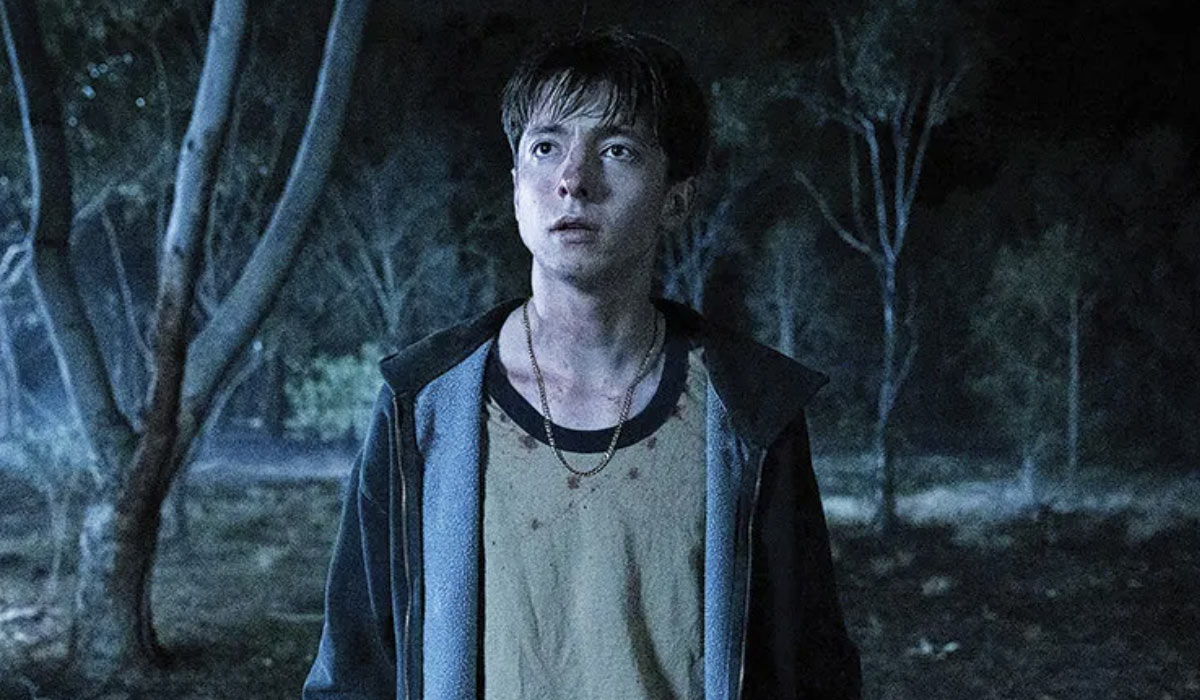
Some Sundance world premieres feel like they take ages to hit theaters. In an ideal world, you’d hope they would come out within weeks of the festival. But six months after Sundance said goodbye to Park City and four other premieres later, Adrian Chiarella’s critically acclaimed supernatural romantic thriller “Leviticus” is finally dropping in U.S. theaters. And co-lead Joe Bird is no stranger to the hype.
READ MORE: “Leviticus” Review: Spirit-Fueled Conversion Therapy Haunts A Passionate Gay Love Affair
The Aussie actor was just 14-years-old when he starred in Danny and Michael Philippou’s “Talk To Me,” a massive critical and box office hit for A24 in 2022. With “Leviticus,” he steps into the spotlight as Naim, a high school senior (or Australian equivalent) who has just moved to a small town with his religiously conservative mother Arlene (an aged-up Mia Wasikowska). He soon falls for a classmate, Ryan (Stacy Clausen), the son of the local evangelical preacher. When their relationship is discovered, what can only be described as a conversion exorcist intervenes. The boys think it’s all a performative joke, until it’s most decidedly not.
On a short shooting schedule, Chiarella had both Bird and Clausen get to know each other as quickly as possible before cameras rolled. They did an escape room, and they had fun with…snakes.
“In hindsight, Adrian wanted to put us in activities that were rooted in fear so that we could be scared around each other and vulnerable, which definitely would, because once you’re vulnerable around each other, that connection can be built so much easier,” Bird notes. “So yeah, I think that’s a testament to Adrian as well. He knew exactly what he was doing, but he didn’t tell us that until I just realized that the other day I was like, when I’ve been speaking about this, I’m like, ‘Oh, you knew what you were doing there.'”
Over the course of an interview earlier this week, a busy Bird explained why he told his Year 12 classmates he wanted the lead so badly, his surprise at a script that felt like 10 genres in one, the one scene he was most nervous about, getting that sign of approval from his younger brother, and much more.
This interview has been edited for length and clarity.
____
The Playlist: You’ve attended premieres of “Leviticus” at Sundance, SXSW, in Sydney, and now in LA. Out of all of them so far, which one were you most nervous about?
Joe Bird: I think I was probably most nervous for the South by Southwest screening because I mean, I always had a feeling that this film was going to be great. So I wasn’t really worried that it was going to lack in quality, but I guess the second time I was watching it was the first time I was actually processing the film, if that makes sense.
Definitely.
Because I feel like when you watch it at Sundance, it’s the first time everybody’s seeing it. It’s so overwhelming, and it’s also the midnight screening, so you’re so tired as well and all of that. So yeah, I think I was nervous watching the second time because I was like, wait, am I good or is this just like what’s going on?
I’m sure friends and family came and saw it in Sydney.
Yeah, I had my little brother come up, and it was really lovely because the first kind of horror sequence when the conversion ritual happens, I remember I looked over to him, and he was like, “Chills down my spine, Joe.” And I was like, “Yeah, let’s go.
So, you are a horror veteran. You were in a seminal horror movie of the decade, “Talk to Me.” When this script came your way, what made you want to audition for it or even participate?
I mean, when I first received the synopsis brief, because in Australia it’s [through] this thing called Showcast where things just get auditions from there. And it was at lunchtime. I was in Year 12 at school, and I remember getting the email, and I read the brief and the synopsis, and there’s only a couple of lines, but immediately I was like, to my friends, I was like, “Oh, I have to get this.” Because a film that I was supposed to do had just fallen through. So, it kind of felt like a bit of “Ah, oh, O.K., that’s fallen through,” but this has just come up. And yeah, I think when I went to go do the audition, I didn’t overthink it. And that was the first time I just was like, “You know what? Let me just do this audition the way that I want to do it.” And then it was great because to get a response back, I got a callback, and then that turned into an in-person callback, and that’s when I received the script for the first time. And it was like there were 10 different genres on the page that all coexisted and lived in harmony because this isn’t a traditional horror film in the sense of maybe “Talk to Me” was. And then also, so I actually filmed two projects right before I went into “Leviticus.” I did this Western where I played this villain, and it was quite interesting to see the fear in that film. How is it different in this setting, and what can be brought over? The things that you learn in other sets, how can you bring it into this to just keep pushing yourself and challenging your thinking?
When you finally got the full script, what surprised you the most? What weren’t you expecting when you finally read the script?
Well, I mean, I think what really was exciting, because I mean, this is my first leading role and I think what was really exciting was that when I was reading the script, the name never left the page. And I thought, “Wow, what an opportunity this could be to really delve into a character and do a full…” because it’s kind of like he has relationships with a lot of people in this film, and I found that really exciting, getting to have to traverse all of that and really build a character that is a living, breathing person. And yeah, I think that really, really excited me. And as any actor I think would love to do one day have the main character sort of role. And it was great as well because the cast, Stacy and Davida [McKenzie] and Jeremy [Blewitt], we’re all best friends, so it just never felt like we were really working on set.
I spoke to Adrian, and he told me that he thought you might’ve been trying to pick up his mannerisms to play this role. Is that correct?
So he brought that up to me the other day. So, I was in Sydney, and his friends from school were telling me that Naim is pretty similar to Adrian in the film. I looked back, and I feel like directors and the lead actors subconsciously…you influence each other. And I think I definitely was. I think Adrian knows this world so well, and I just was picking up little things around everyone on the crew and just thinking interesting things I could put into this character because people are so unique and individual. So, I think I probably maybe did, but subconsciously.
But it was not conscious. You weren’t trying to do it.
No, no, I wasn’t trying to do it. I don’t think Naim is very similar to Adrian at all, but I think there maybe might’ve been certain head movements or things like that.
Mia, as your mother delivers this performance where I don’t know if I’ve ever seen her play such a…I don’t want to say evil, but…
I mean the thing is though, what’s so interesting about that character and what’s so great about Mia is that I think as an actor, you don’t judge any character you do, and I can see why this character would want to do this to her son because she is fearful and it’s out of a place of love. And I remember speaking to Mia about that and looking at all the different perspectives on it because the thing is, Arlene’s not necessarily a bad person because at the start of the film, the whole reason as to why she’s in this community is because we’ve just lost our father, which isn’t overly explained, but it’s an added layer that she’s grieving and so is name and that just goes into turn as to why he has found this comfort in Ryan because he doesn’t really have anyone anymore because he might’ve been close to his dad, he might not, but the dad’s not in the picture anymore and that has affected the way that Arlene is and that just in turn affects everything else.
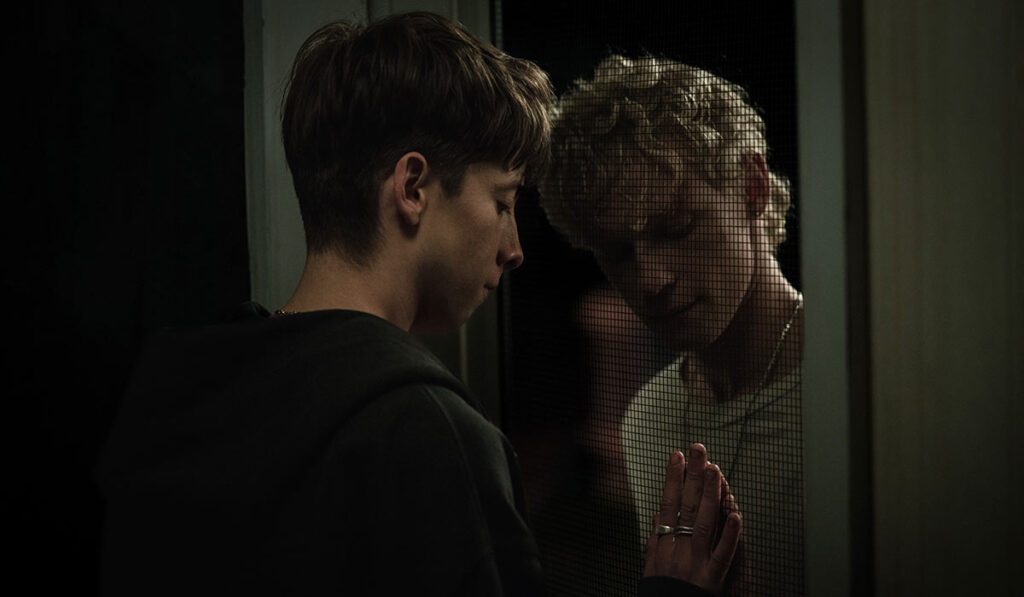
The last third of the movie is essentially all from Naim’s perspective. It is him trying to figure out what is going on, and it’s a lot for any actor to put on their shoulders. When you got to that third act, and you realized what it was going to be, what was your reaction?
Obviously, you film all out of order when you’re filming a movie you’re in. I was there every day in every scene when I was filming, so I didn’t necessarily feel like … I feel like maybe the whole time I definitely felt a little bit of a pressure of, “Oh, this film really does hinge on Naim’s shoulders in terms of as the story progresses.” But I found that exciting, and it just gives you an ambition to go, “I can do this.” But it’s also all the support that you get from everyone else and our intimacy coordinator, Amy Cater, obviously our director, Adrian, and all the other cast and Causeway Films as well are so great with how they give time for preparation and whatnot. So, it never really felt like a hassle. It was definitely challenging, but I like to be challenged.
Speaking of challenges, was there one sequence or scene that was either tough or an unexpected challenge for you?
Yeah, so there’s this scene in the midpoint of the film, which is with the counselor at the police station, so that was filmed on the second day, and that was when I first read the script, and I thought, “O.K., that’s my hardest scene.” Because I got told in pre-production it was being filmed as a one-er, and I was like, “Great, O.K., so I have to go through all these emotions and all this and blah, blah, blah.” But what was so great is that I was comfortable enough to go up to Adrian and be like, “Hey, if I could just have just a little room just to be by myself so I can just get in the zone.” And then what was great is that they would just mic me at the last minute, and it was all unspoken, but it just speaks to how professional everyone was, and everyone knew how a film set worked and how to treat people so that they can do their best.
You mentioned how you and the rest of the cast are good friends now, but how do you think you and Stacy, I mean, you’re acting, but how do you think you guys were able to form such a compelling bond on screen?
I think we just had a lot of time in pre-production hanging out, and we did escape rooms together. We held snakes…
Wait, time out. Why did you all hold snakes?
Yeah, so basically we held snakes obviously because there’s a snake at the start of the film.
Oh, right, sorry.
No, no, but I think it’s because, in hindsight, Adrian wanted to put us in activities that were rooted in fear so that we could be scared around each other and vulnerable, which definitely would, because once you’re vulnerable around each other, that connection can be built so much easier. So yeah, I think that’s a testament to Adrian as well. He knew exactly what he was doing, but he didn’t tell us that until I just realized that the other day I was like, when I’ve been speaking about this, I’m like, “Oh, you knew what you were doing there.”
I don’t want to give anything away for people who haven’t seen the film, but do you think the ending is hopeful or do you think it’s a warning that they will never escape?
What I want people to take from Naim and Ryan’s decision is that these boys are choosing to live in hope and not in fear. I think not that it’s either a happy ending or a sad ending, but this is what these boys have decided to do. And so I hope that does evoke this hopefulness, but yeah, I think that’s how I would phrase it.
Are you actually a horror movie fan?
Oh my God, I love horror movies. They’re the best because I feel like I love when I feel something from a film, and I feel like with horror films, that’s the most likely genre to definitely feel something.
And it’s a bit of a tangential connection, but in a way your film is sort of like “Obsession,” right? You can make that argument.
I definitely think you can 100%. I feel like there’s similarities across all horror films, but I think because I feel like this might be a different perspective, but what I like to think about the comparisons between “Obsession” and something like “Leviticus” is that they both started off as small productions that broke into this mainstream and it’s kind of like the world is telling the film industry that, “Yeah, we want original stories, we want to see new and exciting actors, we want to see new and exciting filmmakers.” So I hope that translates over to this film.
“Leviticus” opens in limited release on Friday
Follow Gregory Ellwood on Bluesky
Follow Gregory Ellwood on Threads
Follow Gregory Ellwood on Instagram
Follow Gregory Ellwood on TikTok
Sign Up For The Breakdown Newsletter

Editor-at-Large Gregory Ellwood is one of the entertainment industry's most respected journalists and critics. Based in Los Angeles, he's the only current awards expert who previously worked on Oscar campaigns at a major movie studio. Over the years, he has written for the LA Times, Variety, The Hollywood Reporter, and Vox, among others. He also co-founded the entertainment news site HitFix, which spawned a legion of influential Emmy and WGA Award-winning alumni.


