


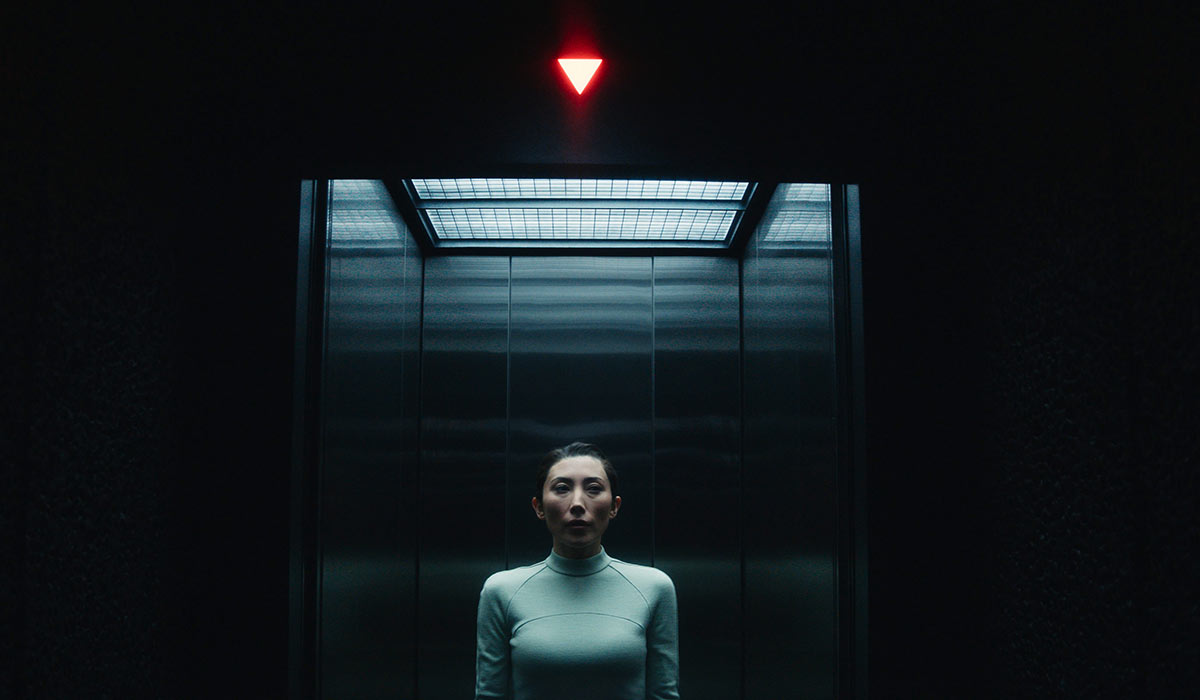
With so many categories, history happens often with the Emmy Awards, but what Jessica Lee Gagné pulled off was distinctively special. The Canadian-born cinematographer became the first woman to be nominated for Outstanding Cinematography for a Drama Series (One Hour) and Outstanding Directing for a Drama Series in the same year. Those nominations were for her contributions to Apple TV+’s breakout hit, “Severance,” and, oh yeah, she landed a nomination for Outstanding Drama Series as a producer too.
READ MORE: “Severance”: Apple TV+’s Biggest Hit Is Renewed For Season 3
Gagné directed one of the most celebrated episodes of the second season, the seventh, “Chikhai Bardo.” This was the first time the Dan Erickson creation explained what exactly happened to Gemma (Dichen Lachman), the wife of our hero, Mark (Adam Scott), who was seemingly killed, only to be turned into an “innie” in the Lumen world unbeknownst to Mark’s innie. We won’t spoil what the episode reveals, but to say Gemma appears to have been kept against her will is something of an understatement.
During our conversation earlier this month, Gagné reflected on how she never really expected to direct after transitioning to a cinematographer after film school; she explains that, unlike Lumen, there is no handbook for “Severance’s” distinct aesthetic; discusses the thought process of shooting on film for episode 7; notably, pushes back on the industry narrative that “Severance” benefited from an abnormal amount of reshoots; and much more.
____
The Playlist: First of all, congratulations on making history.
Jessica La Gagné: Thank you.
What was your reaction when you got the Emmy nominations?
I was pretty emotional. Yeah. For me, I mean for everyone, it’s special to get a nomination. For me I took a huge risk on myself and I did something I had never done before. So to get recognition for it was one of the most beautiful things that could happen. I feel like I didn’t even trust myself to do this. And then also as a cinematographer, I’ve dedicated four years of my life to this show. So yeah, it meant a lot, and we worked so hard. Yeah, I don’t know, it’s just special.
Had you not thought about directing before? Was this a career goal?
It was a goal when I went to film school a long time ago, and then I kind of picked up a lot of energy being a DP, I picked up a good momentum, and I felt safe in that. And I was happy at the beginning doing that. And at one point, I dunno, I felt like something was off, but I never opened the door in my mind to being a director. I was just afraid of doing it, to be honest, that I never let it be an option in my mind. And then they asked if I wanted to do it. So, at first, I even said no. But then I read the synopsis of season two of each episode, and episode seven was why I was like, “I need to do this.” It just felt like where I was in my life, it made a lot of sense for me to do it. And as a woman, I wanted to do it. And then I had the realization that there was never going to be a better opportunity for me to try this, even just as a DP. And people would say, “O.K., well, DPs often do this when they come back for a second or third season, they direct.” And well, I’ve never been interested in it since film school. But then I realized that, oh, I think I owe myself this opportunity.
Do you have the directing bug now?
Oh, a hundred percent. We’re screwed. [Laughs.]
So, let’s go back. What about episode seven made you say, “Yes, I want to jump in” on this story?
Well, I knew it was going to be a whole new world, and for me, one of the things I love is working with production design and being a part of that process. So, I was like, “Well, this is going to be something I’m comfortable doing and I love.” And there was also the language of the past. I kind of selfishly, as a cinematographer, didn’t want anyone else doing it, and I really felt like I wanted to be the one creating this language. And then the most important connection was more with making sure a woman was going to be telling this specific story because it was going to be Gemma’s story.
You’ve been on the show since the beginning and working with the production designer and Ben, setting up the language and the aesthetic for the show. Is there a book or a one-pager of rules that everybody has to look at every day to remind themselves, “We don’t do A, don’t do B,” to make sure it’s this aesthetic?
There’s no physical book. I know they tried to make one in season two. I don’t know if it ever was finished, but because I shot all of season one, I think I was just the voice of that between the two directors, between Ben and Aoife [McArdle]. So, it wasn’t needed. And then I came back for the next season, so I got to work with the other two. We had two new DPs, David [Lanzenberg] and Susie [LaVelle], and we just had conversations. We looked at stuff. I gave them the operator watch list that I made early on. I had mood boards that I had made, and all of these things were shared with them, so they had a lot to look at. Also, the language of the show, when you watch it, it’s very obvious in my mind. It’s very present. So that happened all kind of naturally. And we did have a third DP who worked with me for the flashbacks, just for the film, but he was on just for a week. And it was interesting not briefing him on the language of the show because the flashbacks were just another language. So yeah, there exist these two big books where it’s like the original mood boards that I made for the show. And in those mood boards, there’s a whole bunch of lighting and mood inspirations, and also the production design teams’ set drawings were in there, storyboards were in there, and we had set it up by Ben and Aoie’s offices and in the hallways so everyone could walk through that. If they had a meeting with Ben or with me, anyone, they would basically walk through this wall of image, and I’d always find people stopping and looking at it, and you could see what the show was going to look like if you saw those walls.
But in theory, you never had to tell one of the other DPS, “Don’t do a backlight”, etc?
It’s funny that you talk about backlights because I hate backlights.
That’s what I was curious about.
I don’t want to shoot down the other DPs because they really crushed it. But I have had a moment or two where I was like, “We’re not doing it because it’s a reflex.” I think for a lot of cinematographers, I think it’s appealing to the eye to have that kick-punch thing. But we had a really great and respectful back and forth about stuff. Sometimes, if they lean too far away from the aesthetic where it could happen would be more on the coloring of the lighting in the grade. I also know that we’re going to be honing things in. I do that with my own work moments on set, where Ben can comment about, “Oh, that light, it’s a little bright,” or whatever. And I know that in the grade, we can fix that in two seconds, and then when I know we can’t, I’ll fix it for him. But there’s that as well, understanding when it’s worth doing some things and when it’s not. I feel like that’s essential as a DP these days because of time and how intense production is. You just kind of have to understand the tools that you’re working with to see what’s worth it and what’s not.
By the way, I’m assuming you guys shoot on digital. I could be wrong.
We do, except for the flashbacks. Those are film.
The flashbacks were the one time I ever remember the aesthetic taking a jump. It’s interesting that you brought in another DP to be a new set of eyes in some ways for it. What was the decision behind that choice? Because many “Severance” fans read into every single little thing in the show and have all sorts of theories because of it, but what made you decide to go down that road?
It was an obvious choice. So, I’ve had to choose cameras and lenses for many projects in the past. I’ve had the opportunity to work with a lot of different directors and try many different things. I’m always about what’s the right thing for the story, not necessarily what’s the most aesthetic thing or what’s the coolest thing or whatever. And when we were talking about season one and what the show was going to look like, there was a conversation of, “Oh, should it be shot on film or digital?” In my mind, it was clear that “Severance” was shot digital. I don’t think we were trying to purposely make it look like film. Even though film is really beautiful and special as a medium, I didn’t feel like it should have that organic warmth that film has. So, that’s kind of where we ended up going with the show. We did tests to make sure that this was right. I love tests. And Ben also, and the production design on this show does a lot of testing as well. So, we all kind of make sure we’re aligned. But then this language, because for me, this [portion of the show] was life before being severed.
I mean, the show is “Severance,” and it is told originally in season one, mostly through Mark’s perspective, but it’s like the way he feels. The way he views life, that’s kind of what we’re taking in. And this is before that decision in his life. So, it opened up a whole range of possibilities of how he feels. And life before that decision was obviously a life where there was more love, happiness, even though there were all these other emotions. Film would give us natural warmth and organicness. The other thing about film is that when you see it as a viewer, subconsciously you think you’re in the past, especially if it’s juxtaposed with digital. I think that’s the thing that even makes it more powerful. We all know it as a thing of the past now, with where we are today. So, it’s a way of communicating without putting some big, strong filter or without doing any chronological elements within the frame. You’re like, “Oh, O.K., this is the past.” You automatically know that. And it’s also this beautiful medium for skin. I feel like there’s nothing like film to show skin tone, and there’s just something about them, even these love scenes between them, about seeing the warmth of the skin. It was really, it just felt perfect and effortless, and we got the opportunity to do it, and that took off so much of the work because it was just what it was.
I thought there was a chance you guys were shooting on film. I know that would be super expensive, but you certainly don’t have that Netflix or current Hollywood studio flatness that is pretending to be film, but is really not. What have you done to pull that off? Or am I overthinking it?
No, you’re not overthinking it. There’s multiple things that go into this. Sometimes you can look at a film shot on film and not know it’s film because of the way it’s lit and the way it’s color graded.
True.
We work with Tom Poole, an amazing colorist who absolutely loves film, and he can make digital look like film. He’s kind of really good at it. This is a little, I think I’ve said it a couple of times now, but not that many people know this. I wonder if the fans have figured this out or into this, but I’ll come back to your question. All the flashbacks were shot at the end of the schedule. So it’s days at the end to do all of that work. [Redacted]. Oh no, I feel like I just gave it away. There’s one scene that’s a flashback, but it wasn’t shot on film. I’ll just say that. And I’m always trying to quiz people to see which one it is. But anyways, back to answer your question…
Oh, it’s the one where she’s in the airplane.
No, that’s not supposed to be shot on film. Only the flashback scenes are shot on film. So the Mark and Gemma moments together, their life in the past, and there’s one scene that we didn’t have access to the film stuff yet, because we have to shoot it earlier in the schedule.
Oh, I see.
If you’re bored and you want to go on a hunt, you can. All that to say is amazing with film and making digital look like film as well. But I think what you’re referring to and the feel that it has is by not overlighting. First of all, let mistakes happen. Letting things be imperfect and more natural is very important. And then also, this might get a little techie for you, but we shot 2-perf spherical instead of anamorphic. So, the show is shot on anamorphic, usually, except for a couple of spherical lenses that we have, which means if we were shooting film and we were doing anamorphic, we’d be using 4-perf. So we’d be using more surface area on the film, so it would be a cleaner look. But I intentionally wanted to shoot two perf so that we would have that Super 16 kind of grit. Basically, 2-perf, it’s like if you take two super 16 frames and you put them next to each other, so you have the 2, 3, 9 lengths. And then the other reason for doing 2-perf was because we could save film. We did have to find ways to reduce the cost to get permission to shoot on film. So, that was also part of the thing. It’s like you shoot half of the film.
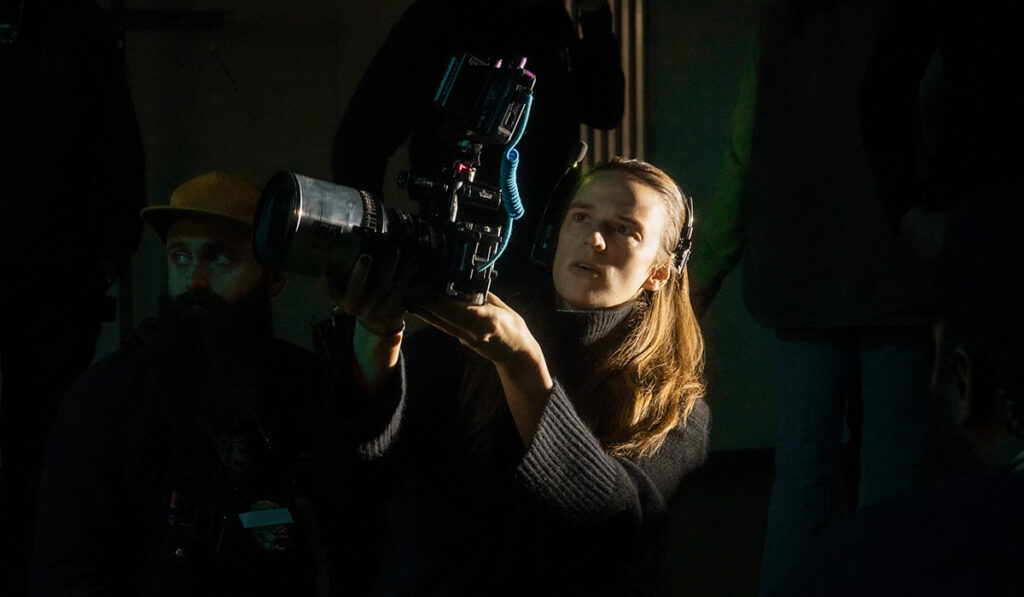
I’m pretty sure I remember that all of season two takes place in winter or fallish-winter.
Again, it’s always winter so far outside.
Except in the flashbacks, their spring and summer, and fall, I believe. Was that something that Dan came up with in terms of the script? Was it just a conversation everyone had? How did that work into it?
No, so Mark Friedman’s the writer that I really worked with on this episode, Dan obviously was chiming in, but it was mostly him and me working together. It was kind of like an isolated episode. And there was the mention of spring for the first scene when they meet, which I thought was really beautiful. That was always in the script that they met in the spring. And then what happened was because there was no time, the big time lapse where we’re going through all these moments, I don’t know if you remember all the moments of their life. It’s all these joyful moments, and the books are stacking, and she’s watering flowers, and then you’re seeing the seasons change in that wasn’t scripted. That was a scene I asked to add because I felt that. So, it was a transition I wanted to do, and then it just became this giant thing. But I wanted to show people that time was going by.
What challenges were there with the flashbacks?
We have these 13 scenes, and we’re going from intense moment to intense moment right after the other. And I felt like there needed to be some levity and some love moments between them, in this instance. So, I pushed to make that happen, and I lived in that house. So, I got a Bull X camera from my gaffer, and I got my assistant to go buy me some Ektachrome 100D, the reversal film. And I shot the seasons going by in the house. So, the snow melting and the flowers coming up were all kind of part of trying to get these things in because in a normal production schedule, you wouldn’t be able to do that. So, I did time lapses in the house. I would leave the camera over a weekend on some flowers and then take the sun moving past the flowers and all these different things. And then also, we really wanted the timing of the flashbacks. We wanted to be shooting at the end of our schedule, which was in the spring. So, I knew at this house that the cherry blossom tree blossomed in the back of the house. And that’s why when they’re in that love scene together, there are cherry blossoms behind them. So, everything was very planned, but it was something I had to push for to make sure that we got it.


