

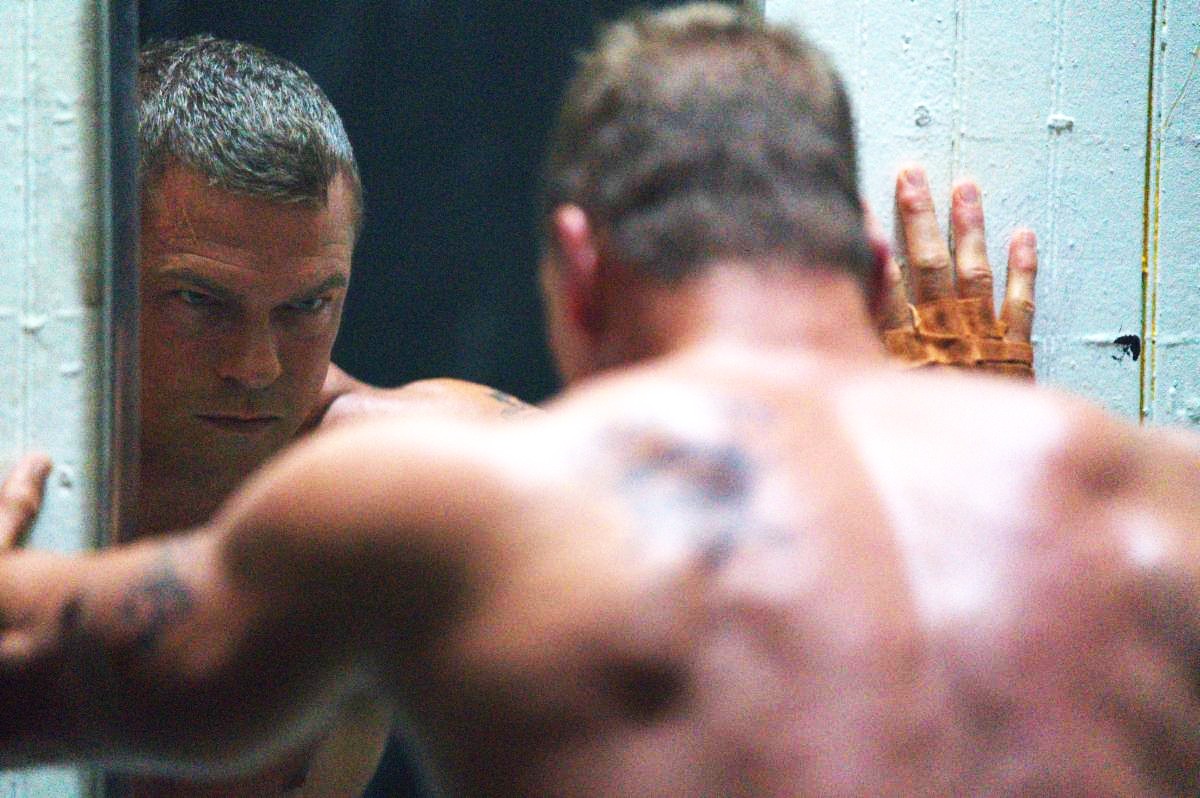
“Motor City” feels like somebody found a filthy ’70s revenge movie in the trunk of a burned-out Cadillac, wiped off the blood, and restored the whole thing in 4K and Dolby Atmos. It is loud, violent, strangely romantic and, thankfully, almost entirely uninterested in people sitting around explaining themselves. The fists, engines, needle drops and occasional shotgun blast handle most of the talking.
Directed by Potsy Ponciroli (“Greedy People,” “Old Henry“) and written by Chad St. John, the film stars Alan Ritchson (“Reacher“) as John Miller, a working-class Detroit mechanic framed by a wealthy gangster after falling in love with the man’s girlfriend, Sophia, played by Shailene Woodley. After spending years behind bars, Miller emerges with revenge on his mind and very little concern for whether he survives long enough to enjoy it.
Ben Foster, Pablo Schreiber, Lionel Boyce, Ben McKenzie and Amar Chadha-Patel also star in the nearly dialogue-free action thriller, which arrives in theaters on July 24 through IFC Films.
On this episode of The Discourse, host Mike DeAngelo is joined by Ritchson and Ponciroli to discuss creating a revenge movie without words, digging through old Detroit photography, designing an elevator fight that could have lasted 15 minutes and turning Miller into a human wrecking ball for anyone who has ever felt cheated by the system.
Ponciroli began forming the visual language of “Motor City” by studying photographs of actual Detroit streets from the 1970s with his cinematographer.
“We poured through old ’70s photo albums,” the filmmaker explained. “There was one that had a lot of images of real-life street corners and just a day in the life in Detroit.”
Several of those photographs became direct references for the film’s opening, including its bus stops, trash-strewn sidewalks and people lingering on street corners. It was less about copying individual images than absorbing the physical weight of the city.
“We just tried to recreate some similar scenes throughout,” Ponciroli said. “It was really about feeling that world and that thickness of it, the filth and the grime, and wanting to get that on screen.”
Ritchson, who was attached to the project before Ponciroli, said the director’s visual instincts quickly made him feel that the long-gestating script had finally found the right person.
“Potsy has impeccable taste,” Ritchson said. “Everything he’d done prior always had a super-interesting take on a subject that maybe had been dabbled in before. He can find an interesting way into character and story that most people miss.”
For all its carefully composed imagery, “Motor City” eventually becomes a ferocious action movie. Miller’s revenge campaign includes a brutal fight inside an elevator and another sequence built around a moving car, with Ritchson working alongside fight designer Ryan Terry to expand brief passages in the screenplay into elaborate physical set pieces.
“What was in the script was sort of a paragraph of, ‘They bite, scratch and claw in the elevator,’” Ritchson said. “We expanded that out to four pages of really specific fight moves.”
At one stage, the fight became so long that the elevator apparently needed to be traveling through a fictional skyscraper of absurd proportions.
“It was a 120-story building that we had to draw,” Ponciroli joked.
“The elevator ride would have been 15 minutes,” Ritchson added.
The pair eventually compressed the sequence, but the extended version helped them find the desperation underneath it. Miller is not fighting like someone with a sensible plan for the morning. By that point, he has accepted that his revenge may also become a suicide mission.
“There’s this life-and-death nature, this kamikaze nature, that Miller eventually adopts,” Ritchson said. “At some point, he knows, ‘I’m not even going to win. I’d rather just die trying to get justice.’ That’s a cool story to tell.”
The lack of dialogue was not a late stylistic flourish. According to Ritchson, former Warner Bros. executive Greg Silverman originally approached St. John with the idea of creating a movie without a language barrier, allowing audiences around the world to experience the same emotional story without relying on translation.
St. John answered that unusual request with “Motor City,” a screenplay that spent roughly 15 years circulating Hollywood and appeared on the Black List before finally being made.
“It had been through the hands of every leading man and every big director for years and years,” Ritchson said. “It truly is a meeting point at the intersection of art and commerce. It’s a very commercial film that feels very independent and artistic.”
That long history also created an unusual pressure for Ponciroli. Many actors and filmmakers had read the script, considered making it or developed their own imaginary version of the film.
“Everyone had this movie in their mind,” Ponciroli said. “Making a movie that everyone has already made in their brain, it’s going to be different than what they imagined. You have to make something incredible.”
Removing dialogue did not mean removing conversation. One of Ponciroli’s biggest concerns involved a restaurant scene between Woodley and McKenzie’s characters, where an emotionally complicated confrontation needed to remain completely understandable without allowing viewers to hear a word.
The solution was to stage the moment from the perspective of a piano player, leaving the argument in the background and trusting posture, movement and performance to carry it.
“You get it,” Ponciroli said. “You understand every word that they’re saying. You know the emotions.”
He also likes that the silence may leave viewers with slightly different interpretations of what they have witnessed.
“If I go see this with my wife, we’re going to leave the movie and I think we both had a slightly different experience,” he explained. “That’s conversation for the car ride home, which is half the fun. ‘That was so romantic.’ ‘That was so violent.’ I loved it.”
Although “Motor City” is planted firmly in the 1970s, Ritchson believes the anger powering its revenge fantasy has become uncomfortably timely. Many of the era’s crime and vigilante movies grew from distrust in institutions and the feeling that ordinary people had been abandoned by the systems supposedly built to protect them.
“The institution versus the individual, corruption, authoritarianism,” Ritchson said. “We’re revisiting the cyclical nature of the worst of our humanity. It feels eerily relevant to what we’re all watching happen right now.”
Miller’s enemy has money, influence and seemingly endless ways to bend the world in his favor. Miller has his labor, his anger and, eventually, nothing left to lose.
“There’s something cathartic about seeing this exaggerated or hyperbolic version of a character who is really our own frustration with the system, with the way things are and with the injustice of the world,” Ritchson said. “What if this frustration came to life and just kicked the shit out of everybody who fucked it over? That is Miller.”
Music naturally becomes even more important when dialogue disappears, and “Motor City” brought in Detroit native Jack White as an executive producer and music director. White also makes a cameo as the piano player in the restaurant sequence.
Ponciroli described White as a crucial guide to the city’s musical history and said the production made a point of avoiding songs released after 1977, with one irresistible near-exception.
“He knows the flow of the music and the progression of Detroit music and where it was at the time,” Ponciroli said. “He was super helpful in all things Detroit, really giving us a look at what was authentic and what would make this real.”
Later in the conversation, Ponciroli also addressed the unexpected second life of his Western “Old Henry,” which recently climbed Netflix’s charts after initially finding an audience through video on demand during the pandemic.
“It is weird to see it resurface now and find an audience again that maybe didn’t see it the first time around,” he said. “It’s been amazing. I wake up every morning and check my Netflix app to see if we’re still in the top ten.”
Ritchson, meanwhile, offered a bloody tease for the fourth season of “Reacher.” After the third season ended with an enormous battle against the physically imposing Paulie, who made even Reacher look small, Ritchson initially wondered how the series could possibly make its next threat feel bigger. His answer was not to make it bigger, exactly, but to make it more dangerous in an entirely different way.
“I think season four is our best season yet,” Ritchson said. “I think we hit our stride. There are a lot of things we’re doing cinematically that elevate the show, but also the story. What happens and what he’s up against is so much more dangerous in a way that you would never expect.”
Ritchson also claimed that a photograph from his final day on set contains more fake blood than viewers would probably believe without seeing it.
“‘Carrie’ would be an understatement,” he teased. “You’ve never seen this much blood in your life. It’s going to be super satisfying for audiences.”
“Motor City” opens in theaters on July 24. Listen to the full conversation with Alan Ritchson and Potsy Ponciroli on The Discourse Podcast or via our YouTube embed below.
The Discourse is part of The Playlist Podcast Network, which includes Deep Focus, Bingeworthy, and more. We can be heard on Apple Podcasts, Spotify, SoundCloud, and most places where podcasts are found. You can stream the podcast via the embed within the article. Be sure to subscribe and drop us a comment or a rating, as we greatly appreciate it. Thank you for listening. Also, remember to subscribe to The Playlist Newsletter for more conversations, reviews, and film and TV coverage.

Mike DeAngelo is a film writer, podcaster, and entertainment journalist whose work has appeared in Variety, The Hollywood Reporter, IndieWire, and beyond. He is the host of The Playlist's podcasts The Discourse and Bingeworthy.

