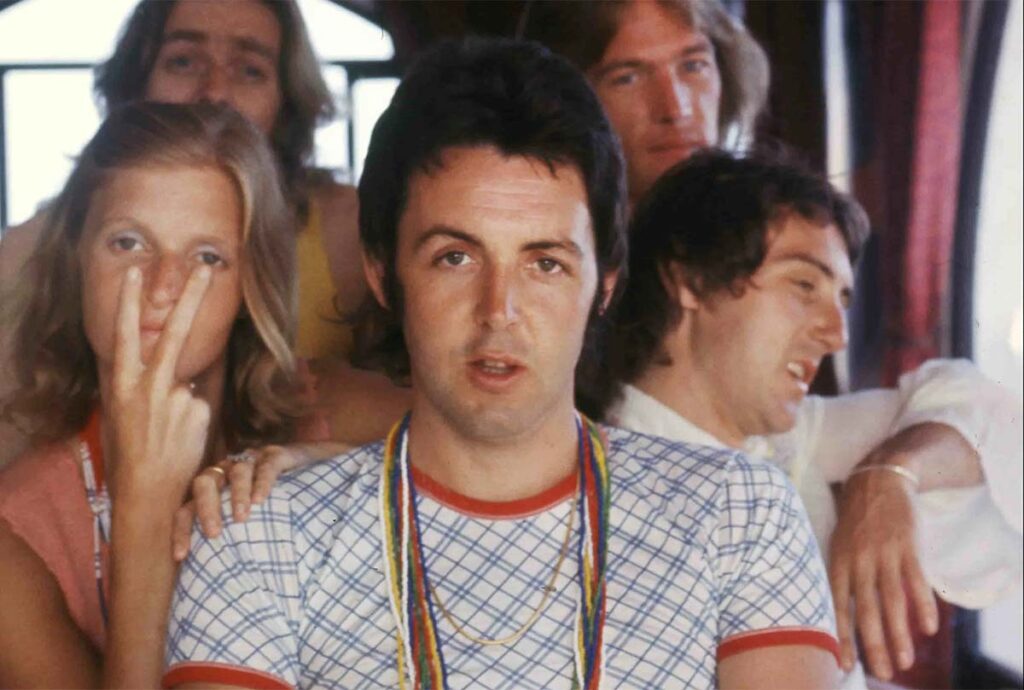
![‘Man On The Run’: Morgan Neville On Paul McCartney, Wings, And The Long Shadow Of The Beatles [Interview]](https://cdn.theplaylist.net/wp-content/uploads/2026/02/28111246/3928.0143_-_SP_-_MPL_-_Paul_Looking_into_Camera_-_1968-1969_-_T215-16_-_MST.jpg "‘Man On The Run’: Morgan Neville On Paul McCartney, Wings, And The Long Shadow Of The Beatles [Interview]")
For Morgan Neville—the Oscar-winning filmmaker who’s made a career out of humanizing icons in “20 Feet From Stardom” and “Won’t You Be My Neighbor?”—his latest, “Man on the Run,” isn’t interested in the usual, canon-polishing hagiography. It’s a film built on a much messier, more fascinatingly human premise: what the hell happens to a man (the legendary Paul McCartney) when the biggest band in the history of the world implodes, and the identity he’s leaned on since he was a teenager suddenly evaporates?
Neville digs into this transformative, post-Beatles vacuum through a uniquely vulnerable lens, drawing on an absolute treasure trove of previously unseen home movies and rare archival deep dives. This isn’t just another highlight reel of the hits we’ve heard a thousand times; it’s an intimate chronicle of a guy facing down a mountain of legal and personal baggage while trying to reinvent himself in real-time.
That specific focus leads Neville straight into the 1970s and the formation of Wings—not as some breezy footnote to the Fab Four, but as a decade-long, often bruising struggle for self-definition. In this telling, McCartney wasn’t just “coasting on” his reputation; he was building a new creative life from the ground up alongside his wife, Linda. He was weathering the kind of toxic critical backlash that would have flattened a lesser ego, largely because every melodic hook he wrote was being unfairly weighed against the impossible shadow of his former band.
Neville frames the documentary around a precise emotional corridor: the volatile stretch between the Beatles’ messy divorce and the tragic death of John Lennon, a period when Paul’s relationship to his own myth shifted once again. He connects the hostility of that era—the sniping reviews, the public blame, the endless litigation—to the long, unfair cloud that’s hung over the Wings catalog for years. But free from that baggage, and aided by recent deep-dive box sets, that work finally feels distinct, addictive, and essential in its own right.
Perhaps most importantly, the film rescues Linda McCartney’s legacy from the scrapheap of Beatles lore caricatures. Neville presents her as the restorative force that actually kept Paul upright during the fallout. By treating this era as much as a family history as a music history, “Man on the Run” finds its most resonant angle: it’s a story about the cost of surviving a massive cultural rupture in the public eye—especially when the public spent most of that decade pointing the finger at you.
I spoke to Neville just a few days before its release. “Man On The Run” is now available in theaters and on Prime Video.
Before I get to a question, I have a theory—my “Subway take”: when you’re a kid, Ringo is your favorite; in your teens and 20s, it’s Lennon; later, late ’20s and 30s, it’s George; and by your ’40s or ’50s, you come around to Paul. That’s where I’m at. What do you think?
I had that exact same take. I get all that, and I think that’s an interesting take. The reality is, I don’t think you have to choose. Certainly, Paul is the one who, when you have kids and get married and all that, speaks to that way more. John’s anger and cynicism appeal to your younger self. And as somebody says in the film, particularly unmoored from having to answer to the other Beatles, those first couple of McCartney albums—McCartney and Ram—are like pastoral odes to cooking breakfast and hanging out with your lady in the country and things like that. Paul was making music for grannies.
Ha, I dunno about that, but yes, they are very lovely.
But that music was so out of sync with its time, and it’s totally timeless. Which means now, 50 years later, you take the context away from it, and that music is pretty great.
What’s interesting is that Wings is almost like the band that time forgot. I have a whole theory about that, too, which is: if you look at the numbers—which I did, because I did all the research—charts, sales, everything, Wings were like the third or fourth biggest band in the ’70s. Huge. And yet they’re treated now as this band that was just what Paul did, and nobody really liked them. If you talk about the biggest bands of the ’70s, nobody ever says Wings.
Again, I think it’s still the thing Paul dealt with then, which is that the shadow of the Beatles is long and the gravitational pull of it is inescapable. But I also think this film is part of how Paul has been coming to terms with that over the last 10 years—which is amazing, that he’s still processing this in real time 50 years later. Even if you look at the number of Wings and ’70s songs he’s doing in his sets, it’s been going up through the years.
When I think about the Beatles’ solo work, I’ve definitely spent way more time with Paul’s work—even before this film. I love a lot of John’s solo work, but I looked it up: in the ’70s, from 1970 to 1980, Paul put out ten records. John put out seven, George put out six, and Ringo put out five, I think. So Paul put out a lot more music. And even those records that are iffy—there are great songs on every one of them. Even records that everybody shrugged at had one or two monster hits.
Beyond tonnage, there’s an aggregate body of songs he put out in the ’70s that’s pretty amazing. Some of my very favorite songs I’d put up with any Beatles song—personally, things like “Uncle Albert/Admiral Halsey,” “Let ’Em In,” or “Nineteen Hundred and Eighty-Five.” A bunch of those songs are just fantastic.
The doc made you sound like the perfect person for this. Did you chase it, or did it fall in your lap?
It fell in my lap. But it’s funny—I’ve been making music films for a long time, in part because I’m a music nerd through and through. I played in bands for years. I’ve always loved music and loved the stories around music.
My whole career, really, I was like, “Am I ever going to get to do anything that touches The Beatles?” for decades. Then this call came from Paul’s manager, Scott Rodger, saying, “Hey, Paul’s interested in doing something about the Wings period. Are you interested?” And honestly, at that point, I wasn’t looking to make a music film. I was on a hiatus from doing music films. I felt like I’d done a lot.
Within 60 seconds, I was all in. Of all projects, this is one I have been training for my entire life. Every Beatles book and documentary—I went to my first Beatles Fest when I was 12. I can go deep into it.
But I also felt like this was a time when there was still a lot you could say. There was no real brief beyond “something about Wings.” And when I thought about it, I realized the story had to begin, essentially, the day the Beatles broke up, because that’s where Paul begins his journey through the ’70s. And it had to end when John dies, because that’s when everything changes. Wings are no more. He starts working with George Martin again. Ringo plays on Tug of War. He’s done trying to distance himself from the Beatles, in a way.
He becomes self-actualized, I guess. He becomes the full Paul that we know today. But that decade is where he has to answer all these questions.
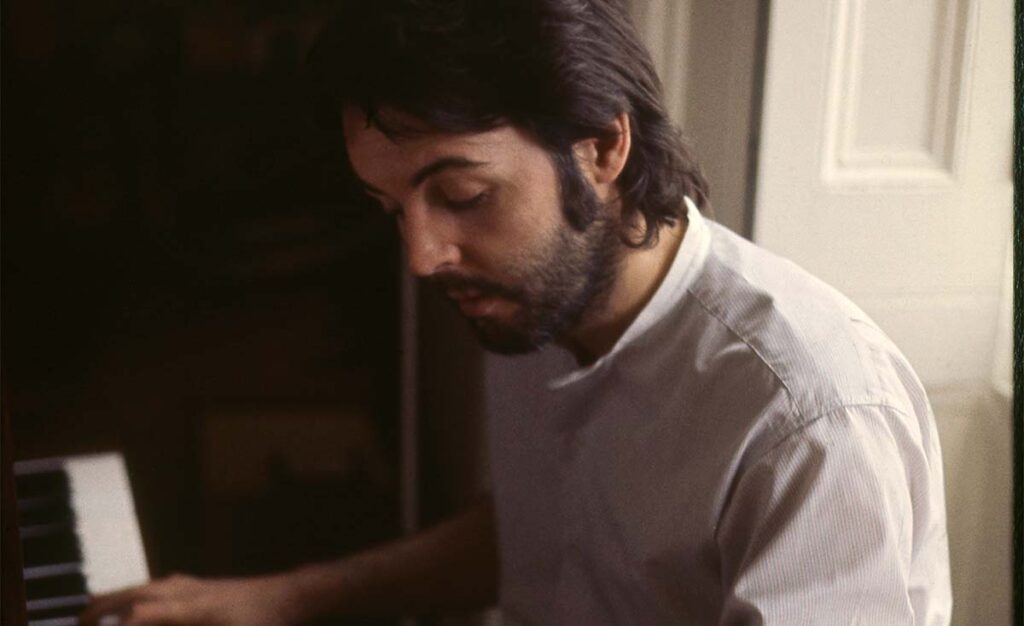
When I met Paul to discuss the film, I said, “This is what I think the film is.” And he said, “Okay, sounds good. I’ll see ya.” It was very casual. He just totally trusted me.
Then I’d get together with him and do interviews—just audio. We’d talk and talk, then I’d edit, and I’d go back two months later and do more, then edit and go back. Part of that is building trust and understanding what I need, but also trying to get beyond the usual answers.
In that way, I didn’t want the film to be just a recounting of what Paul did in the ’70s. There are a bunch of albums—half of them or more—that I don’t even mention by name in the film, because it’s not that kind of movie. Paul is a character. What does he go through emotionally and creatively through that decade?
That got to something I loved in the doc. It didn’t feel like a standard “Paul McCartney is a genius” movie. It felt more like an identity story—almost a post-divorce rediscovery story. And [Peter Jackson‘s] “Get Back” seemed like part of that too. Was that fair?
Totally. I didn’t want this film to be about what a musical genius Paul McCartney is, not because he isn’t one. Of course he is. But we all know that, right? You hear the music, you know that.
To me, it was more Paul. It’s a story about a guy named Paul who is going through a, as you said, a divorce, with his band, and has just been fired from his job essentially. And also, all he’d known since he was 16 was being a Beatle. They had this extraordinary experience that no other humans have had except the four of them—or maybe Elvis Presley. And then it disappears overnight.
I kept thinking about “Get Back,” which I think Paul had given a lot of thought to because it made him rethink that period. The original “Let It Be” film was so focused on the negative, and I think “Get Back” showed Paul that no, actually, all the emotions were there—love and humor and friction and tension. They were all together. It was them being brothers.
Another thing the doc really got at was how identity gets shaped after a breakup when you’re the one who gets villainized—“You broke up the Beatles,” “You sued the Beatles.” That seemed like part of what tainted the whole ’70s period for him, and maybe part of why it’s still underappreciated. Was that part of your thinking, too?
Yeah, absolutely. I think from Paul’s point of view, on a gut level, there was a lot of negativity around that time because of everything he went through with reviews and the legal problems. I think that’s part of why he kept it a little bit at arm’s length for a while.
And I think part of reopening the door—through “Get Back”—is maybe realizing, “This is way more nuanced than I remember it.”
The thing I really came across, and of course it makes sense, is that there was heartbreak from everybody about the breakup of the Beatles—the fans, the critics, not to mention Paul. But out of that heartbreak came anger. There’s this constant: “What are you doing? Why can’t you just get back together again? Stop messing around. Just play Beatles songs. When are the Beatles going to get together?” Everything is dogging him.
And that’s why I called the film “Man on the Run.” He’s trying to escape this gravitational pull that he can’t. It’s impossible. I actually think the film is still helping him process it in a way. He’s obviously seen it. The first time he saw it, he was very emotional. Then he arranged a screening for his entire family, including all the grandchildren—partly because what I’m doing is holding up a mirror and saying, “This is what I see.”
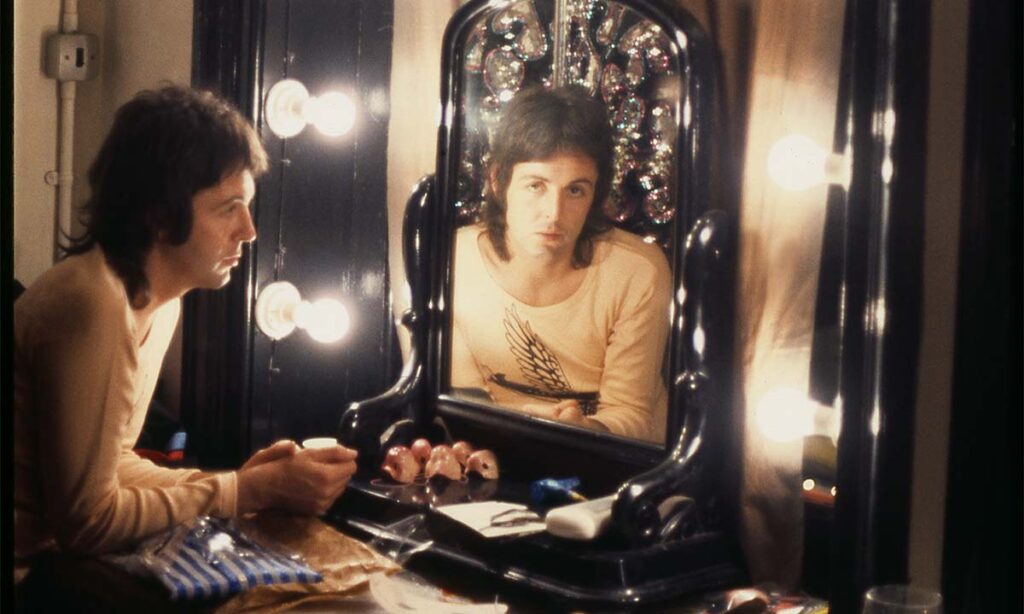
I do think it helps explain what he went through, and I think Stella McCartney, Mary McCartney, and James McCartney feel the same way about the film—like, “We had an unusual childhood, and this is what it was like.” The life he had was unusual. And this is who Linda was.
Understanding Linda’s role in this was something I really wanted in there. She’s a cardboard character in most people’s telling of Beatles lore, in part because she didn’t really care, didn’t give interviews, and didn’t play that game. But you see everything that was put on them. Linda, like Yoko Ono, got a ton of blame for “breaking up the Beatles.” There was anger at all of them. There was cultural resentment going in every direction.
Very quickly—on Linda, my tiniest little beef: no mention of Wild Prairie. I love some of the songs on Wild Prairie. I think they’re brilliant.
Yeah, sorry about that. You’ve got a two-hour doc, and there’s only so much time. And also there was Suzie and the Red Stripes [Wings under a psedonymn, that recorded the brilliant reggae track, “Seaside Woman“] and because Wide Prairie came out later. She put out a 45, a reggae 45 single.
Yeah, I’m just teasing, though, that song rocks. Thanks so much, Morgan. Glad we got to geek out over the Beatles.
I can do it all the time.
The interview below was lightly edited for clarity.