


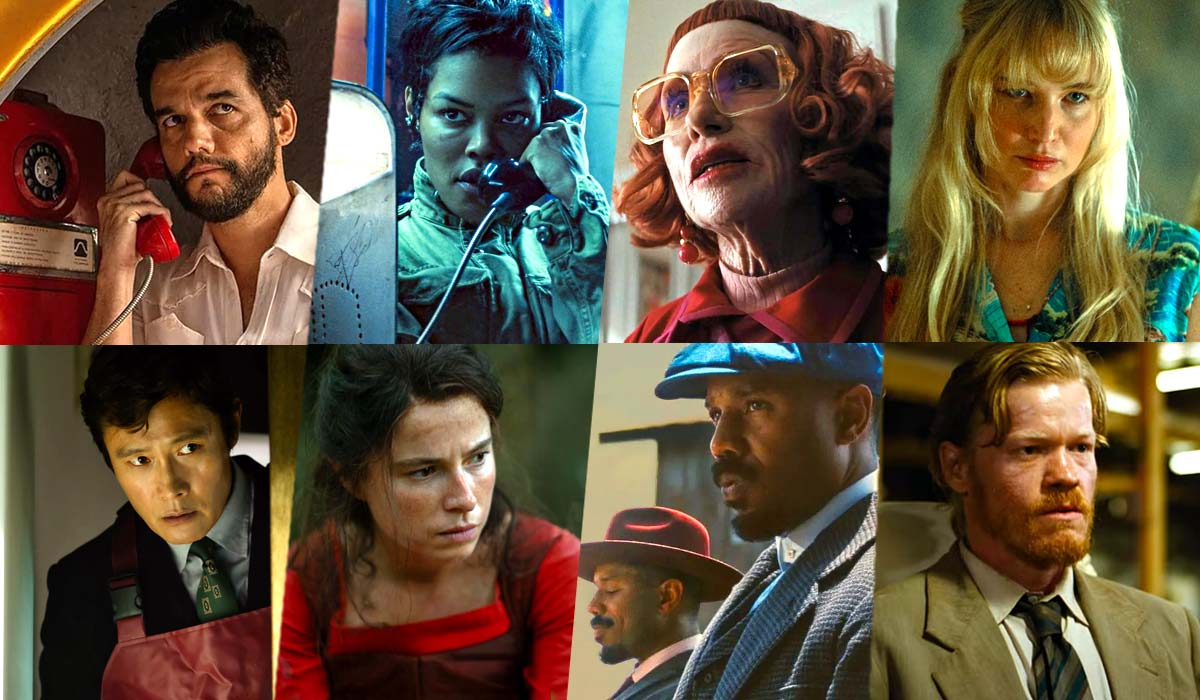
Lee Byung-Hun, “No Other Choice”
We always have a choice. Late-stage capitalism would like us to accept the alternative. When choice is denied us, we’re left with an array of predominantly bad decisions–but it’s nonetheless possible to make good choices. Man-su, the lead in Park Chan-wook’s new sociopolitical artful thriller, opts for “bad” because if a Park film does not spur his characters toward destructive behavior, then is it really a Park film? Lee Byung-Hun puts his most confident foot forward first, coaching himself in his wicked plan to murder potential competitors for a cushy job in the papermaking business; when it comes time to execute, both the plan and his competitors crumble into whimpering cowardice. Man-su isn’t the sort of antihero that’s foundational to Park’s career. He’s a good deal more pathetic than that. But Lee weaponizes his movie star power and good looks against his audience. We want Man-su to make good choices; we’re also enamored watching him make macabre ones. – AC
Joshua Burge, “Vulcanizadora”
A movie as troubling and as triggering as Joel Potrykus’ “Vulcanizadora” requires a lead who can carry that dual onus without overdramatizing its weight. Luckily, Potrykus has Burge on speed dial for these situations. Burge is one of our greatest broadcasters of male dissatisfaction, whether that emerges as apathy, inertia, or despondency. In “Vulcanizadora,” he contends with all three and more, playing social malcontent Marty as supremely bored with life, the glory of nature, and even his best friend Derek (Potrykus), tagging along with him for a guys’ weekend camping. Marty has an ulterior motive, one best discovered by watching the film, and which viewers may figure out before Potrykus reveals the truth. In the aftermath of that pivotal moment, Burge delves deep into Marty’s psyche and paints a distressing landscape of the consequences of negative self-talk. We’re quick to write off men like Marty when we encounter them in the real world and ignore their cries for help. In “Vulcanizadora,” and in Burge’s performance, we find good reason to listen. – AC
Benicio Del Toro, “One Battle After Another”
The soul of Benicio Del Toro’s work in “One Battle After Another” is dignity, which is a laugh given that his character, Sergio St. Carlos, a karate instructor and stealth freedom fighter for undocumented individuals in his city, has been reduced to a silly meme about small beers. Nothing is dignified about Sergio’s exit from the film. But that’s okay. In the indignity of the character’s fate, Del Toro finds playfulness and humor, which, in a roundabout way, allows him to preserve Sergio’s dignity after all. This quality is, of course, at its best when contrasted against DiCaprio’s livewire foolishness; as he sputters and flails, Del Toro remains unfailingly cool and endlessly gracious, and as such, a placid reminder of who, and what, they’re both supposed to be fighting for in the first place. – AC
Daniel Day-Lewis, “Anemone”
The first thing you feel is the silence—stretched taut like a wire in the woods—because Daniel Day-Lewis knows exactly how to weaponize absence. In Ronan Day-Lewis’ blistering debut “Anemone,” he plays Ray, an off-the-grid brother who’s been missing for twenty years, and the performance arrives like a controlled burn: you don’t even get a clean look at him for a while, and when the dam finally breaks, it’s fury with history behind it. (As I wrote in my Playlist review, when Ray finally speaks, “it’s volcanic.”) What makes it so bracing isn’t just the aggression—though Ray can cut people to ribbons with a look—it’s the sense of pain calcified into posture, into refusal, into a stare that feels like it’s boring holes through whoever dares approach. The film’s basic shape is simple and brutal: Jem (Sean Bean) goes into the forest to drag Ray back because Ray’s son (Samuel Bottomley) is spiraling, urged on by Jem’s partner (Samantha Morton), who used to be Ray’s wife. But Day-Lewis plays Ray as the emotional apocalypse at the center of that errand—anger as a survival tactic, cruelty as a language, humor as a jagged defense mechanism that’s disturbing and funny in the same breath. With Ben Fordesman’s shadowy, damp-light cinematography and Bobby Krlic’s score grinding like dread, Day-Lewis doesn’t “return” so much as reassert why the medium missed him: he makes trauma physical, and he makes every buried thing feel like it’s about to claw back to the surface. – RP
Josh O’Connor, “The Mastermind” & “Wake Up Dead Man: A Knives Out Mystery”
In Kelly Reichardt’s droll, anti-heist hangover “The Mastermind,” he turns J.B. into a rumpled American question mark—part suburban phantom, part charming mistake—moving through the aftershocks of an art theft like a guy allergic to intention, charisma doing the heavy lifting while emptiness creeps in around the edges; our review nailed the contradiction in a clean, brutal line: “He’s a shadow of a person, but in O’Connor’s hands, he never feels empty.” Then he pivots and becomes something entirely different in Rian Johnson’s “Wake Up Dead Man: A Knives Out Mystery,” playing Rev. Jud Duplenticy with a livewire sincerity that’s equal parts bruised conscience and canny showmanship—the kind of performance that sells faith as yearning, doubt as a twitch, and humor as survival, while still carrying the narrative’s weight; as our review put it, “O’Connor, effectively, is the lead of ‘Wake Up,’ demonstrating he can carry a charismatically studio-esque tentpole by himself with genuine comedic chops.” Taken together, it is a two-project flex that underlines his superpower: making the slippery guy and the searching guy feel like members of the same human species—restless, readable, and impossible to pin down. – RP


