




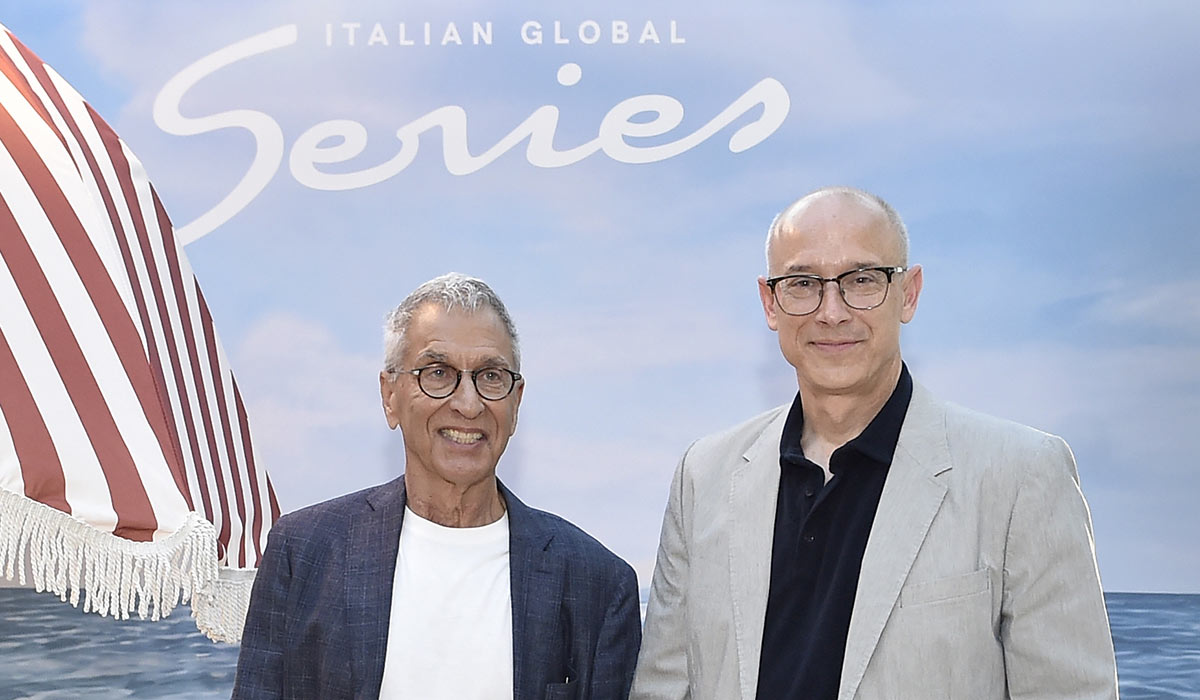
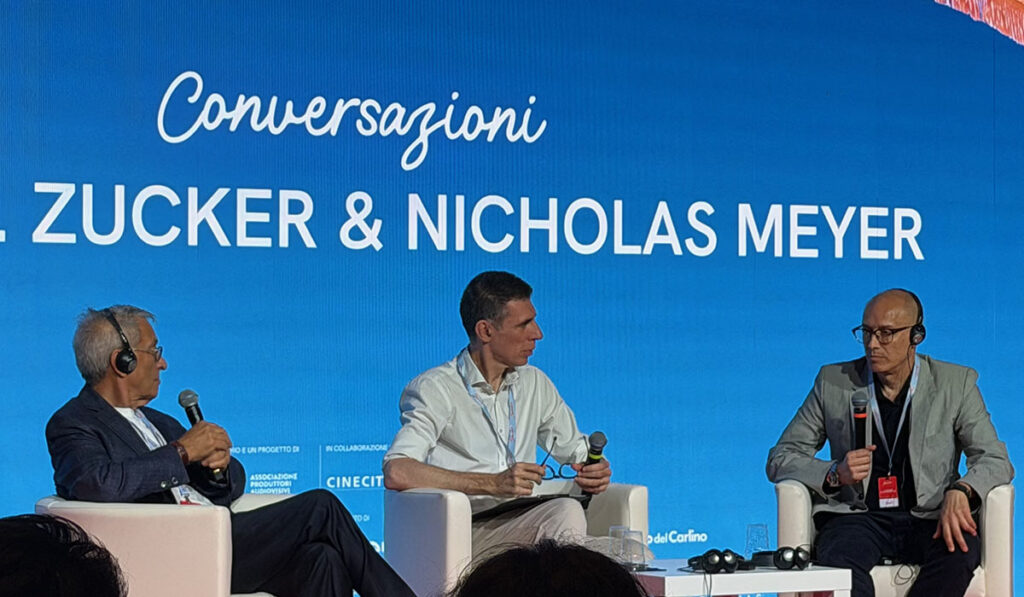
RICCONE, ITALY – It’s summer festival season. As the entertainment industry braces for the 2026 Emmy nominations, some of television’s most influential voices have convened on the east coast of Italy for the 2026 Italian Global Series festival. Tuesday night featured an in-depth conversation with two unique creators in the field, producer David W. Zucker and director Nicholas Meyer. And while they were short on news-breaking quotes (though Zucker teased that “Blade Runner 2099” will have a moment at San Diego Comic-Con), they had plenty to say.
If you’re of a certain generation, Meyer is best known for his work on the initial “Star Trek” films, including the highly influential “Star Trek II: The Wrath of Khan.” But he also directed the acclaimed television movie “The Day After,” a cultural touchstone during the Cold War, and has worked on programs such as “Houdini,” “Venetta,” and “The Odyssey.” He also has a major connection to Italy as he co-created the well-received 2016 series “Medici: Masters of Florence” for Italian broadcaster RAI. An opportunity that arrived in his 70s.
Meyer recalled one particular quote that he feels is relevant to his career.
“Somebody recommended a general to Napoleon, and he said, ‘This guy’s a very good general.’ And Napoleon said, ‘I know he’s good, but is he lucky?’ I think I’ve been very, very fortunate in the people I’ve worked with, the people who’ve put up with me, the people who’ve given me chances,” Meyer says. “I learned a tremendous amount from Frank [Spotnitz] with whom I’ve been partnered for years, and we did ‘Medici: Masters of Florence,’ together. And he was my sort of television teacher in a way because, as you know, I didn’t understand it very, very well. But I think it’s largely a matter of luck that I’ve been able to switch hats or coats or something. And I’ve never really planned my professional career. I just sort of fall into things. I fell into doing ‘The Day After.’ It wasn’t something that was planned.”
To many, Meyer’s work on 1983’s “The Day After” still evokes nightmares. The realistic depiction of a nuclear holocaust shook the nation and delivered Super Bowl-esque viewership with a 38.5 rating and an estimated 100 million viewers. Always intended for TV, Meyer again attributes his participation to luck, joking, “I think I was the fourth director ot be offered it.”
“The thing about nuclear war, the worst problem is that nobody wants to talk about it or think about it,” Meyer says. “We hope it won’t happen, but hope is not a strategy. I didn’t want to do the movie either. And I was being psychoanalyzed at the time and lying on the couch and staring at the ceiling and trying to figure out reasons why not to do this. If you were doing feature films, which I was, you weren’t supposed to go down to television. That was a step down. I had all kinds of reasons. And my analyst, who seldom spoke, opened his mouth and said, ‘Well, I think this is where we find out who you really are.’ Checkmate. I didn’t know how to wriggle off that hook, and that’s why I wound up doing it.”
Originally, the project was intended as a two-part event. When Meyer read the screenplay, he wondered if anyone was going to tune into night two of armageddon. The network, ABC, thought they needed two nights of ad sales to cover the cost of the production. Meyer recalls, “They said, ‘We don’t expect to make any money on this movie, but there’s a limit to how much we can afford to lose.’ But in the end, I sort of got my way because all the sponsors dropped out. General Foods, General Motors, and General Mills, and all the generals went to the hills. And finally there was just me and Orville Redenbacher popcorn. And so when that happened, I said, ‘Can I please cut it down?’ And they said, ‘Oh, please.’ Because I had filmed the whole four hours or whatever it was. So, I took a hacksaw to it.”
Zucker, currently the Chief Creative Officer at Ridley Scott’s Scott Free Productions, has a long, esteemed resume of series including “The Good Wife,” “Dope Thief,” “Raised by Wolves,” “The Man in High Castle,” “The Hot Zone,” “Alien: Earth,” and “The Terror.” An episode of the third season of the latter, retitled as “The Terror: Devil in Silver,” screened at the festival with stars Judith Light and CCH Pounder in attendance. But while “Alien: Earth” is in production for a second season, it’s the unveiling of the long-in-the-works “Blade Runner 2099” that piqued the interest of many in the audience.
“I mean, the one thing I can share about ‘Blade Runner’ is that the Comic-Con event this summer, which is coming up in a couple of months, information will begin to get released then,” Zucker says. “But I think the title tells you something from 99. And Michelle Yeoh and Hunter Schafer are quite terrific.”
He adds, “The one insight I would share because there was a lot of discussion post ‘Blade Runner 2049,‘ about when to set this series. And one thing that was very important from Ridley’s point of view was to keep the timeframe on that exists within the lifespan of people who were currently living. And that connectivity was very important to him, even as obviously this is a world of great distinction. And to a degree, just to sidetrack for a moment, that was a similar experience we had when we were making ‘Man on the High Castle,’ which was also something we did with Frank Spotnitz.”
One of the more intriguing exchanges was regarding the future of narrative storytelling. Meyer, in particular, believes long-form stories, which have proliferated in some form for centuries, may have met their match with modern-day technology. There is simply too much distraction.
“I think what really is the death of narrative as near as I can figure it out is the cell phone. And now our attention spans, I think, have become biologically or physiologically changed,” Meyer suggests. “We’re addicted to these things. We’re on them all the time. We take them into movie theaters. And now there’s something called Verticals where you watch a story in four minutes. About 10, 15 years ago, Jeffrey Katzenberg had this idea with something called Quibi, sunk a fortune into it, and it flopped. He was just ahead of his time. And what I sort of despair of I hear that students in film schools don’t want to watch the whole movie anymore. ‘We haven’t got time.’ And what I worry about is how narrative, as I love it, whether it’s a multi-part series or a two-hour movie, is being diluted or jettisoned in favor of these sort of soundbite stories. I’m concerned about this, and I’m also concerned about the reason for it, which is what it’s doing to people’s headspace.”
In some respects, Zucker concurs, noting, “I do see, particularly in our office with the younger generation, that there’s a real resistance that’s growing to this and sort of a recognition that we’re losing connectivity. We’re losing an ability to feel and relate. I mean, to the point now that there was one article I read the other day where young people were having young assistants who would prefer to email or text. They don’t want to call anyone because they’re uncomfortable. But what the article was saying is, well, how are they going to learn to deal with conflict if they don’t know how to engage with someone? So, there’s no question that everyone is quickly coming to terms with the impact of all of this. But where my hope resides is that when this kind of rapid aggressive change transpires, we will inevitably be drawn to each other again for the reasons that Nick was describing.”
The irony in this discussion is that, refreshingly, the crowded audience at this event was dominated by television fans in their twenties. And it wasn’t even close. Perhaps that will give hope to Meyer, who noted, “I’m very in favor of the theatrical experience that when you go to the play or the ballet or the opera or the movie, you are having an experience with a bunch of people. You don’t know them, they don’t know you, but you are having an experience that is simultaneously individual, intimate, personal, but also collective. And I think when human beings come together, which is what theater does, that’s the best thing it can do is to bring people together. That’s what art can do. And that’s why I’m voting for it.”
The 2026 Italan Global Series Festival runs through July 12
Follow Gregory Ellwood on Bluesky
Follow Gregory Ellwood on Threads
Follow Gregory Ellwood on Instagram
Follow Gregory Ellwood on TikTok
Sign Up For The Breakdown Newsletter

Editor-at-Large Gregory Ellwood is one of the entertainment industry's most respected journalists and critics. Based in Los Angeles, he's the only current awards expert who previously worked on Oscar campaigns at a major movie studio. Over the years, he has written for the LA Times, Variety, The Hollywood Reporter, and Vox, among others. He also co-founded the entertainment news site HitFix, which spawned a legion of influential Emmy and WGA Award-winning alumni.


