


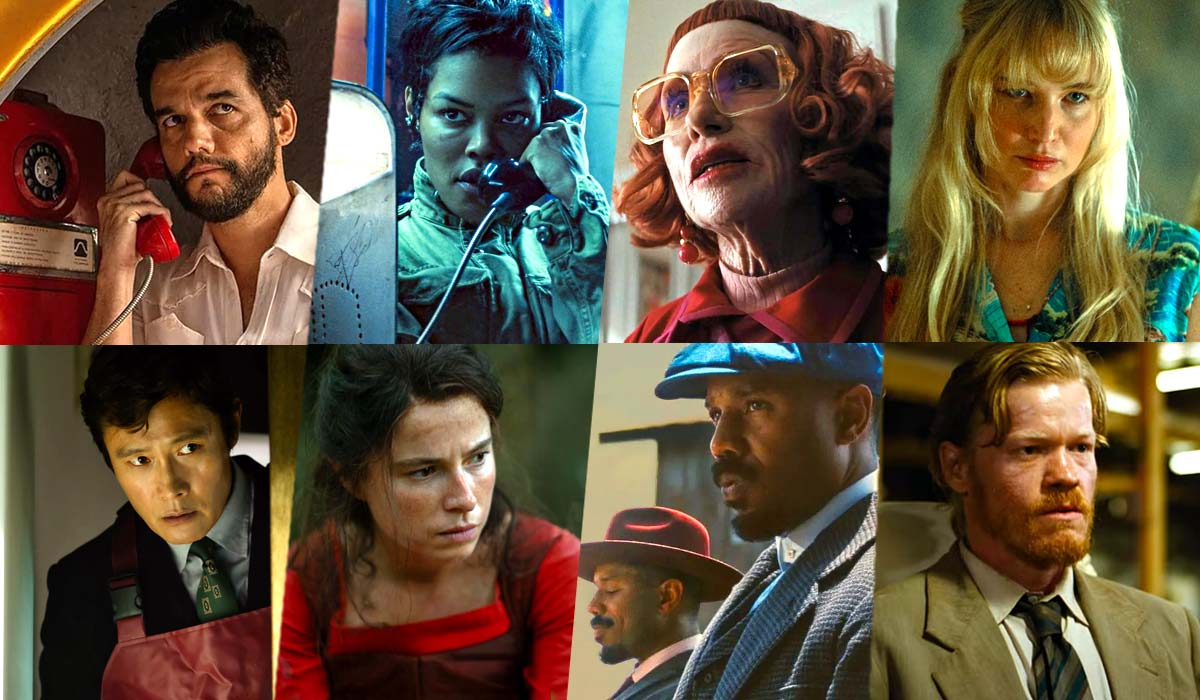
Sally Hawkins, “Bring Her Back”
The ending shot of Danny Philippou and Michael Philippou’s rattling “Bring Her Back” may lack punch for viewers who don’t have kids of their own; for those who do, and those who don’t but possess basic empathy, the gruesome details of the film’s conclusion are enough to induce tears. That’s on the back of Hawkins’ desperate portrayal of Laura, an erstwhile childcare counselor and current foster parent, who takes in orphans Andy (Billy Barratt) and Piper (Sora Wong) when their father dies in the shower. Laura seems well-intentioned; her credentials don’t hurt, either. But she’s hiding worse things in her closet freezer than skeletons. The Philippous, having spent their YouTube career making joyfully unhinged shorts where Cookie Monster dismembers the Power Rangers, turn to the movies for therapeutic narratives where mental illness plays a part, but the monsters are real; twice now they’ve offered their protagonists an abyss to gaze into, and boy does the abyss gaze into Laura. Hawkins doesn’t sand down her edges. She scuffs them up and makes herself as prickly as possible. But in that final image, she shows us what the edges have kept out of reach all along, and with such force that we’re inclined to weep along with her. – AC
Renate Reinsve, “Sentimental Value”
The power of Renate Reinsve in Joachim Trier’s “Sentimental Value” is how she plays rage as an internal climate, not a spectacle. Nora is angry and bitter, a woman who feels forgotten and abandoned by her father, so his sudden reappearance after her mother’s death doesn’t reopen wounds—it proves they never closed. And yet Reinsve doesn’t give you obvious fireworks. She keeps it simmering: a tight jaw, a polite tone that sounds like self-control, eyes that flicker with decades of awful memory. We see her unable to be truly intimate with a FWB—sex without closeness, touch without trust. We see her fiercely protective of her younger adult sister, the kind of defense mechanism that’s also love, also guilt, also survival. Trier is a director obsessed with interiority, with what people swallow to keep functioning, and Reinsve is a world-class instrument for that language: her most devastating moments aren’t spoken, they’re silent surges—whole lives of resentment and tenderness bubbling under the surface, contained just barely enough to feel like it might rupture at any second. – RP
Indy, “Good Boy”
Cats get all the flak in the world for being unmanageable, as if shepherds would bother with a flock of felines in the first place. There’s no money in that kind of livestock. Besides, dogs, no matter how much we train them, are mercurial in their own way, incapable of paying us any mind when there’s a squirrel 50 feet behind them on a sidewalk. So it’s easy to write off Indy the dog’s contributions to Ben Leonberg and Kari Fischer’s excellent demonic possession film “Good Boy,” because as they’ve pointed out in interviews, Indy isn’t really “acting” at all; they shot the movie around him, knowing full well that a dog doesn’t take direction like a human. What we see Indy do on screen, we interpret as action, when it’s actually a reaction: a dog doing as dogs do, observing the world and responding accordingly in their primal physical language. But even if Indy is simply being Indy, the effect of his movements on screen conveys what the filmmakers wish – curiosity, perplexity, misapprehension, and dread. Among horror cinema’s many famous animal actors, Indy ranks among the very goodest. – AC
Leonardo DiCaprio, “One Battle After Another”
Leonardo DiCaprio could have made his career playing heartthrobs and prototypical heroes until the day he dies; his 80-year-old will probably look like our 50. Instead, he’s made the conscious choice to play scads of scumbags and losers, like Rick Dalton in “Once Upon a Time in Hollywood,” and now, Bob, AKA “Ghetto Pat,” in Paul Thomas Anderson’s “One Battle After Another.” In his heyday, Bob was a revolutionary. In today, he’s a layabout, burnout, and single dad, struggling to raise his beloved daughter Willa (Chase Infiniti), without screwing her up too much by modeling rampant paranoia for her. Bob has a reason to be paranoid, of course, and in another movie, that sensation might have been validated, even rewarded, with permission to be badass. But Bob, as written, isn’t badass; he’s just a dad. And as played by DiCaprio, he’s a bundle of nerves. When his past actions catch up with him, his past self pointedly doesn’t–he’s just a terrified parent, bumbling his way through chaos to protect his child. DiCaprio’s fatigued, threadbare appeal ingratiates us to Bob even when he’s at his most oblivious and useless. – AC
Michael B. Jordan, “Sinners”
The trick isn’t that Michael B. Jordan plays twins in “Sinners”—it’s that he makes you forget it’s a trick at all, splitting Smoke and Stack into two distinct instruments with different rhythms, different temperatures, different kinds of danger. In Ryan Coogler’s 1930s Southern vampire fever dream, the brothers return home after a stint up north, carrying the swagger of men who’ve survived too much and the haunted eyes of men who know survival always comes with a bill. Jordan gives Smoke a coiled, watchful authority—like he’s always reading the room for exits and betrayals—while Stack moves with slicker bravado, an easier grin that still can’t quite hide the desperation underneath. That’s the ferocity here: not volume, not macho posturing, but a performance built on nuance and control, the sense that both men are improvising their way through a world designed to chew them up, and doing it with charisma that can be seductive one second and lethal the next. The film’s grindhouse pulse and spiritual weight only work because Jordan anchors both registers simultaneously—he sells the horny, lurid genre delirium, but he also sells the soulful ache of overdue homecomings, brotherhood as both bond and burden, the devil at the door and the devil already inside. – RP


