


“Bugonia,” Jerskin Fendrix
Fendrix’s score for Yorgos Lanthimos’ latest is a lesson in contradiction. It is, at times, grand, even a bit orotund, or otherwise outsized for a movie whose primary location is a whacked-out conspiracy theorist’s dungeon. But don’t blame Fendrix. Blame Lanthimos. In fact, don’t blame either of them or anyone else, because the contrast works: yes, a basement it may be, but the grandiosity links back to the conspiracy theorist (Jesse Plemons), who believes against all rationality that the woman he has kidnapped (Emma Stone) is an alien overlord disguised as a high-powered CEO on Earth. What we see on screen is a man playing out his delusions, and Fendrix’s score reflects those delusions, though only by happy accident; he had only a scant idea what kind of film he was scoring. Thank goodness for intuition. – AC
“Resurrection,” M83
Anthony Gonzalez, the constant behind the French electronic rock group M83, provided Bi Gan with music throughout the production of Bi’s latest, “Resurrection”; as Bi began the film’s final edit, Gonzalez’s soundtrack remained incomplete. He made Bi wait. The wait, though, was worth it, for Bi (who reportedly wept on hearing the finished soundtrack), for the movie, and especially for the audience. This is a rich, layered work, where the chief elements of M83’s aesthetic, their cherished synths, mingle with string instrumentation–a marriage between the digital and the analogue, futurism and antiquity. This also makes the marriage of Gonzalez’s music and Bi’s direction well-chosen, given that “Resurrection” is a film about the tension between the past and the future. But the soundtrack is so sharply constructed that, divorced from Bi’s driving theme, it stands on its own legs as an illusory experience, where the familiar and the far-out flow into one another. – AC
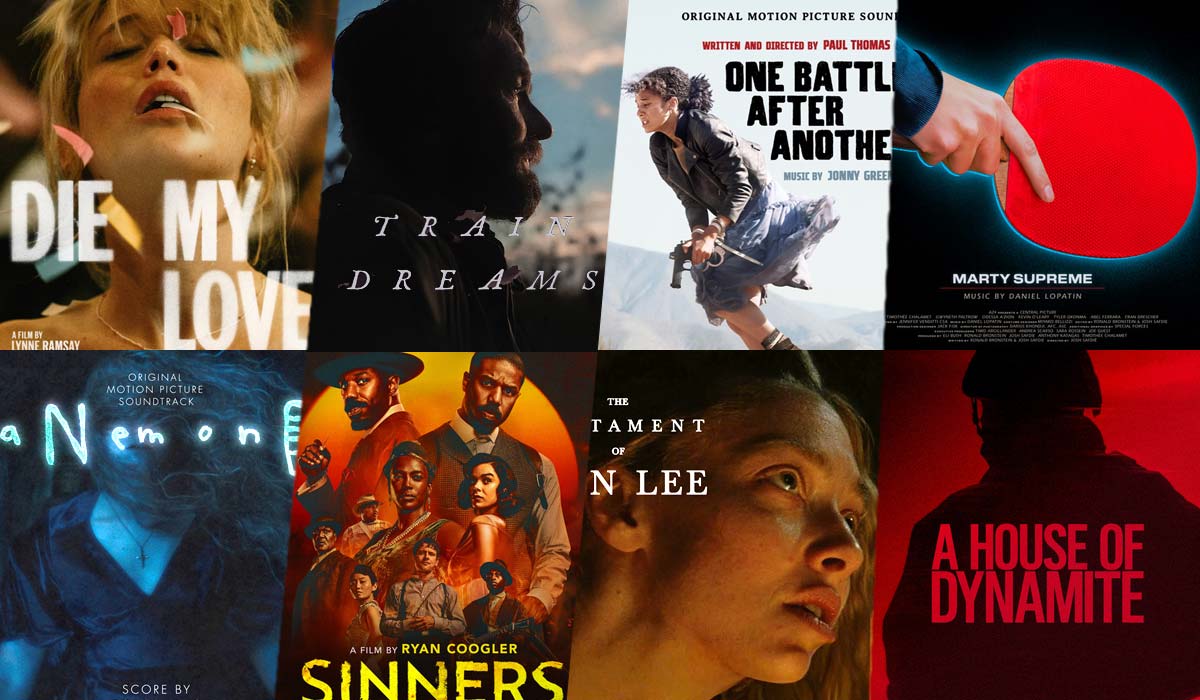
“Train Dreams,” Bryce Dessner
There’s so much ache, longing, heartbreak, despair, and guilt in Clint Bentley’s period drama “Train Dreams,” a melancholy film that tracks the life of a logger over many decades as he experiences love and loss across a rapidly changing 20th century—one that leaves him feeling like a sad man out of time by the end. Joel Edgerton is really tremendous in the film; Bentley and his cinematographer out-Malick Terrence Malick in their discreet observation of quiet devastation and dolorous grace. All the while, softly underscoring every moment is Bryce Dessner’s (of The National) gentle, profoundly human, tenderly empathetic score. The way pianos twinkle with forlorn restraint (“Memories Foretold”), cellos cry out to one another—like lost ghosts in the woods, spirits trying to find each other (“Passageways 1”)—or the trembling crescendo of a symphonic swirl that reaches for glimmers of hope (“The Cut,” “The Gadabout”) amid all the tragedy, Dessner wraps it up in something soulful, sorrowful, and deeply human. The cherry on top is the eponymous title track from Nick Cave, but also the ascending-to-the-heavens “The Great Mystery,” which will find you smiling through tears. We’re not ranking this feature, per se, but this would easily be my #1 pick. Just devastating. – Rodrigo Perez
“Jay Kelly,” Nicholas Britell
Noah Baumbach’s deceptively soulful “Jay Kelly” is not for the posturing, giving it the side-eye, ’cause it features a guy who seemingly could have partied with the elite class one too many times in his life. It’s a superficial-seeming film—because it’s about an actively shallow and selfish man, a famous actor (George Clooney)—with a surprising amount of depth. It’s easy to miss, and many have, but the true tale of it all—a life of regret, a man being celebrated only to finally realize he’s missed the true party of life by never really being present for friends, family, and loved ones—is bittersweetly rendered by the spectacularly talented three-time Oscar-nominated composer Nicholas Britell (“Andor,” “Succession”). Wistful, melancholic, and also playful, longtime Baumbach enthusiasts will catch all the affectionate homages to French composer Georges Delerue—one of the filmmaker’s faves, and someone he quoted often in “Frances Ha.” Given that the film is indebted to François Truffaut’s metafictional and self-reflexive film-within-a-film comedy “Day for Night,” also scored by Delerue, cinephiles should at least appreciate the musical cleverness throughout. If we can’t convince you to give “Jay Kelly” a second chance—though I’m mostly talking about film snobs—well, fine, but you’ve gotta love this tenderly striking Britell score, filled to the brim with all of his grand, romantic, melancholy beauty that makes him one of the best composers in the world right now, destined for multiple Oscars when all is said and done. – RP
“Anemone,” Bobby Krlic
In creating this list, I sometimes find myself thinking that some of the most overlooked, underrated, or underappreciated films of the year also feature some of the best scores of 2025. Take “Anemone,” the long-awaited return of Daniel Day-Lewis, directed by his son, Ronan Day-Lewis. Both audiences and critics didn’t seem to adore it wholeheartedly, but there’s so much to appreciate in it—chiefly, if nothing else besides Day-Lewis’ ferocious performance, then its scorching, ghostly, dream-pop/shoegaze-inflected soundtrack by electronic and industrial artist Bobby Krlic (aka The Haxan Cloak), known for working with Atticus Ross, Ari Aster, Björk, Goldfrapp, and many more adventurous artists. A psychologically bruised, emotionally wounded drama, Krlic takes his cues from the smoldering tension, bitter resentment, and rotted fury that festers between two estranged adult siblings. The “Anemone” soundtrack quietly builds with seething acoustic guitars, seemingly recorded 20,000 leagues below the sea through bad speakers, and angelic, haunted voices accompanying the sad desolation that lies beneath all that gnawing antipathy. But boy, does it soar when he lets it rip, burning with hot-lava-ish guitars that would make My Bloody Valentine’s dreamy fierceness blush.– RP

