


“Roofman,” Christopher Bear
Another humanistic gem of an underappreciated film this year is Derek Cianfrance’s quirky and poignant crime-comedy “Roofman,” which is really just a wistful portrait of a misguided mensch (a terrific Channing Tatum), always seemingly doing the wrong thing, but with thoughtfulness and compassion at all times. All of that soft, sad tenderness—and the comedic light touch the film possesses—is delicately captured and never overdone by Christopher Bear’s (of Grizzly Bear and Dirty Projectors) emotional, atmospheric score; one that seems to embody a quiet man who carries a profound sadness beneath his attempts to appear cheerful. There are dynamic, pensive pianos (“Setting Up”), lugubrious Wurlitzers (“Marking Calendar”), glimmering Rhodes pianos (“It’s A Date”), and troubled, anxious cello and bass moments (“Pawn Shop”). Still, the score’s most inspired choice is the use of a bittersweet clarinet (typified by “A Nice Guy Like Me”), essentially the movie’s primary instrument. Its vibrato makes it a versatile weapon in Bear’s arsenal—joyful, picaresque, and, of course, chock-full of the sorrowful regret from the well-intentioned mistakes we cannot undo. – RP
“The Mastermind,” Rob Mazurek
Kelly Reichardt’s film “The Mastermind” is, well, a Kelly Reichardt, meaning it’s essentially an anti-heist film: slow, methodical, human, wry, a little absurd, and not all that interested in traditional, exciting heist tropes (and it’s a little gem). But perhaps the one concession the film makes—which is really just its main asset—is its jazzy, smoky noir score, which plays like an indie heist soundtrack without all the elaborate bells and whistles. Composed by jazz musician and trumpeter Rob Mazurek of Chicago Underground (who’s worked with bands like Jim O’Rourke, Stereolab, and Tortoise), at times, “The Mastermind” nearly forgets there’s even an art caper at its center. But Mazurek’s playful, propulsive score is like a sly reminder and nod to the film’s counterintuitive nature. Is the film thumbing its nose at heist-film conventions? It’s debatable, but Mazurek’s gently energetic jazz score—cornets and lively percussion—acts almost like meta-commentary: crafty, observational, and perhaps just a little more cunning than the hapless thief at the heart of this convention-defying drama. – RP
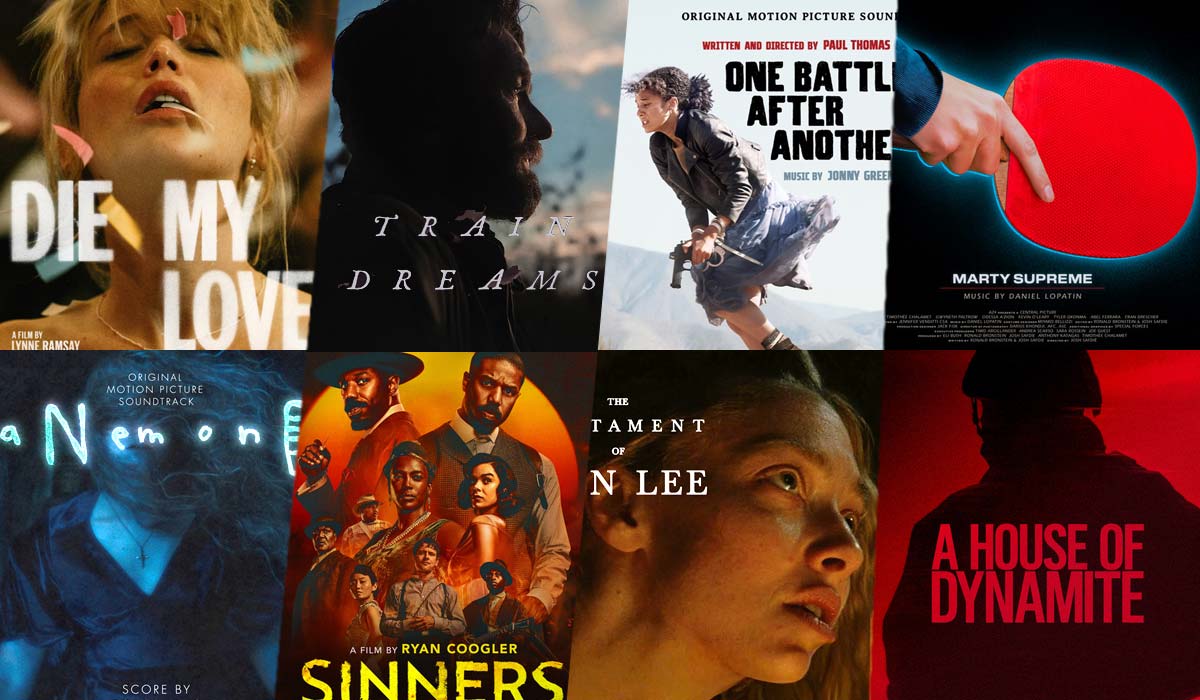
“Die My Love”
Lynne Ramsay tends to hang her musical hat on Radiohead’s Jonny Greenwood and his atonal scores, but for her wild, madcap, humorous psychodrama with Jennifer Lawrence and Robert Pattinson, she goes more of the vinyl-rip route. While George Vjestica (of Nick Cave and the Bad Seeds), music supervisor Raife Burchell, and Ramsay herself do contribute some score music here and there—including a cover of Joy Division’s “Love Will Tear Us Apart” sung by Ramsay herself in the end credits—most of the memorable tunes in the film are needle drops. Stand-out tracks in the eclectic soundtrack include David Bowie’s early, quirky jaunt “Kooks” and songs by Elvis Presley, Cream, Cocteau Twins, Nick Lowe, and more. But the big door prize is really the wry country duet “In Spite Of Ourselves,” by John Prine and Iris DeMent, that Lawrence and Pattinson also sing in the movie. This heterogeneous one is all over the place, much like the film, but it’s still a fine little keeper, reminding us of the power of a well-chosen playlist.– RP
“Weapons”
If there’s a downside to horror, it’s the one-dimensional aspect of just being scary, or just trying to scare you—typified in obvious jump scares. The beauty and genius of writer/director Zach Cregger’s “Weapons” is just how ambitious and complex it is. Beyond its bold structure—told through six POV chapters, with an introduction and conclusion that frame it all together—it’s creepy, unnerving, and frightening, sure, but it’s also extremely moody, atmospheric, mysterious, and playfully, nearly archly tense, as well as absurdly funny. The score, by Ryan Holladay and Hays Holladay (Bluebrain) and also Cregger himself, contains all these multitudes and is an effective vessel in keeping the audience on its toes without ever really overselling its innate horror until the moments when it really needs to frighten and raise the hairs on your arms. Even then, its sense of perky, sometimes atonal strings and twitching, sometimes pounding percussion never strays too far from the film’s overall métier—an unusually daring, freaky, and bold horror film that has a lot on its mind, has a warped sense of humor, and isn’t afraid to go full-on batshit crazy. – RP
“The Testament Of Ann Lee,” Daniel Blumberg
Fresh off his Oscar-winning run, musician Daniel Blumberg channels his affecting knack for the beautifully plaintive and the experimental, the atonal and the deeply poignant for Mona Fastvold’s “The Testament Of Ann Lee” (the co-writer and co-producer of “The Brutalist,” so keeping it in the family). An audacious avant-garde period-piece musical about the Shaker religion and the devoted matriarch at its center (Amanda Seyfried), Blumberg’s score is typically cathedral-grand and heart-stirring. Still, his ace-in-the-hole might be Seyfried—her beguiling voice, and the passion she brings to his captivating songs. The Shakers in Fastvold’s film have a zealous devotion to their cause, and appropriately, Blumberg’s yearning incantations sung by Seyfried in the movie (“Beautiful Treasures,” “I Never Did Believe”), many of them with hypnotic chanting qualities, are so profoundly moving in a corporeal, right-in-the-gut-of-your-soul manner. Try to leave the theater without humming the aching “Hunger & Thirst” or the mesmeric “All Is Summer.” The cherry on top is the haunting original song in the end credits, “Clothed By The Sun,” another soulful, gorgeous invocation that sums up the movie’s bold magnificence. – RP
Honorable mention:
A few others we loved include Ari Aster’s “Eddington” score, including music from Bobby Krlic and Daniel Pemberton, “Black Bag” by David Holmes, Nala Sinephro’s “Smashing Machine” score, “The Shrouds” from Howard Shore, and Kangding Ray’s music for “Sirāt,” among others.
Follow along for all our Best Of The Year and Most Anticipated coverage here.


Rodrigo Perez is the founder and editor-in-chief of The Playlist, which he launched in 2008. He has worked in entertainment journalism since 2000, including at MTV, and has written for SPIN, IndieWire, Pitchfork, Complex, Magnet, and various music, film, and entertainment publications over the past two decades.


