


“Frankenstein,” Alexandre Desplat
The easy way out of scoring Guillermo del Toro’s long-imagined dream project would be to project inhumanity, an aural reflection of the title’s stitched-together monstrosity. A lazy composer might have taken that tack and leaned into a narrow understanding of what is implied by such words as “Gothic” and “horror.” But Desplat, reteaming with del Toro for what feels like the umpteenth time despite it being only the third, taps into his director’s well-documented affection for monstrous things; he sees, as del Toro sees, the humanity in the good mad doctor’s creation rather than the macabre terror. So the violin becomes the anchor instrument in “Frankenstein’s” score, the gentle, soulful, sparsely beautiful heart in a horror film about the pain of isolation and paternal rejection. This could have been one of 2025’s most grandiose soundtracks. Instead, it’s one of its most delicate. – AC
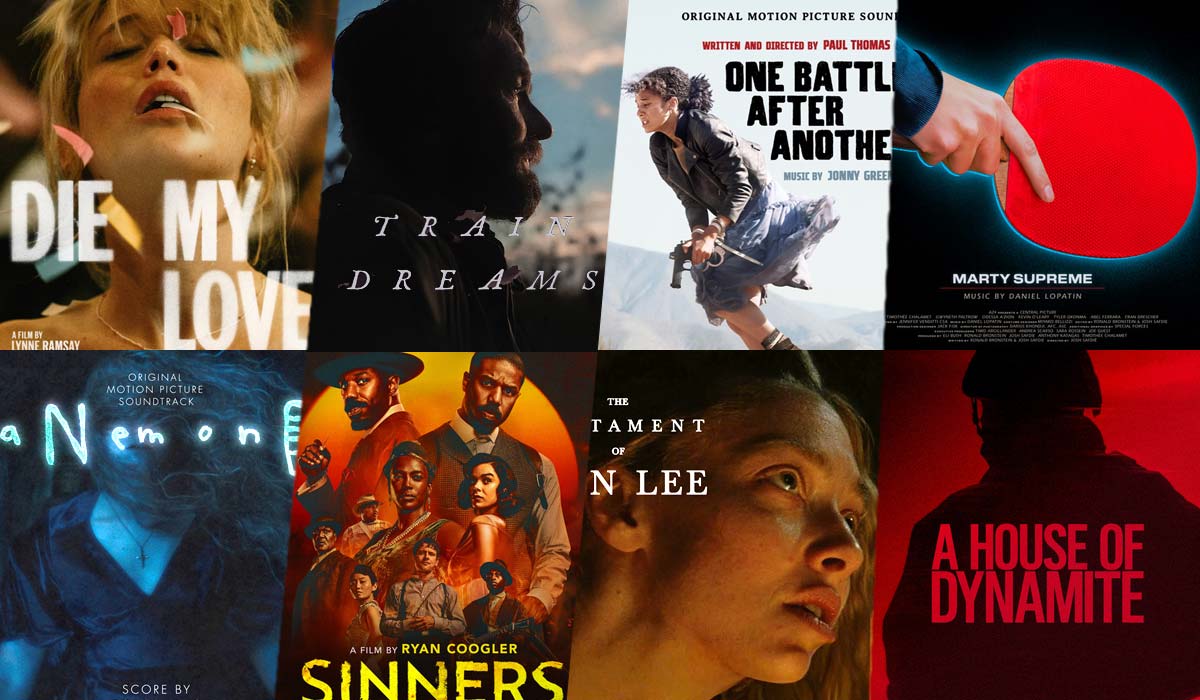
“A House of Dynamite,” Voker Bertelmann
A film about an unsubtle crisis–an ICBM of unknown origin aimed at Chicago sends the White House and every government office that participates in nuclear responses scrambling–practically demands a subtle soundtrack. Granted, a bombastic one to match the catastrophic threat of such a strike on a major American city has its temptations; all the same, Bertelmann brings a level of nigh-unbearable tension to Kathryn Bigelow’s nailbiter via chafing quietude. “A House of Dynamite’s” soundtrack is, in a word, muffled, but that quality applied to his compositions becomes suffocating in partnership with Bigelow’s filmmaking: in a movie where the characters scarcely feel as if they have room or the time to breathe, Bertelmann’s music functions as an additional constriction. – AC
“Hamnet,” Max Richter
Is it a knock against a soundtrack when it doesn’t play well outside the context of its film? Or is it a sign of a truly effective one when it is so intrinsically bound to its movie that one can hardly imagine said film without hearing it? Richter compliments Chloé Zhao’s adaptation of Maggie O’Farrell’s 2020 novel, a dramatization of William Shakespeare and Agnes Hathaway’s relationship and the death of their son–the story’s namesake figure–with hushed orchestral flourishes; if it is, perhaps, obvious to call the music “haunting,” then that’s only because “haunting” is precisely what Richter appears to be going for. In a film that’s ultimately about the way we relate to art, and the power of art to assuage even the deepest grief, the delicacy of Richter’s compositions actually speaks volumes to Zhao’s point. – AC
“One Battle After Another,” Johnny Greenwood
Forget the lush grandeur of Greenwood’s score for “Phantom Thread,” and ready yourself for the sparse individualism of “One Battle After Another,” in which Paul Thomas Anderson puts together an ensemble just to keep them separated for the bulk of the film’s 162 minutes. There’s a reason for this, of course, as there is for anything Greenwood composes. “One Battle After Another” focuses on battles each character must wage, instead of joint engagement between opposing sides; the score reflects that division through abrasive discordance, effectively inflating the tension in, for example, the rooftop chase scene where Leonardo DiCaprio attempts to do what even a younger man probably shouldn’t try, with the fear of death or capture on the line as he makes a daring but inadvisable escape from authorities. Greenwood’s music keeps us on edge and burrows under our skin, a perfect compliment to Anderson’s high-stakes action. Let’s not forget the soundtrack itself, featuring terrific needle drops from Steely Dan, Tom Petty, and Gil Scott-Heron. – AC
“Marty Supreme,” Daniel Lopatin
The rare case where the soundtrack eclipses its film by suggesting a film that’s more pleasurable to watch than it actually is. “Marty Supreme” is contextualized in reviews as something like a theme park ride, where amusements and thrills make up the “stuff” of the picture; Lopatin captures that abstraction with his compositions, soaked in the 1980s (Peter Gabriel, New Order, P.I.L., Alphaville, Tears For Fears) despite blaring in the 1950s. On paper, the anachronism feels ill-suited. In practice, the relationship between incorrigible Marty and Lopatin’s beloved saxes and synths helps inform the character as a living motif: he is of his time and timeless all at once. People like him existed in the 1950s, in the 1980s, and still exist today. Lopatin nails that observation without even trying, investing an energy and insight into his work that’s otherwise absent from the film itself. – AC

