


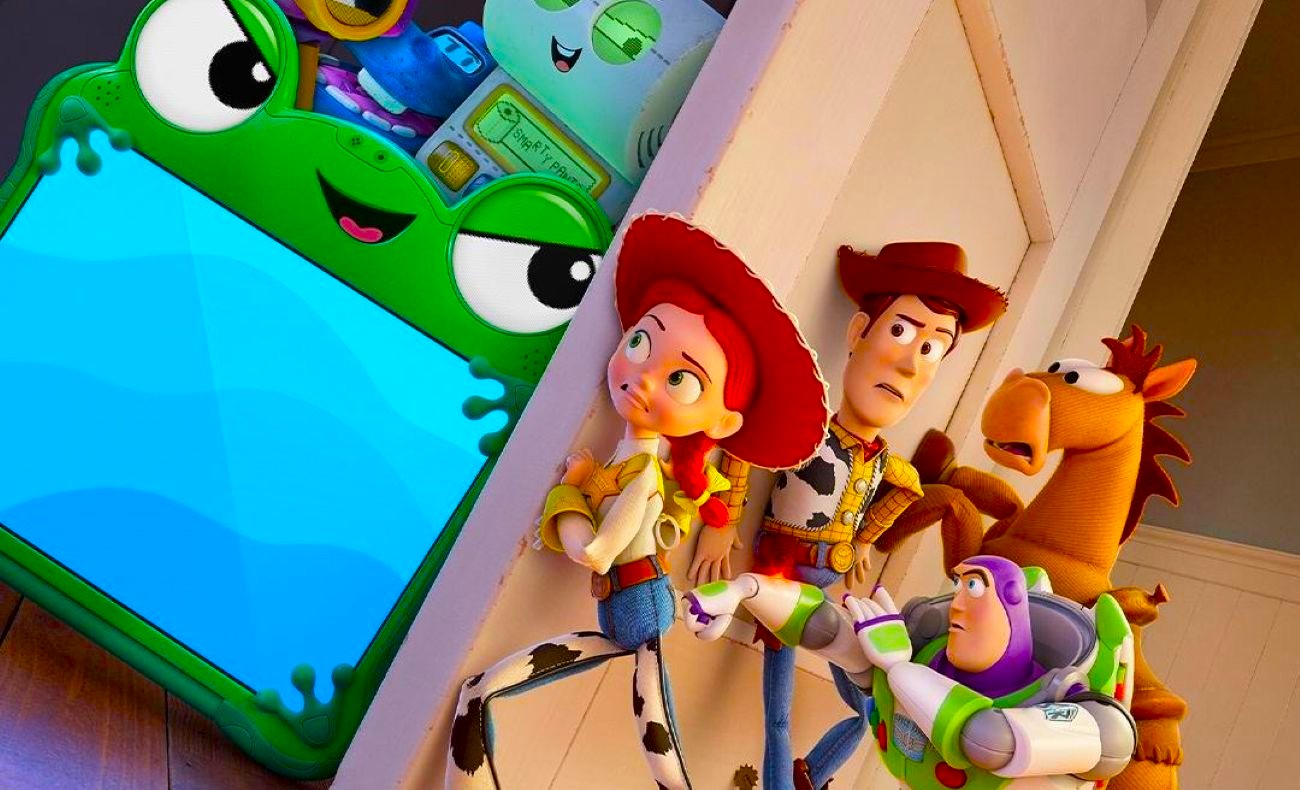
A “Toy Story” movie needs a reason to exist. That has always been the burden of extending a franchise that reached something close to a perfect ending with “Toy Story 3.” Now “Toy Story 4” had its mild pleasures, but it never fully shook the feeling of an aimless epilogue. “Toy Story 5,” by contrast, has a clear reason for reopening the toy box: it explores how childhood is changing and how technology, for better or worse, is reshaping it.
READ MORE: 53 Must-See Films To Watch Summer 2026
Directed by Andrew Stanton and written by Stanton and Kenna Harris, Pixar’s fifth main installment pivots the emotional center away from Woody (Tom Hanks) and toward Jessie (Joan Cusack). After Woody left Bonnie (Scarlett Spears) to stay with Bo Peep (Annie Potts) and help abandoned toys find owners, Jessie has become the leader of Bonnie’s room, with Buzz Lightyear (Tim Allen) as her second-in-command. But Bonnie’s fixation on Lilypad, a.k.a. Lily (Greta Lee), a frog-like tablet, creates an existential crisis among the traditional toys and pulls Woody back into the fold.
And that crisis has real shape. The toys have spent the whole summer trying to help Bonnie make friends, and for a moment, it looks as if their efforts might pay off with Blaze Manoukian (Mykal-Michelle Harris), a potential new friend. Then Lily enters the picture and, without intending to, ruins that fragile progress, pulling Bonnie deeper into a shallow, screen-obsessed social orbit of mean girls. Technology arrives like an invasion, not because the device is evil, but because it disrupts the emotional work the toys have been nurturing. Lily even treats Woody and Buzz like boomer toys, relics from another age who cannot understand how kids connect now. Suddenly, the toys do not just feel forgotten; they feel abandoned. They feel like they are losing their kid.
That shift from Woody to Jessie is smart. Woody is still here, and Hanks remains a comforting presence, but he is more of a supporting player than a protagonist. Jessie gives the film a more emotionally direct engine. Her history of abandonment makes the screentime anxiety feel less like a topical gimmick and more like a character problem. She is not simply jealous of Bonnie’s new device. She is terrified of being left behind all over again, and a terrific Cusak voice performance makes that fear feel poignant.
Thematically, the film handles its central idea well: technology can isolate, while play creates wonder, imagination, and connection. The movie is not anti-tech, and Lily is not simply the villain. But Bonnie’s attachment to her is funny, recognizable, and sad because the screen does more than distract her from her toys; it isolates her emotionally, pulling her away from curiosity, imagination, and the vulnerable work of connecting with other kids.
That gives the film a sharper core than “Toy Story 4.” The toys are fighting for a form of childhood that feels increasingly under siege: the tactile, imaginative, social kind of play that turns objects into companions and rooms into whole worlds. “Toy Story 5” understands that technology is not merely replacing toys; it is redefining what play, friendship, curiosity, and childhood even look like. Times change, the tools of childhood change, and even toys have to adapt. But the movie’s sweetest idea is also its most classically “Toy Story” one: friends stay forever, even when the world moves on.
The film also widens that anxiety into something more resonant: obsolescence and the existential crisis that comes with being outgrown. For Jessie, the fear is not just “Will Bonnie still play with me?” but “Who am I if I’m no longer helping a child grow?” That gives the movie its strongest metaphor for parenthood. Like any empathetic parental figure, Jessie ultimately realizes that it was never really about her. The purpose was always to serve the child, even if that means accepting that Bonnie’s world, needs, and friendships will evolve beyond her.
The movie is pretty enjoyable, even if it is not always as strong in execution as it is in concept. The first act is engaging enough, but it takes a while to get going and fully capture your attention. The returning ensemble still brings warmth, even as many regulars take more of a backseat. Buzz has more to do, including high-tech Buzz Lightyear units stuck in demo mode, and Forky (Tony Hale) remains a reliably odd delight.
The new additions are a fun welcome, including Atlas (Craig Robinson), a cheerful talking GPS hippo toy, and Snappy (Shelby Rabara), an excitable toy camera. But the standout is Smarty Pants (Conan O’Brien), an old 2000s potty-training toy who steals nearly every scene he is in. The character is wonderfully ridiculous, and O’Brien gives him exactly the right blend of desperation, smugness, and wounded dignity.
The second act starts to sag, circling its ideas rather than sharpening them. The premise remains strong, Jessie’s leadership gives the film a fresh point of view, and Lily is an effective complicating presence without being reduced to a villain. Still, the middle section lacks the escalating momentum that has defined the franchise’s best.
Thankfully, the third act is terrific, turning the movie’s ideas into a heightened, stake-filled race to help Bonnie connect with Blaze. After Lily inadvertently creates more problems for Bonnie, the toys and Lily eventually work together to repair the damage, making the final stretch less about defeating technology than using it in service of connection. It is thrilling, funny, moving, and finally gives the movie the comic urgency and emotional payoff it has been building toward.
That final act is so good it almost makes the unevenness more frustrating. “Toy Story 5” is a mostly satisfying return to form, one with strong thematic purpose, inspired comedy, and enough emotional clarity to justify its existence. It is not as elegant as “Toy Story 3,” but unlike “Toy Story 4,” it finds a contemporary reason for these characters to keep asking what they mean to the children who love them. [B]

