


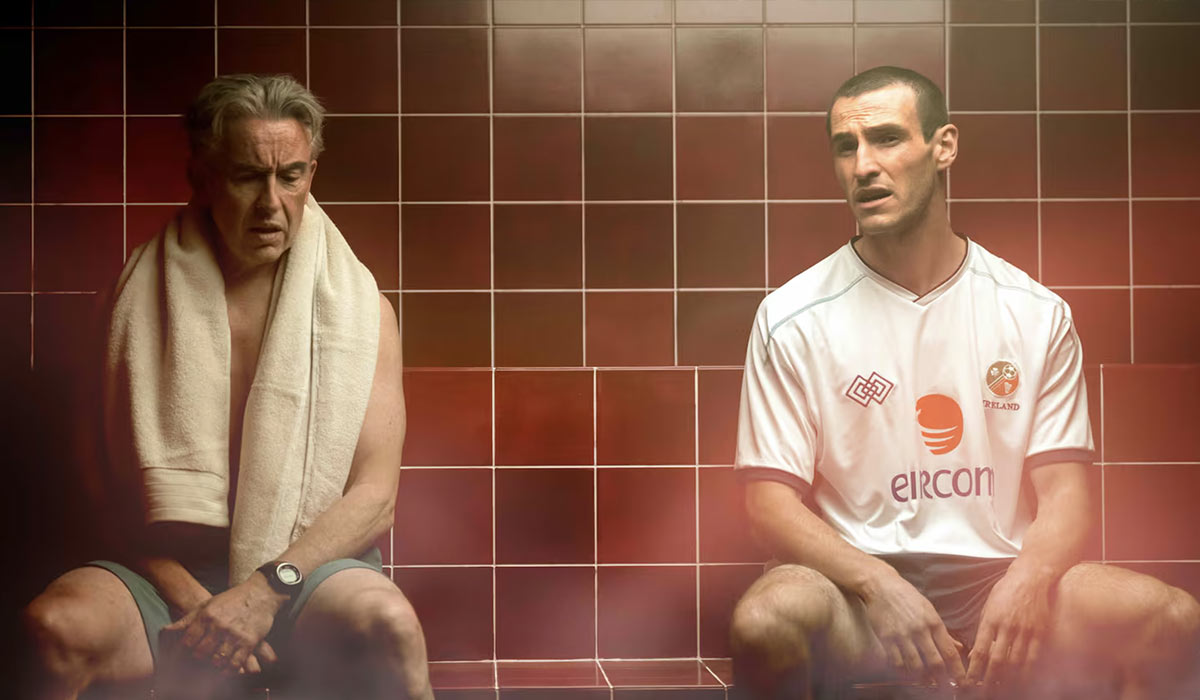
TORONTO – For anyone outside of Europe or heavily invested in the history of global football, it’s challenging to explain how massive a news story the events depicted in “Sapian” were at the time. Imagine if Michael Jordan or LeBron James decided not to play for Team USA in the Olympics at the last minute. Or if Wayne Gretzky threatened to ditch the Canadian National Team before the Winter Olympics. What occurred in the weeks leading up to the 2002 World Cup would define the careers of celebrated Irish football star Roy Keane (Éanna Hardwicke) and the coach of the Irish national team at the time, Mick McCarthy (Steve Coogan). And, surprisingly, in a film where one of the world’s best players and his coach disagree, Paul Fraser’s screenplay actually takes a side. That would matter if the movie amounted to anything.
READ MORE: “Hamnet” Wins TIFF 2025 People’s Choice Award
The fourth feature from directors Glenn Leyburn and Lisa Barros D’Sa sets up a pretty straightforward narrative. Ireland’s football team has qualified for the World Cup for just the third time in its history and the third time in the past 12 years. They did this without the participation of their team Captain, Keane, in the final qualifier. A star player for global powerhouse Manchester United and one of the greatest Irish players of all time, Keane was recovering from a knee injury in the months before the World Cup. An injury that the tabloid press and, seemingly, McCarthy, were skeptical of (thankfully, the movie does not play into this falsehood).
McCarthy, on the other hand, was born in England, but his parents were Irish. As a player, he was a part of successful Irish international teams, including the 1990 World Cup. History makes it very apparent that there was no love lost between McCarthy and Keane before the events in “Sapian” ever took place (why is left up to conjecture). And Keane makes his feelings quite clear that he doesn’t think McCarthy is “truly” Irish because of his U.K. upbringing. A perfect winning recipe for team sports.
The lifestyles of professional football players two decades ago were not as extravagant as today, but as a member of Manchester United, Keane was used to private planes, car service, and, most importantly, top-notch medical and training facilities. He was also a multi-millionaire who lived in a sprawling British estate. Even with sponsorships, that level of luxury was not something the Football Association of Ireland (FAI) could compete with.
In order for the players to adjust to the time zone and the intense humidity they would face in Japan, FAI set up a 14-day training period for the team on the island of Saipan. When Keane shows up for the bus for the flight to the Marina Islands, he’s already isolating himself from his teammates and is visibly disappointed by the travel arrangements. Things are about to get much worse.
Not only did the FAI advance scout not find a suitable pitch (or field) for the team to practice on, but he also didn’t make sure soccer balls arrived either. Yes, the team shows up on this island without any soccer balls to practice with. (Shockingly, not one player brought one with their luggage, but this is reportedly true.) Keane, who is already horrified by the food options at the cheap resort hotel they are staying at, and his teammates’ interest in partying over training, finds himself ditching practice multiple times. He vents his frustrations to himself as he walks miles back to the hotel. He is getting more and more angry, believing no one is taking this World Cup opportunity, perhaps his last, seriously. In theory, this was not McCarthy’s responsibility, but as coach, Keane blames him for not making sure everything was taken care of. Did the buck stop with McCarthy? Some would say yes, some would say no.
As the days pass and tensions rise, bored members of the media begin to fixate on said tensions, and the world starts to get reports about internal conflict within the team. When a reporter publishes a scathing interview Keane was told would run after the tournament, the two men’s frustrations come to a head. An infamous showdown between the two occurs in a team meeting, and, in theory, Ireland’s World Cup hopes go up in flames.
While LeBurn and D’Sa spin this endeavor as stylishly as possible, it’s the actors who have to make this borderline reenactment as compelling as possible. And they are committed enough to almost score the game-winning goal. Hardwicke needs to spark some sympathy or understanding for Keane’s perspective to keep the tension high. That’s no easy task because, at worst, Keane was a bully or an a**hole. At best, he was extremely competitive and intense to a fault. Harwicke makes you believe Keane isn’t trying to flake on the team. He simply can’t deal with the circumstances and makes some major errors in judgment.
On the other hand, Coogan has to portray McCarthy’s simmering frustration over having to kowtow to one of the greatest players in the world. A player he needs engaged and committed for the team to have a legit shot at winning, arguably, the greatest team prize in sports. Seemingly a generally affable fellow, Coogan delivers an impressively internalized performance of a man who slowly begins to realize he simply can’t win (with Keane at least).
Both actors are superb, but the problem is that history isn’t really on their side. The incidents depicted in “Saipan” were dramatic in 2002, especially in the sports arena, and to a fixated Irish public who took sides. But two decades later, it all lands with a thud. The end result has nothing significant to say about sports, media, or how competitors interact with each other. It all feels like an exercise to document a moment in history that is fading in relevancy. And, frankly, that will probably piss off Keane, if he ever sees the movie, even more. [C]

Editor-at-Large Gregory Ellwood is one of the entertainment industry's most respected journalists and critics. Based in Los Angeles, he's the only current awards expert who previously worked on Oscar campaigns at a major movie studio. Over the years, he has written for the LA Times, Variety, The Hollywood Reporter, and Vox, among others. He also co-founded the entertainment news site HitFix, which spawned a legion of influential Emmy and WGA Award-winning alumni.


