




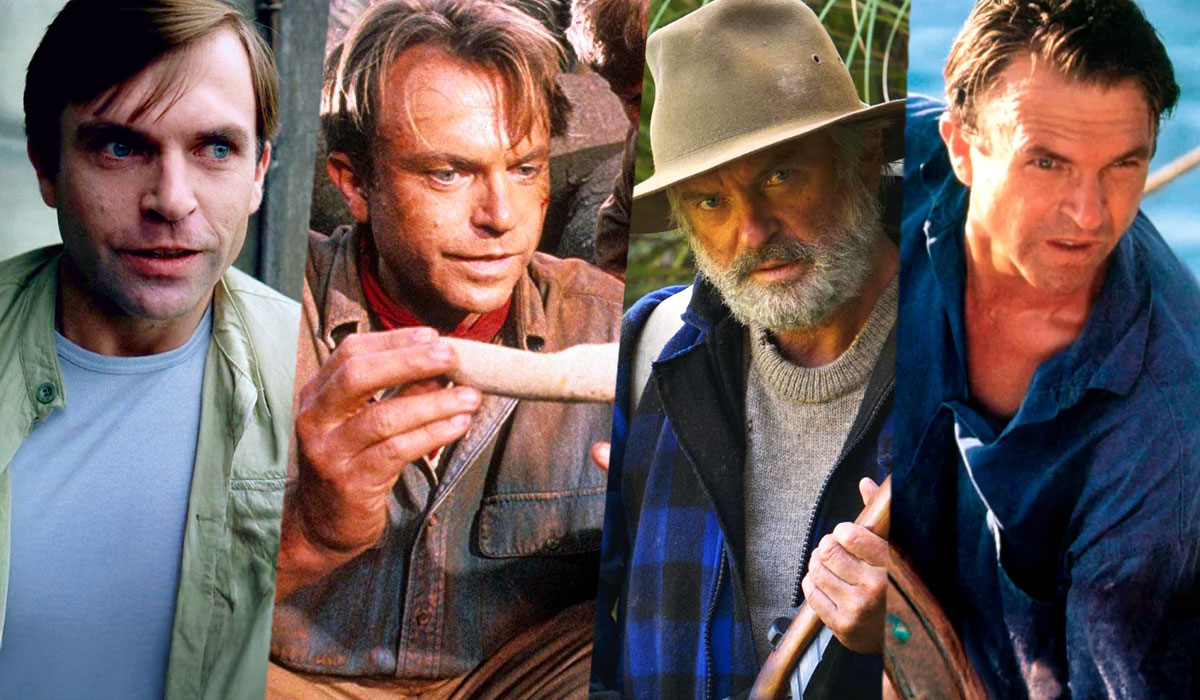
Sam Neill, the enormously versatile New Zealand actor whose career stretched across more than five decades, died Monday at 78. Born in Northern Ireland and raised in New Zealand, Neill became one of those rare performers equally at home in Hollywood blockbusters, intimate dramas, gonzo horror movies, eccentric comedies, and the emerging national cinemas of Australia and New Zealand.
He possessed an understated intelligence and a soulful, slightly rueful presence that could suggest decency, menace, wounded pride, or some volatile combination of all three. Yet even when playing monsters, cowards, broken men, or characters losing their grip on reality, Neill seemed incapable of withholding their humanity. Compassion and empathy coursed through his performances, making even his darkest characters feel painfully recognizable rather than merely cruel or grotesque.
That warmth was even more apparent away from the screen. Neill was a treasure of a human being, and his funny, eccentric, unusually tender social media presence offered a glimpse of the compassion he carried throughout his life. His posts about vineyard life, music, garden gnomes, and the beloved farm animals he named after celebrity friends felt like small gestures of reassurance from a man trying to make the world feel warmer. His love for animals, whom he treated as companions with personalities and emotional lives of their own, revealed the same gentleness, humanity, and empathy that illuminated his finest performances.
“Possession” (1981)
Andrzej Żuławski’s “Possession” is a super-freaky psychological horror film about a marriage disintegrating so violently that emotional betrayal begins manifesting as bodily terror, supernatural monstrosity, and outright madness. Sam Neill plays Mark, a spy who returns to West Berlin and discovers that his wife, Anna (Isabelle Adjani), wants a divorce, sending him into a spiral of jealousy, desperation, and increasingly deranged attempts to understand what she has been hiding. Adjani’s volcanic performance may be the film’s most famous element, but Neill matches her hysteria with a different, equally terrifying form of psychic collapse: Mark begins as a devastated husband clinging to rational explanations and gradually becomes sweaty, bug-eyed, abusive, and barely recognizable. Neill makes the character frightening because his need to possess Anna remains emotionally legible even as the movie descends into grotesque, apocalyptic lunacy. He is both victim and aggressor, reacting to the insanity surrounding him while generating plenty of his own, and the performance reveals an actor completely unafraid of ugliness, humiliation, or loss of control. “Possession” is an emotionally punishing horror movie, and Neill’s willingness to surrender himself to its feverish extremity is essential to its enduring power. —Rodrigo Perez
“The Omen III: The Final Conflict” (1981)
Directed by “Alien Nation” filmmaker Graham Baker, the third installment in the “Omen” franchise takes the series’ religiously rooted hysteria to its most feverish extreme. “The Final Conflict” is filled with macabre pleasures for viewers willing to embrace its heightened wavelength, chief among them Neill’s go-for-broke performance as Damien Thorn, a grown-up and curiously polished version of the Antichrist whose chilling composure he captures with elegant precision. In the subsequent decade, Neill would reveal a remarkable gift for portraying men at the mercy of their own fraying minds, most notably in Paul W.S. Anderson’s “Event Horizon” and John Carpenter’s “In the Mouth of Madness.” His terrifying performance here anticipates both of those roles while also standing in fascinating contrast to his work in “Possession,” released the same year. In Żuławski’s film, Neill reacts to mounting insanity before gradually succumbing to it; as Damien Thorn, he embodies evil with an unnerving degree of confidence and control. That he could deliver two performances of such wildly different psychological textures in the same year speaks to the extraordinary range already visible near the beginning of his career. —Nicholas Laskin
“Dead Calm” (1989)
Australian filmmaker Philip Noyce has worked across an unusually broad range of genres, from prestigious period pieces like “Rabbit-Proof Fence” to serial-killer procedurals like “The Bone Collector” and a pair of Harrison Ford-led Jack Ryan adaptations. “Dead Calm,” Noyce’s third proper feature, is an agreeably nasty piece of glossy late-’80s suspense whose lurid veneer is given a substantial boost by a central trio of terrific actors: Nicole Kidman, Billy Zane, and Neill. A high-seas thriller with a sadistic undertow, “Dead Calm” revolves around a woman in peril, a dangerous stranger, and a distraught husband confronted with something he cannot rationalize. Neill is not the film’s primary focus, which makes the force of his simmering, rage-choked performance even more impressive. Playing a Royal Australian Navy officer trapped aboard a sinking ship while his wife remains stranded with a murderer, he gives the story urgency, anguish, and emotional weight. “Dead Calm” is a Hitchcockian pressure-cooker endurance test with the ’80s sleaze dialed all the way up, and Neill gives its dark machinery a wounded, recognizably human soul. —NL
“The Hunt for Red October” (1990)
John McTiernan’s “The Hunt for Red October” is a dense, muscular submarine thriller built around shifting allegiances, geopolitical suspicion, and the uncertainty surrounding a Soviet commander’s true intentions. Sean Connery provides the film’s gravitational force as Marko Ramius, the captain secretly attempting to defect to the United States, while Alec Baldwin’s youthful Jack Ryan struggles to convince the American military that Ramius is not planning an attack. McTiernan’s film is stacked with legendary character actors, including Tim Curry, Scott Glenn, and Courtney B. Vance, but Neill makes a lasting impression as Vasily Borodin, Ramius’ trusted second-in-command. Neill does more with a glance or a quietly measured reaction than many actors could with an entire monologue, conveying Borodin’s loyalty, uncertainty, and private hopes without pulling focus from the larger ensemble. His wistful monologue about the life he imagines in America gives the film one of its most unexpectedly tender moments, making Borodin’s fate all the more affecting. Neill was a born movie star, but he also understood the lasting value of contributing to a larger dramatic tapestry in a supporting capacity. —NL
“Until the End of the World” (1991)
Even in a filmography filled with head-spinningly ambitious works like “Wings of Desire” and “The American Friend,” something is staggering about the scope and sprawl of Wim Wenders’ “Until the End of the World.” The ultimate manifestation of the road-movie template, the film is a cosmic epic of doom, love, technology, and romantic obsession. Neill works in a reduced capacity in terms of screen time, but he still makes a lasting impression within an ensemble that includes William Hurt, Solveig Dommartin, and Max von Sydow. Neill, who also narrates Wenders’ sweeping, globe-spanning cyberpunk epic, plays Eugene Fitzpatrick, the estranged lover of Dommartin’s Claire, whose growing fixation on another man sends their relationship toward collapse. His melancholy voice provides the film with a steady emotional current, grounding its vast geographical and philosophical ambitions in the sadness of a man watching someone he loves slip beyond his reach. Neill’s hauntingly subdued performance demonstrates how much he could contribute to a film through stillness, observation, and quiet emotional ache. —NL


