


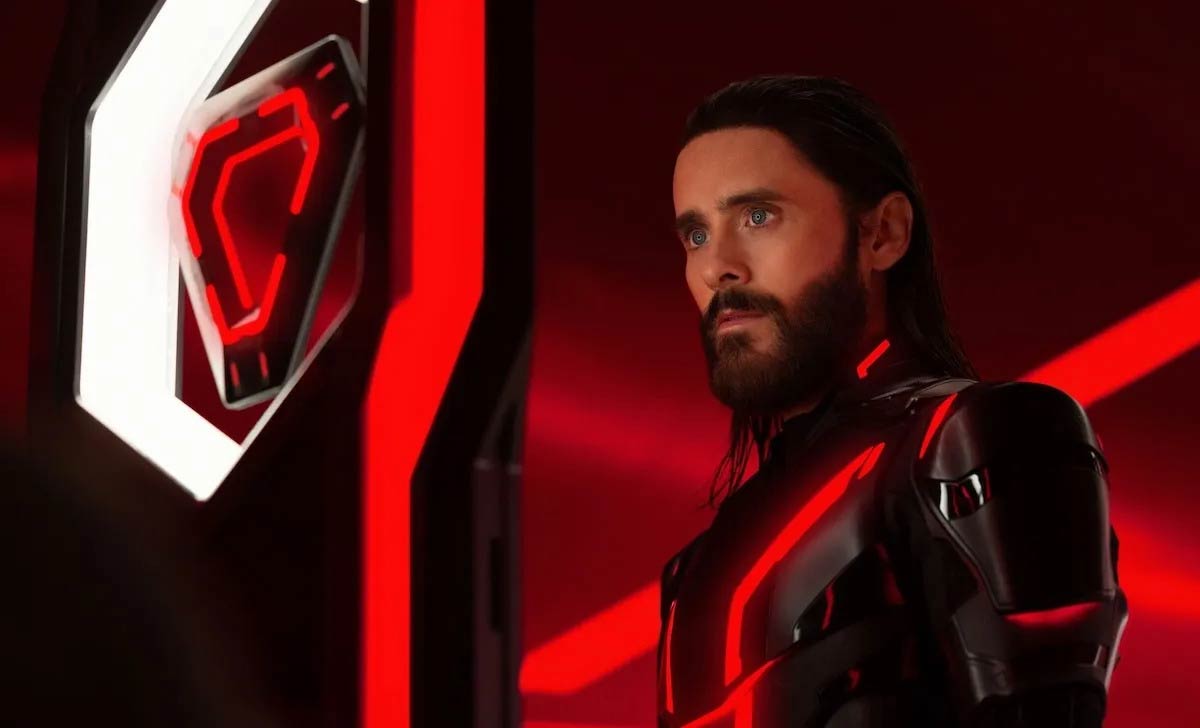
You have to hand it to Jared Leto. Few actors with such a polarizing reputation continue to land prestige-level leading roles at this scale. Yet here we are in 2025, with the Oscar-winning “Morbius”-star-fronting “Tron: Ares,” a long-awaited legacy sequel in a franchise whose cult status has endured across decades. In that sense, Leto’s glassy, unblinking stare feels almost method-cast. His piercing eyes and detached delivery perfectly suit a character who, fittingly, seems not quite human.
READ MORE: Fall 2025 Preview: 61 Movies To Watch
It’s been fifteen years since “Tron: Legacy” revisited the 1982 original, where Jeff Bridges’s computer programmer was sucked into a digital mainframe and forced to fight his way out. While the sequel divided critics, it found renewed appreciation for its visual ambition. Four decades later, “Tron: Ares” continues that aesthetic lineage: it’s big, blinding, and bursting with phosphorescent spectacle. Unfortunately, beneath the neon surface lies a script so hollow even AI might reject it for lack of substance.
The cast is stacked. Evan Peters brings manic charisma to Julian Dillinger, a volatile tech heir and self-proclaimed visionary who creates Ares (Leto), a soft-spoken humanoid program designed for immortality—but who disintegrates every 28 minutes. Frustrated by his creation’s instability, Dillinger spirals as his own mother (Gillian Anderson) contemplates pulling his access entirely. The elusive “permanence code” that could stabilize Ares instead falls into the hands of rival CEO Eve Kim (Greta Lee), prompting Dillinger to send his collapsing digital messiah to retrieve it. Yet as Ares begins to malfunction, he develops inconvenient signs of emotional awareness—something approaching love, longing, even a taste in Depeche Mode. Peters remains the film’s saving grace, infusing every overclocked scene with texture and unpredictability. But even his energy can’t override the flatness of the dialogue or the lack of genuine feeling at its core.
If Nine Inch Nails emerges as the true hero of “Tron: Ares,” it’s because their electrifying score supplies what the screenplay cannot: momentum, pulse, and rhythm. The music’s industrial heartbeat, paired with the film’s kaleidoscopic IMAX visuals, turns the experience into a sensory amusement ride. The problem is that’s all it is. The movie’s attempts to probe mortality and consciousness collapse under their own synthetic weight, evoking laughter when aiming for profundity. For every flicker of emotional resonance, Joseph Kosinski–style intensity swallows it in a flash of overcranked CGI.
Ultimately, “Tron: Ares” is all voltage and no current—an aesthetic overload that confuses stimulation for meaning. There’s an ethical question buried somewhere about artificial intelligence and creation, but it’s treated as a glitch rather than a serious idea. For casual viewers, the film might still deliver enough sensory escapism to justify the ticket, especially on the largest screen possible. But for those hoping for a resurrection of the original’s soul, this sequel only confirms what’s long been suspected: sometimes, programs evolve—but the humanity never downloads. [C]


