

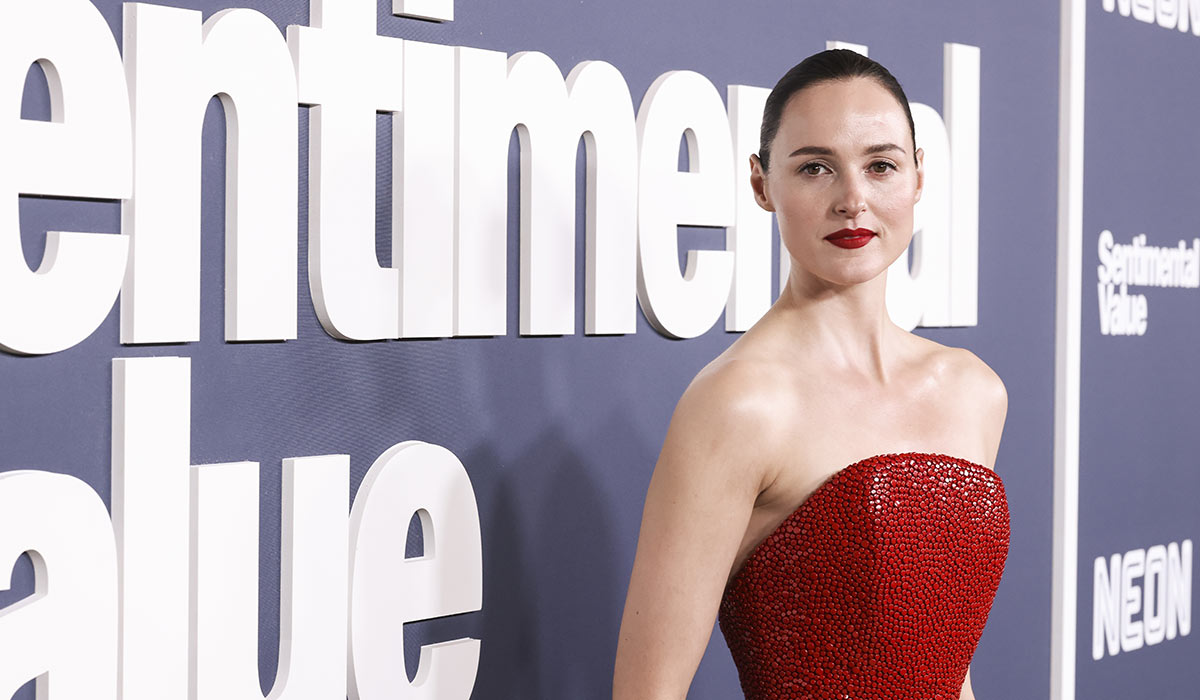
Renate Reinsve has already climbed the mountain. Well, maybe she almost hit the summit. In 2021, the Norwegian actress captured the hearts of the Cannes Film Festival faithful when she took the Best Actress award for Joachim Trier’s “The Worst Person in the World.” Four years later, she and Trier returned with “Sentimental Value,” which earned universal acclaim and the 2025 Cannes Film Festival Grand Prix honor. The past six months have been something of a whirlwind as Reinsve earned her third European Actress Award nomination, on the cover of major magazines, and finds herself anointed as something of a lock for a Best Actress Oscar nod. She says the whole experience is “surreal.”
“It’s, of course, the biggest honor just that I’m on those lists,” Reinsve says. “I feel I’ve won because it’s so far away from what I ever thought would happen. I am very, very happy, but it is also a little bit overwhelming. So, I try to kind of halfway not pay attention, but it’s impossible because it feels so huge.”
Set in contemporary Oslo, Reinsve plays Nora, a relatively successful theater and television actress navigating her 30s. Following the death of her mother, her semi-estranged father Gustav (Stellan Skarsgard), himself a famed film director, returns to Norway and reenters her and her sister Agnes’ (Inga Ibsdotter Lilleaas) lives. The film hints at this inevitable tension in its first scenes, where Nora battles massive stage fright before the opening night of her new play. It’s wonderfully tense and comedic, but Reinsve says she’s never experienced anything like that herself.
“I really know how to facilitate my fear. My fear is my friend,” Reinsve says. “I have it, I have a lot of fear, but I feel I can kind of delegate it into the character and know how to use it. But I have seen someone next to me go into that panic. So, I was kind of inspired by someone. I’ve seen that almost exact thing happening, and it’s, of course, tragic when it happens, but it is a lot of fun, and I personally love playing panic scenes. And finally, to get to do something that had humor in it was really great. I did like a lot of humor when I worked in the theater, but I worked on a lot of heavy roles, dramatic roles, after I started doing movies five years ago.”
During our chat earlier this week, Renate reflected on being in the middle of the Best Actress conversation, the scene she was most worried about shooting, teases working with celebrated Romanian filmmaker Christian Mungiu on his new drama “Fjord,” and much more.
Note: There are spoilers regarding narrative plot elements in “Sentimental Value” in this interview. This conversation has been edited for length and clarity.
___
The Playlist: I dunno how many screenings and receptions you’ve been to since the movie debuted at Cannes, but is there one question about the movie or Nora that you keep hearing?
Renate Reinsve: I think what is kind of circling around is how I enjoyed playing with what she knew about herself and what she didn’t know about herself. And I think you’d see that in the first beat of the movie or the introduction of her character, where she goes on stage and she is carrying so much emotional weight that she doesn’t know how to process it. She doesn’t know everything that’s going on inside of her. But to be a really good performer, you have to access most things in you to make it rich enough. So, she actually physically panics going over that threshold. She panics and rips off her dress and gets people to slap her out of it. And she really tries everything she can to get away from being in that. And when she finally is physically pushed on stage, you can see where she gets her force as an actor from. And I think it also mirrors the character of Gustav, her father. And it’s interesting how they are so similar, but they do not know how to communicate. And I think that little kind of description of her and the relationship to her father is really her core problem as a character.
I have not spoken to Joachim yet about his inspiration, but is he exploring his relationship with his own parents or father in the movie? Did you feel like you were Elle’s character in any way?
No, actually, I think that the first seed of this, the way I remember it, and maybe he has a different memory of the process, but I remember that we started talking about different traits of Julie [from “The Worst Person in the World”] that had no place in that movie because she was a specific character, but she was going through all these phases. So, we would have this game on set, where we played around with what if she were carrying even more in this scene, or what if she had this relationship. And then I knew that he went into the writing room with Eskil [Vogt] thinking about the sisters first, and then this father just kept on coming into the room, and in a very persistent way. I think he wanted to talk about family dynamics, but it’s not based on anything specific from someone working on the project. It’s more kind of all these characters coming into being in the creative process.

And I think for everyone going into the project after all the characters and all the scenes had been written out by Joachim and Eskil, everyone gets very attached personally because of how Joachim gets us all into his vision. And we talk in the first rehearsals. We talk a lot about our own families and dynamics to get into how complicated things are and how to move away from a black and white way of seeing things, because for the human brain, that is really, really hard. So, I think also that’s why it’s so important to talk about these themes that the movie brings up in such a complex way that doesn’t judge anyone. Even though the father is really clumsy and sometimes treats his children really badly, you have a lot of love for him. And I really feel that the way Joachim works and, of course, the way Stellan worked with his character, that complexity is allowed to be there, and that is the strength of the movie
My sister was in town and I brought her to the LA premiere because we both have a very similar relationship with our own father, as your character and her sister does. Is that a common anecdote you’ve heard? [Laughs.] Yes, you’re shaking your head yes.
Yeah, I think it felt like such a collective on set. All of us working crew and cast, everyone was so connected, and we all were so emotional on set, and then the collective has just gotten bigger. So, whenever I talk [about a project], the first people we meet are journalists who have seen the movie and are very articulate about what they’ve seen, and they can also be very specific, even more than we can sometimes, because we are [so in it]. It’s really interesting when journalists who see so many movies and are so articulate start seeing the movie you see it in a different way as well. And now to actually show it to audiences that are not necessarily journalists and not as articulate about what they see, and so specific. And that has also been a new level of expanding the collective with this movie, with their experiences. And it’s been amazing to feel kind of that collective just growing for every step that more people come in and see the movie.
I do want to go back to the beginning of the movie, though. I know you’ve done stage work, but have you ever been at that point where Nora is? Where you are petrified to go out on stage? Are you a stage fright actor at all?
No, I’m not at all, actually. I really know how to facilitate my fear. My fear is my friend. I have it, I have a lot of fear, but I feel I can kind of delegate it into the character and know how to use it. But I have seen someone next to me go into that panic. So, I was kind of inspired by someone. I’ve seen that almost exact thing happening, and it’s, of course, tragic when it happens, but it is a lot of fun, and I personally love playing panic scenes. And finally, to get to do something that had humor in it was really great. I did like a lot of humor when I worked in the theater, but I worked on a lot of heavy roles, dramatic roles, after I started doing movies five years ago.
When reading the script, was it inherent to you that it was as funny as it turned out to be, or did you have to ask Joachim, like, “Hey, is this supposed to be this tone?”
No, I knew it was funny. Yeah. And I was so excited, I couldn’t wait because then it was months before we were going to start shooting, and that was the scene I was most excited to do, actually.


