


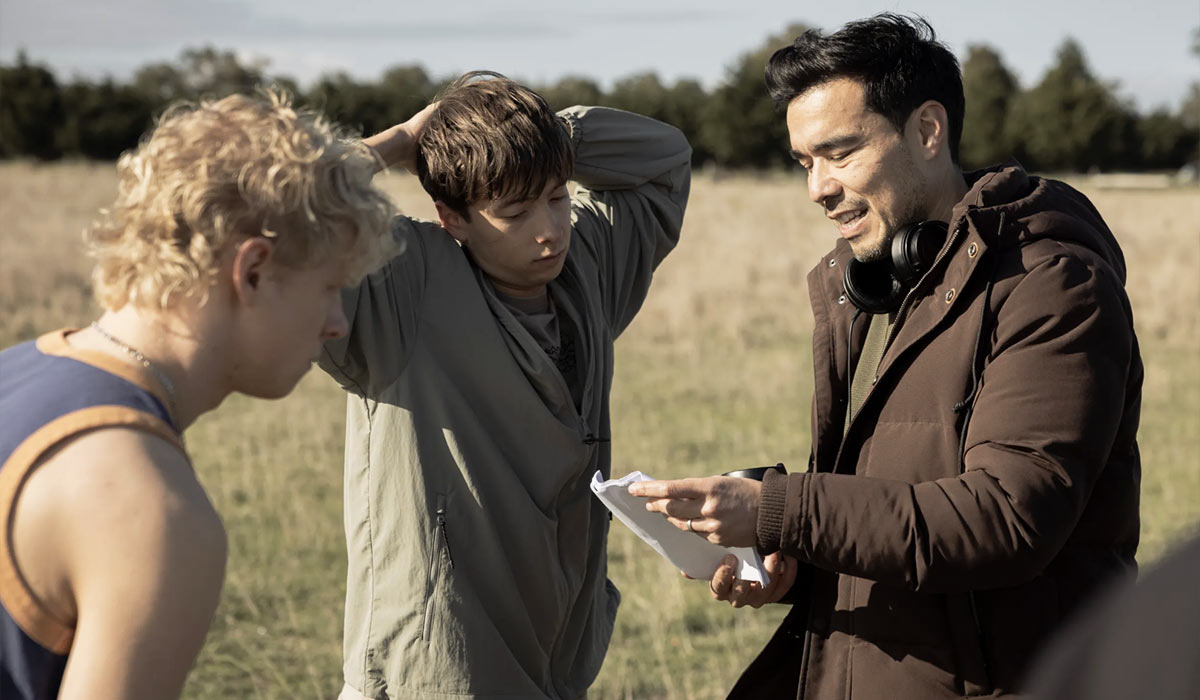
You might have missed the memo, but horror is hot. Horror is dominating the box office. And prestige horror is even hotter. After the success of “Obsession” and “Backrooms” (not to mention “Ready or Not 2,” “Undertone” and “Hokum”), having a buzzworthy horror movie can get audiences, critics and, well, financiers, very excited. Enter the June release of Sundance world premiere standout, “Leviticus.”
The directorial debut of Adrian Chiarella, this Australian supernatural thriller begins with two high schoolers, Naim (Joe Bird) and Ryan (Stacy Clausen), who have something of a mutual spark, but the former is too ashamed to act on it. When Ryan and another boy are outed, his father, a conservative, evangelical preacher, calls in an exorcist to cast the “gay” out of them. As Naim looks on, the two boys think it’s all a performative joke. That is until the exorcist curses them with a horror that is all too real and all too deadly.
Still one of the best-reviewed films of the year, the Neon acquisition had a very good opening weekend, taking in $2.6 million over the weekend and dropping just 7% from Sunday to Monday (super impressive). We’re not sure it can completely pop like the aforementioned “Obsession” and “Backrooms,” but watch out.
Earlier this month, we caught up with Chiarella to talk about his inspiration for “Leviticus,” how nervous he was about finally screening it down under, casting Mia Wasikowska to play the mother of an older teenager (we’re still shook), his numerous inspirations for the film, and much, much more.
This interview has been edited for length and clarity.
____
The Playlist: So, I know “Leviticus” recently screened in Sydney. Were you more nervous to show it at Sundance or to show it back home in Australia?
Adrian Chiarella: I think I was more nervous to show it in Australia, to be honest. I mean, both were incredibly high-stakes screenings for me. Obviously, Sundance not only is Sundance, but it’s one of the biggest film festivals in the world. It was the first time we ever showed it to an audience, so I just had no idea if this thing was going to work or not. But as soon as we got those first quite loud reactions from the audience in the first few minutes of the film, I thought, “O.K., we’re here. It’s all good. We’ve got this.” But at the end of the day, it was more or less a room full of strangers, very meaningful strangers, but it was people I did not know. And so I thought, “Well, if it really lands flat, at least I can just go home and hide. We go back to my life.” But Sydney’s my hometown. That’s where I grew up. That film festival is the film festival that I’d been going to since I was a teenager. I joked when I introduced the film there that I’d been going to that film festival since before they were legally allowed to even sell me a ticket. [Laughs.] I was going in so young. And, on top of that, I felt like so many people from my life were at that screening in Sydney. My family was all there. People I went to high school with were there. People I went to film school with were there. Just a lot of very, very important people to me were at that film, but we got a really great response from all of them. And so that was the one that made me feel like, “O.K., we’re close to reaching a finish to this film.” I feel like I’ve actually completed the film now because not only is it done and all wrapped up, but I’ve actually shown the people I care about.
You’ve seen it then at multiple screenings and multiple continents. What’s the difference between audiences seeing it in Park City, SXSW and back home?
I had this image that Australians are very reserved when they go and watch a movie. And I thought when we played it in Sundance and SXSW, I was like, “Oh yeah, this is what American horror audiences do. They kind of jump out of their seats, and they laugh, and they clap, and they gasp, and all that sort of thing, and Australians won’t do that.” But I was pleasantly surprised to see, “No, no, no.” We got quite a vocal, enthusiastic response from our Australian audiences too. So, that was really great.
You’ve done a number of shorts, but this was your first feature. How long were you working on this script? When did this idea first pop up into your head?
I’d been thinking about the idea for a while, but I actually put pen to paper in the early COVID years, I think around 2021.
You make it sound like it was 20 years ago. It was literally just like five years ago. [Laughs.]
I know, I know, but I don’t know. No, no, no. I mean, I had been thinking about it on and off for a few years before even that, but I was quite lucky because in Australia we have all these amazing state and federal funding programs. So, the project got into something called Originate, which is a program that VicScreen in Victoria, where I live at the moment that they run and it was designed to support original ideas from emerging filmmakers. And so over the course of, I think about two or three years, I got little bits of support to keep writing drafts on that script, and I was able to do that whilst I was doing bits of TV work writing and directing episodic television. And so from 2021 till about 2023, 2024, when Causeway Films, the production company, came on board, I was just working on the script. And then when Sam Jennings and Kristina Ceyton from Causeway started working with me, we spent about another six months just polishing the draft. That was quite an intensive process where they would give me 300 notes on each draft, and I’d work through all of those. I really love working that way though. I kind of love getting feedback and talking about story. And once we had the script in a place that we were all happy with, they got it financed pretty much straightaway. And then we were scouting for locations and going into casting in late 2024, early 2025.
But do you remember when you got the idea for the twist? For the whole concept?
I remember doing a lot of free writing. The reason the idea came up was that I’d seen a lot of regression, a lot of turning back on the rights that we’d fought so hard for in the LGBTQ+ community in the last 10 years. I certainly was feeling that in Australia, and I sensed people were feeling it over here in the US as well. A lot of political conversations and things were coming up where it felt like, “Are we just undoing all these rights that we fought so hard for?” And I wanted to make a film that was a little more personal. So, I started thinking about what homophobia was for me when I was a teenager, and I knew that I turned to a lot of horror movies at that point in time in my life. I discovered when I grew up that I was not alone in that. A lot of young queer teenagers have felt this connection to horror movies. So, I wanted to do a horror movie that explored homophobia as the fear at the heart of it. I’d heard about exorcisms being performed on queer teenagers in cultures all around the world. And so for a while I’d thought, “Oh, what if I’m doing something a bit like ‘The Exorcist,’ but it’s got this queer twist to it? ” And I could never make it work because every iteration just felt like it was perpetuating this myth that they were putting out there that there’s a gay demon inside of you. And I remember sometime in the COVID years, I think it was 2021, I just sat down, and I just did all of this free writing about, “What am I really trying to say? What is this? What are they really doing when they perform these sorts of practices on young people?” I remember writing, “They’re trying to scare us away from how we feel. They’re actually not taking anything out. They’re putting something in. It’s almost like they’re putting a demonic presence into us that is terrifying us away from our desires.” And that’s when I came up with this idea of, well, what if there’s a horror movie monster that looks like the person you’re most attracted to? And once I had that, I was able to start focusing on the other half of the film that I’ve really wanted to do as well, which is a love story between two young characters.
It’s such a great twist, and it’s so well executed in the film, but you needed the two actors to pull it off. How did you know that both these guys could do it? And was there a moment on set where you breathed the sigh of relief like, “Yep, it’s going to work”?
That moment of relief was in one of the casting sessions, one of the callbacks. I did callbacks where I brought in a whole bunch of actors who had all been shortlisted for the roles, and we all sort of worked together and tried different scenes out, and everyone came in for a few hours at a time in lots of different combinations of people. And as soon as Joe and Stacy did a scene together, I think it was the very first scene that they have in the film, which is when they’re looking at the snake. As soon as they did that scene together, I just sensed that there was a natural connection between the two of them. And then I started noticing just when they were taking little breaks in the casting session, and they were just sort of chatting, I was like, “Oh yeah, there’s something here. I don’t need to pretend that there is any kind of energy going on between the two of them. They’re just two guys that get along really well. And when they’re acting, they just have this chemistry that you can’t fake.” And I think my producers saw that as well. And so we just knew straightaway that these are the two that we’re going to have in our film.
Did you have Stacy in the auditions do any of the evil version of his character, or were you confident it didn’t matter, he’d pull it off?
That’s a good question. We did do a little bit, but I think for me, I knew he had the acting chops to pull it off. He’d done quite a bit of television in Australia. And also the thing that made me confident he could do the evil entity was that he responded so well to direction when we were having those casting sessions, and he was able to come up with ideas very quickly on the fly around emotions, around physicality, around all of that sort of stuff. And I knew, “Oh, O.K., this is a guy I can go and spend a little bit of rehearsal time with, and we will figure it out.” So yeah, he gave me a lot of confidence.
Between all the characters in the film, is there one that you think is the closest to you that you relate to?
That’s such a tough question. I mean, sure. It’s probably Joe’s character, Naim. And I think, I don’t know, I haven’t asked Joe this directly, but I suspect he might’ve studied me a bit to play that character.
Oh, well, when I finally talk to him, I will ask him that because I don’t know, but I haven’t seen that anywhere.
But that might also be because Joe is the sort of person who’s really curious and fascinated by people, and I feel like he asked me a lot of questions about my life, but I think he does that with everybody. I think that’s why he’s such a great actor.
Did you come from or were you close to this sort of radical fundamental religious sort of background at all? Did that inspire the story at al?
My parents are atheists, but I did go to a religious school, so I grew up with a lot of that when I was a teenager, and my extended family, there’s quite a lot of religion around. So, we have lots of conversations about that sort of stuff.
Making your first feature, what was the most challenging aspect to you?
I think it’s the change of pace. I think I had gotten so used to the fast turnaround of Australian television and the particular type of problem-solving you’re always going through in Australian television, where you’re not only moving quickly, but you’re also dealing with the sort of logistical nightmare of like, “O.K., well, we can’t have that location. Can we just rewrite that story moment to be in the same location we’re shooting out on this day because we happen to have two hours that we can fit that thing into?” And I realized that even though feature filmmaking still comes with its own set of challenges and is still very, very difficult, it’s a different mindset that you have to use to solve the problems and to really survive the schedule and survive the day, but still uphold the vision. You are shooting a little less per day, but that doesn’t necessarily mean you have more time because you’re just moving at a different pace.
Did you enjoy it more than television?
That’s a really good question. I guess I enjoyed it more only because I haven’t directed anything in television where it was my own idea and my own concept. So, of course I enjoyed this one more because it came from me and it was more personal. I think I enjoyed it more than television also because these were actors that I had personally been involved in casting and so I had actually created these characters from the ground up with them as well.
You already mentioned that “The Exorcist” was an initial influence. Do you feel like there’s any other sort of classic horror films or even films that you loved that also influenced the final product?
Yeah, I always pointed to the John Carpenter version of “The Thing,” which I’d watched as a kid because of that horror movie tension of not being able to separate the self from the other and looking at this person in front of you and having no idea whether or not you can trust them. I really wanted to take that idea and work with that and bring it into this story of queer desire. I thought that could be kind of interesting. Also, as I developed the idea – I know it sounds like a really complete departure from the genre – but I rewatched the Tarkovsky movie “Solaris” because as I developed the idea of this monster, this entity, I figured out that in the second half, the more sophisticated side of it that we would learn about as the film progressed is that it’s going to get better and better at mimicking your desires based off your memories of your experience with the person you’re attracted to in the same way that “Solaris” was sort of about that idea of tapping into the memory of a person that the characters cared about. And so that was something that I looked at. I looked at a lot of horror movies from Japan. I really loved the old horror movie “Onibaba,” which was the first time I’d ever seen a movie that meshed those themes of jealousy and desire and then turned it into a horror movie. I thought that was really cool. And more recent films from Japan like “The Ring.”
And perhaps I’m forgetting because she’s done so much, but I never would have thought that Mia Wasikowska could play this sort of role. How did you know she could?
I mean, I’ve been a big fan of Mia since she was the same age as Joe and Stacy. She’s been acting since she was about their age. And I knew that she’s always, always, even when she was really young, she’s been an actor that holds this quiet intensity and brings the weight of the character on screen without seeing very much at all. And for this role, the film really focuses on the teenagers, and we’re very much watching this story through their perspective. And I knew that [her] character, as important as she was, she’s only going to appear at the fringes of the story, and she’s going to drift in for certain scenes, say a few lines, and then drift away. I had to have someone who would bring all of that history, all of that backstory on screen with her and be able to convey that without saying very much and without appearing for very long. And I just had so much confidence that Mia would be able to do that. I’d never seen her play a mum before.
Talk about feeling old. Nothing made me feel older, be like, “Oh, wow, she’s playing a mom now. Damn.”
And she’s younger than me!* So, I’m kind of like, “God, my feature debut.” And even the mom is younger than me. But I’d seen her, even though she wasn’t playing mothers in some of the recent independent films she did, like “Bergman Island” and “Club Zero,” there was something about those films that made me think, oh, she’s in this phase in her life now where I think we could believe she’s a mom.
*Wasikowska is just 36-years-old playing the mother of a 17 or 18-year-old
Well, I think we’re one of a thousand people around the world who saw “Bergman Island.”
I know.
That’s a deep drop, but I love it.
Because she’s in it, that’s probably why I watched it.
I don’t know if you’ve had time to write anything else or if there’s anything else you had in the back burner, but do you know what you would like to do next if you have the chance?
I mean, Leviticus happened so fast. I mean, we got it financed, and then we were into production, and then we got into Sundance before we finished the film, and then we sold the film before we left Sundance. So, I haven’t really had any sort of downtime to explore, but I do have a few ideas I want to delve into once all of this fun of releasing the film is done. But I do know that I definitely want to keep exploring genre, not just horror, but other genres as well, and keep playing with all of the expectations that an audience brings to those kinds of films and then bringing something personal to them. And that personal element will often involve queer stories, I hope, but there might be other aspects of my experience in my life too.
“Leviticus” is playing nationwide
Follow Gregory Ellwood on Bluesky
Follow Gregory Ellwood on Threads
Follow Gregory Ellwood on Instagram
Follow Gregory Ellwood on TikTok
Sign Up For The Breakdown Newsletter

Editor-at-Large Gregory Ellwood is one of the entertainment industry's most respected journalists and critics. Based in Los Angeles, he's the only current awards expert who previously worked on Oscar campaigns at a major movie studio. Over the years, he has written for the LA Times, Variety, The Hollywood Reporter, and Vox, among others. He also co-founded the entertainment news site HitFix, which spawned a legion of influential Emmy and WGA Award-winning alumni.


