


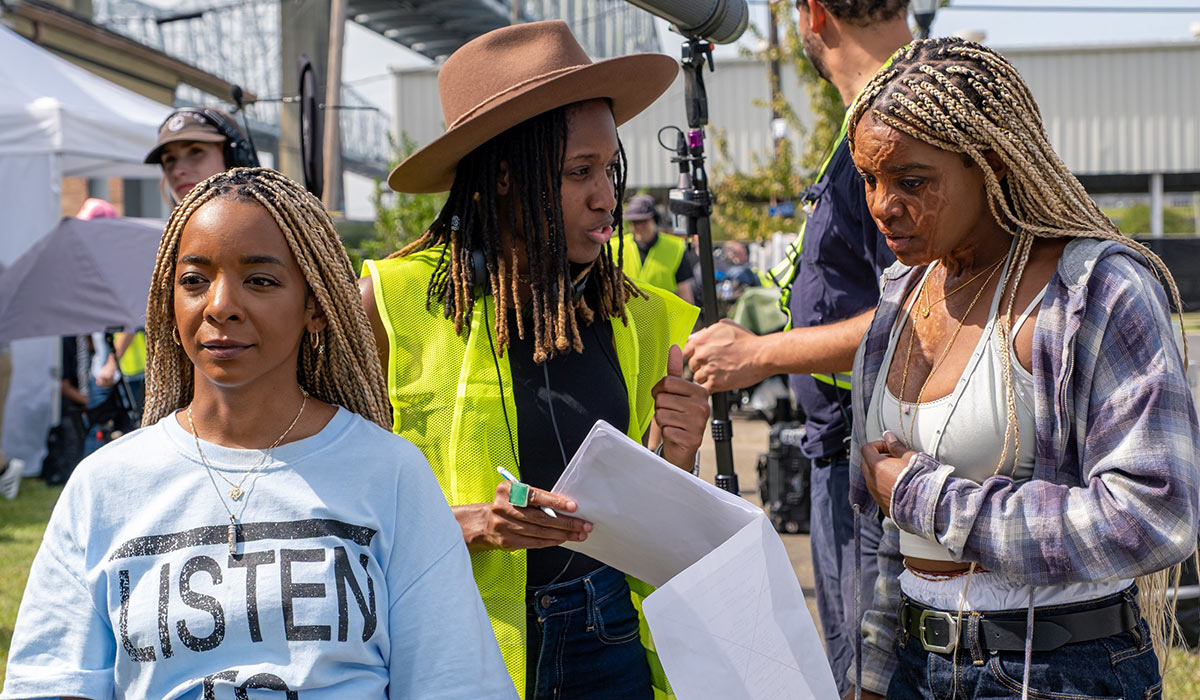
We spoke to Aleshea Harris, the director and screenwriter of “Is God Is,” a few weeks ago. At the time, we wondered why her feature debut, an adaptation from her acclaimed Off-Broadway play, hadn’t screened at the Sundance or SXSW Film Festivals. And now, after a solid but not spectacular week of world premieres at Cannes, we began to wonder if it ever screened for consideration for any of these festivals (it did for one, not the others)? Not all movies need a festival berth to find an audience, but did Amazon MGM Studios, and Orion Pictures make a tactical error by not submitting? Did they misunderstand the potential reception to the film? Considering that it’s one of the most critically acclaimed wide releases of the year so far, they may have.
READ MORE: “Obsession” Review: Curry Barker’s Twisted Horror Debut Turns Toxic Love Into A Grotesque Nightmare
A road trip movie, a quest for vengeance, and a fantastical depiction of generational trauma, “Is God Is” begins and ends with twin sisters Racine (Kara Young) and Anaia (Mallori Johnson). When they receive a letter from a mother they thought was dead, aka God (Vivica A Fox), they journey to her bedside. They learn that, as with Anaia’s face and Racine’s arm, she has also been scarred by a terrible fire. And it was no accident. It was a premeditated attempt to kill God by their father, aka the Monster (Sterling K. Brown). The siblings set out to find him and exact revenge, only to discover he has created an opulent new life for himself. He has a beautiful wife, whom he also abuses (Janelle Monae), and two almost adult twin sons (Justin Ross, Josiah Cross). How Racine and Anaia deal with this unexpected revelation will shock many, but Harris’ vision and thematic justification never wavers.
During our conversation, Harris discusses keeping that signature tone from her stage play (while still making it a movie), the toughest part of adapting “Is God Is” to the screen, and how “people are freaking complex,” and much, much more.
This interview has been edited for length and clarity.
_____
The Playlist: Congratulations on the movie.
Alesha Harris: Thank you so much, Gregory. Nice to meet you.
Nice to meet you as well. Also wonderful to meet a CalArts alumnus. We hide throughout Hollywood. You never know where we are.
We pop-up. That’s right.
Exactly. But anyway, let’s talk about this movie. I’m sure you’ve now gotten this question 300 times already, but did you write this as a play first, or was it always in the back of your mind as a movie, and it became a play along the way?
No, no, it definitely was a play first, and I wasn’t thinking about it being a movie. It’s been really cool to adapt it, but I didn’t imagine even that it would get a production, honestly. So the play is written very much for the reader’s experience. I don’t know if you’ve seen it, but there’s a lot of weird performance of the language on the page, and that’s why I thought, “Let’s just write it for this experience of it, just reading it.”
So who approached you about making a movie? When did this idea even start to gestate?
The play premiered Off-Broadway at Soho Repertory Theater, and it had a really strong response, which is just lovely. There was a buzz. I met with a few people, but I ended up landing with the people who produced the film, Viva Maude, which is Tessa Thompson, Kishori Rajan, Riva Marker, and Janicza Bravo. So really, it was a lot of people who were interested, and it was just a matter of finding the right fit, and they ended up being the right fit.
When you had to begin to envision this story as a movie, what immediately popped into your head as “this” needs to change the most? “This has to be adapted” to transform the story into something else?
Yeah, I think the biggest thing was the amount of language. I think that an audience in a live theater can bear much more talking than in a movie theater. I think in the movie theater, since you have access to a camera, you can really control the viewer’s experience in a different way, and you have greater proximity to intimacy and to people’s faces and micro expressions. I understood that the image needed more space to breathe than I think it does in the theater. And so I needed to kill some of my darlings. Some of the language needed to relax, and the new language had to be, of course, the images. I really considered this, taking the same story, but just adapting it to this medium.
One of my favorite things about the movie is how the twins interact and how you use their dialogue as on-screen text throughout the film. In theory, it might not have worked. Was that an aspect of the stage production as well?
So it was a part of the play, but it was a part of the play because the way that the language dances in those subtitles, the way that there’s a performance of it, that’s what I had in the play, and I wanted to find a way to carry it over. So I brought that way of writing the subtitles over, and this whole thing of them having this language that’s silent to us, but to them, that’s their “twin tuition” is what I call it. That’s a new thing that I found inside the story, so that I could bring that typography over and keep the spirit of that, the playfulness of it. And it opened up a new avenue. People seem to enjoy it in the movie.
In directing your first feature, what was the most challenging aspect for you?
One of my least favorite parts of directing this film was the lack of rehearsal time. As a theater person, I’m used to a lot of time in the room to fail. You fail freely around. And then I also don’t like that it’s also related to rehearsal, that crew would just be staring at us until I learned that I could tell them to go away while we rehearse. [Laughs.] Everybody would just be standing around watching us, and their technical minds are trying to figure out what the blocking will be. But I felt like I couldn’t think, and the actors couldn’t think, and we needed space and a little privacy to let them find that in a limited time. So, that was very stressful, having limited rehearsal time and people sort of staring during those limited beats of rehearsal.
For anyone who did see the original play and then goes to see the film, what should they expect to be the biggest change outside of the visual medium? Did you add another storyline? Is there anything significantly new that wasn’t in the original play?
They’re going to notice that there are two new characters that have a significant space inside the story that just did not exist at all, but I hope they feel organic to the story. They did to me. So yeah, there are two new characters. Other than that, though, the spirit of it, the events are the same. We do learn some more about the sisters. There was a way that I could deepen their story and some of the secrets they kept from one another. But yeah, it’s intact. It’s the same thing.
Are the twin brothers that they meet in the play as well?
Yes, absolutely.
I loved those characters because I thought they were such wonderful mirrors. One of the things I love about Racine and Anaia is that they are their father’s daughters, whether they want to admit it or not. You didn’t have to commit to that. What made you make that choice?
I think that sometimes people, as we know with genetics, they inherit certain behavior, the look, but also certain behaviors. This is a myth. I think the register of this is not realistic. I’m playing with something else. The sort of magic when a character looks at one of the twin women and says, “You have a look like your father.” The way that we could breadcrumb that throughout the story, I just thought, was a lot of fun. And it’s a more interesting story. To have this complexity of being people who’ve been harmed and have maybe inherited the very DNA of the person who harmed them the most, I think, is a delicious irony and thing to play with. Also, it’s true to life. People are freaking complex.
This is your directorial debut, and the film has such a striking and confident tone. Not many first-time filmmakers can pull something off like this. How did you bring that to the set?
I think it was just about communication. For one thing, I think it gave me a lot of confidence that I know this place so well, and I’ve seen other people perform it. I’ve heard the language. I know it up and down, and I know it can work. I know the tone is tricky, but it can hold as long as there’s tremendous attention to detail from the costume designer, the production design, how are we hitting, again, that mythic register I’ve said to people we’re like three clicks to the left of realism. So, how do we achieve that in every frame? So that’s what I think it was. Just being very intentional and specific. And then there’s a lot you can do in post to shape things up, and the music helps, the sound, and the color grade. There are so many tools at our disposal to keep a hold of that. And a lot of it, though, is in the writing. It’s in what these people read, the heads of department, they read it, they know that there’s a mashup, they know there’s a weird thing. I’m trying to do drawing from many buckets in terms of genre, and they’re on board with it. So it’s like, I already have people who are rooting for it. They themselves are thinking through, “How can we achieve this tone?” I’m talking to the actors. It’s just me running around and making sure everybody understands what’s going on. And then also in post, having a tremendous editor, and I’ll put our brains together so that we can honor the tone of the movie.
The characters appear to be in contemporary clothing, especially when you see Janelle’s character and her sons. On the flip side, no one has a cell phone that I can remember. I do think there’s a moment where one of the characters says he’s going to make a call, but you never see him use a phone. Did you want it to seem timeless for the past 20 years or longer? What was the choice behind that?
Yeah, that was very intentional. I thought a lot about time. It feels like a version of the present, but also very, very old. I think that doing that allowed me greater space in terms of – again, I hope I don’t sound annoying – but of the register of it. Where are we in time and space? I generally don’t like to name a specific town if I can get away with it. Even with the play, I name a bunch of states. They’re going to the South, and I’d have them name eight different states to mythologize it, to give it an epic quality and to give it a size, a size up. And I think sometimes when you’re specifically non-specific, it just gives you breathing room, and it indicates to the audience that they shouldn’t treat this like realism.
I wanted to ask, since I have not seen the play, is the ending the same?
Well, no, no, no. I’m so sorry. The very end of the play is different. All of the events you see in the movie are there, but there’s more after that that is not in the movie that’s in the play.
The key event that I will not spoil…
I think I know what you’re talking about. That’s absolutely the same, and I wanted to keep it. People tried to talk me out. I was like, “No, no, no.”
Without giving it away, why did people try to convince you to drop that? What was the justification?
I think that their justification was that people wouldn’t be able to handle it, that there needed to be a different feeling at the end of the movie. Maybe they were thinking about viability, commercial viability, which I can’t worry about. That would make me a terrible writer. So yeah, so I really stuck to my guns. I remember someone being like, “What if that thing doesn’t happen?” And I was like, “That’s not the same story.” I don’t want to spoil anything, but there are things that a character needs to have happened to them to have their full arc.
Since “Is God Is,” you’ve written other plays. You had a play produced a few years ago that was a finalist for the Pulzer Prize. Do you know what you’re doing next? Is it another play? Or have you been bitten by the movie bug?
I’m just a greedy woman, so I feel like this has expanded my sense of what’s possible. I absolutely will make another movie if someone else gives me the opportunity. I have a play that’s going to go up next year. And in a theater in New York, I have another play. I have plays just hanging out [Laughs]. And I am also working on a TV show.
“Is God Is” is now playing nationwide.
Follow Gregory Ellwood on Bluesky
Follow Gregory Ellwood on Threads
Follow Gregory Ellwood on Instagram
Follow Gregory Ellwood on TikTok
Sign Up For The Breakdown Newsletter

Editor-at-Large Gregory Ellwood is one of the entertainment industry's most respected journalists and critics. Based in Los Angeles, he's the only current awards expert who previously worked on Oscar campaigns at a major movie studio. Over the years, he has written for the LA Times, Variety, The Hollywood Reporter, and Vox, among others. He also co-founded the entertainment news site HitFix, which spawned a legion of influential Emmy and WGA Award-winning alumni.


