




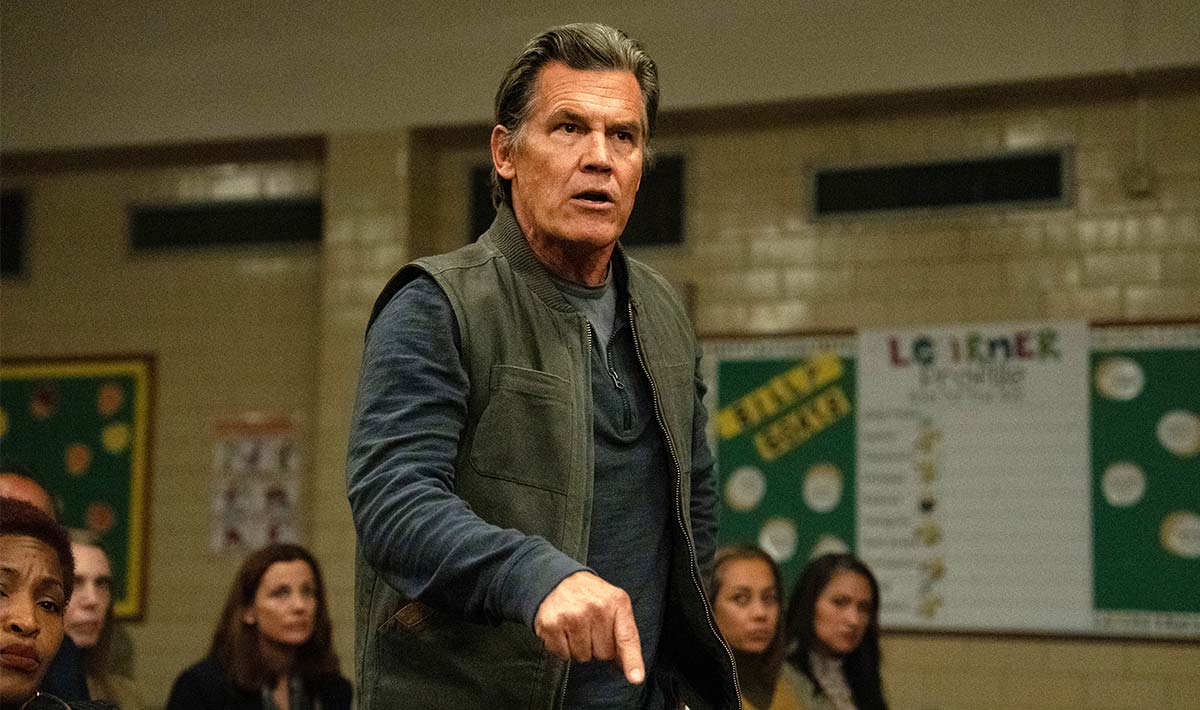
Josh Brolin needs no introduction. Whether playing a rebellious big brother (“The Goonies”), a husband with a target on his back after taking something that doesn’t belong to him (“No Country for Old Men”), or a universe-decimating self-proclaimed God (Thanos in the Marvel Cinematic Universe), Josh Brolin has made his name iconic with a gravelly gravitas and patient, brooding humanity in both his most realistic and fantastical roles.
Brolin’s latest project is the mystery horror “Weapons,” from “Barbarian” writer and director Zach Cregger. After all but one child from Justine Gandy (Julia Garner) ’s classroom mysteriously disappear in one night, leaving the community questioning who – or what – is behind the children’s disappearance, Archer Graff (Brolin), the father of one of the missing children, is left grappling with a potential tragedy while trying to find his son. We sat down with Brolin to discuss his role as Archer and some of his other upcoming projects.
I noticed you were an executive producer on “Weapons.” While not as involved as a traditional producer, it indicates an added level of interest and investment in the project beyond simply taking another role. What about “Weapons” compelled you to take an added interest on a production level?
Having produced enough films where I was developing the film or involved in the movie, whether I acted in the film or not, or to find somebody else, like in “George & Tammy,” this was a different thing. This was for a specific budgetary reason, negotiating, and saying, ‘Okay, this is a film I want to invest in. This is a film that I want to be involved in.’ Knowing that, it’s once removed, because an EP takes less money up front, having ownership of the movie itself. It was a negotiational thing, but it had to do more with investing in Zach than anything, and hoping – and not knowing, by the way, because “Barbarian” was so good, but you don’t know if that’s a one-off – that he’s gonna be able to follow it up. But I think “Weapons” is ten times more refined than “Barbarian,” and I believe what Zach’ll go on to do will be even more special.
I just spoke with him, and that was something we talked about. “Barbarian” was incredibly confident, but the way he wove multiple POVs together in “Weapons” felt effortless. It’s a degree of confidence you rarely see from filmmakers early on in their career.
Yeah. I was talking to somebody earlier about two people: Guillermo Arriaga and Alejandro González Iñárritu. They used to do the nonlinear, intersecting timelines. Christopher Nolan used to do it too, you know, early on with “Following.” It was always something that I was really interested in. So when I read “Weapons,” I hadn’t read something like that for a long time. I thought it was really well done, really well-designed. And then it just went from there. I hadn’t seen “Barbarian,” but I had known about Zach. I hadn’t seen his sketch comedy, which I have now. I thought it was brilliant.
You write in a nonlinear fashion with your memoir. You connect events emotionally rather than chronologically. Is that writing style what made you want to do “Weapons?”
It’s not necessarily the style of writing. It’s the cosmetics of using, because I know my life and whatever’s in that book, the shock or the extremity or the extremes of my mother’s behavior. But, if you can match that with some emotional value, and it’s an excellent line you’re walking, it’s not just well-written visuals. To me, that’s Zach. He’s used a genre exhausted cosmetically and brought us something from his grief. I don’t know if he told you this, but every character in “Weapons” is based on his reaction to somebody he lost, which I thought was amazing. He’s already bringing a depth to it.
This is fascinating because I found the film to be a potent commentary on not just school shootings but also a culture that inhibits our ability to find solutions and catharsis.
And that’s deep enough, talking about school shootings. That’s already enough of a conversation, but the fact that it comes from something personal to him? The most outstanding filmmakers I’ve known in the 41 years or whatever I’ve been doing this, and the movies I respect the most, are usually from visionary filmmakers who are technically proficient, but also a very emotionally alive self. Do you know what I mean?
Totally. Like your work with the Coen brothers.
Well, the Coens have no emotions, but yeah. (laughs)
I felt a bit of their influence in “Weapons.”
There’s absurdity, yeah. They realize how absurd life is, that’s how I see it anyway, and it’s like, we go through the circus and then we get to the end, and hopefully you have a chuckle, and if you don’t, it’s a bummer, but you deserve to chuckle if you live it fully.
I remember on the Graham Bensinger Podcast, you recounted something Anthony Hopkins once told you about nature vs. nurture concerning community and parenthood: “We have this programming, we’re edgy and angry. Left to its own devices, who we are can be the most destructive, hurtful thing imaginable, but given a few tools and directed in the right way, we can be the most productive people imaginable.” After seeing “Weapons, I think it really speaks to the conflict at the heart of the film. How do you feel your performance in the film embodies that?
We all get in our own way, and how do we get in our own way? The great thing about the Hopkins quote, when he said that to me, was that we’re the same person. I always felt broken and needed to be somebody else, but it was like, no, I’m still the same person. It’s just behaviorally doing this, or doing that, and how do you do the right thing instead of the wrong thing? I remember when I was doing “The Hollow Man,” the Paul Verhoeven movie, the invisibility. Would you naturally lean toward doing something sketchy, or would you lean toward some, you know, beneficent thing? I always thought that was an interesting question. So with this, it’s a lot of people getting in their own way, their own chaotic way, and I think that’s my character until he finally loses something, and realizes how emotional it is for him. Does he start to open up and realize the diamond of the gift he’s been given, which is his kid? Maybe.
It’s the antithesis of who you are as a father, very loving and present in your kid’s life, whereas Archer is filled with regret about not showing that love.
That’s why you do a film like this selfishly, because psychologically, you want to keep confronting things like this, to remind you what you don’t want to be. I’m not gonna say I ‘hate’ it, but this staunch masculinity, I get very sickened by, and the most masculine guys that I know, the toughest guys that I know, are the most emotionally available. God, I know a guy who just passed the day after Christmas. He was a Delta Force guy, and he’s been in 250 firefights and died in a car accident. His son was in the car with him; his son lived, but he didn’t. Survived by four kids and his wife. He was that guy—a fantastic human being.
There’s no easy segue out of that, but I want to touch on some of your other upcoming work. I’m really looking forward to “Wake Up, Dead Man: A Knives Out Mystery.”
Me too. I haven’t seen it yet, but I’m reading it. Rian Johnson is one of the best writers out there.
You also have “The Running Man” coming up. What was it like working with Edgar Wright?
Amazing. I mean, I’ve always known him. It got to the point where I’ve known Edgar for so long. We’d never worked together. We’d always look for something. I saw him on the set of “Knives Out” because he’s friends with Rian, and every time we see each other on a set, I’d always grunt when I’d look at him, like ‘Ugh’. And that was every time for 20 years, and then I got offered that role, and I was thrilled to do it with him, because I like him a lot. I think when Edgar hits, when he does something well, he does it very well, and he’s also a unique filmmaker.
On your collaborations with Denis Villeneuve, I could ask about Dune Part Three, but I’m actually interested in Bond 26 because your dad auditioned for Bond back in the day.
I just told somebody, ‘Oh, did you know, my dad was almost Bond?’ That is one of my favorite things. And he got it! He got the role, and then Roger Moore returned at the last second and said, ‘I’ll do it.’ Maybe it was a whole negotiational technique to get more money, but yeah. Wild.
Would being a part of Bond under Denis’s direction appeal to you?
I didn’t even have to read “Dune,” even though I knew the story, to wanna do it with Denis; Denis is it for me. We have a very close relationship; he’s a stellar filmmaker. I like working with people I like and who are stellar filmmakers. So I have that with him, and I’m fortunate. So wherever Bond goes, it will go.
“Weapons” hits theaters via Warner Bros on Friday, August 8th.


