


Wry, clever, thoughtful, and deceptively light in its approach, “Late Fame” is a low-key movie about an exceedingly modest degree of fame. Even its title carries a gently sardonic edge: the attention bestowed upon Ed Saxberger (Willem Dafoe), a forgotten New York poet who has spent nearly four decades working at the post office, barely qualifies as celebrity. Yet even this tiny burst of recognition unsettles a man who thought he had made peace with being forgotten.
The disruption arrives in the form of Meyers (Edmund Donovan), a young poet who appears at Ed’s door clutching his long-out-of-print collection and declaring it a neglected masterpiece. Initially skeptical, Ed is ushered into a coterie of twentysomething writers and performers who treat him as a rediscovered genius—the missing elder statesman of their downtown literary salon.
Their adoration is theatrical, intoxicating, and ridiculous. Ed recognizes the absurdity but is hardly immune. Their attention does not exactly rekindle his desire to write: he tries, but inspiration proves elusive. Their praise revives not a buried vocation but the possibility that his life—and poetry—might have amounted to more.
READ MORE: The Best Films Of 2026 (So Far)
Directed with remarkable delicacy by Kent Jones, “Late Fame” understands how easily validation can disturb an identity built without it. Working from a wonderfully sly screenplay by Samy Burch (“May December”), Jones adapts Arthur Schnitzler’s novella, relocating its portrait of Viennese literary society to contemporary downtown Manhattan, where inherited money, artistic posturing, and nostalgia for a bohemia its young inhabitants never experienced uneasily mingle.

The buildings and streets of old New York remain, but their meaning has changed. Jones mourns the conditions that made an artistic life possible; the city’s shell is now available to anyone wealthy enough to wear it as a costume.
Meyers and his pretentious, anti-technology friends see themselves as radicals preserving a dying literary tradition. In reality, they are blue-bloods masquerading as bohemians, free to pursue poetry because money has spared them practical demands. Yet their enthusiasm is sincere: they want to make something meaningful and are moved by Ed’s work.
That tension gives the film’s class critique its richness. Jones and Burch observe the advantages wealth confers without disdain: famous parents are unnecessary when money provides time, connections, and insulation from failure. The film gently ribs these artists for romanticizing struggle from safety while respecting their aspirations. Whether their commitment could survive rejection or economic insecurity is another question.
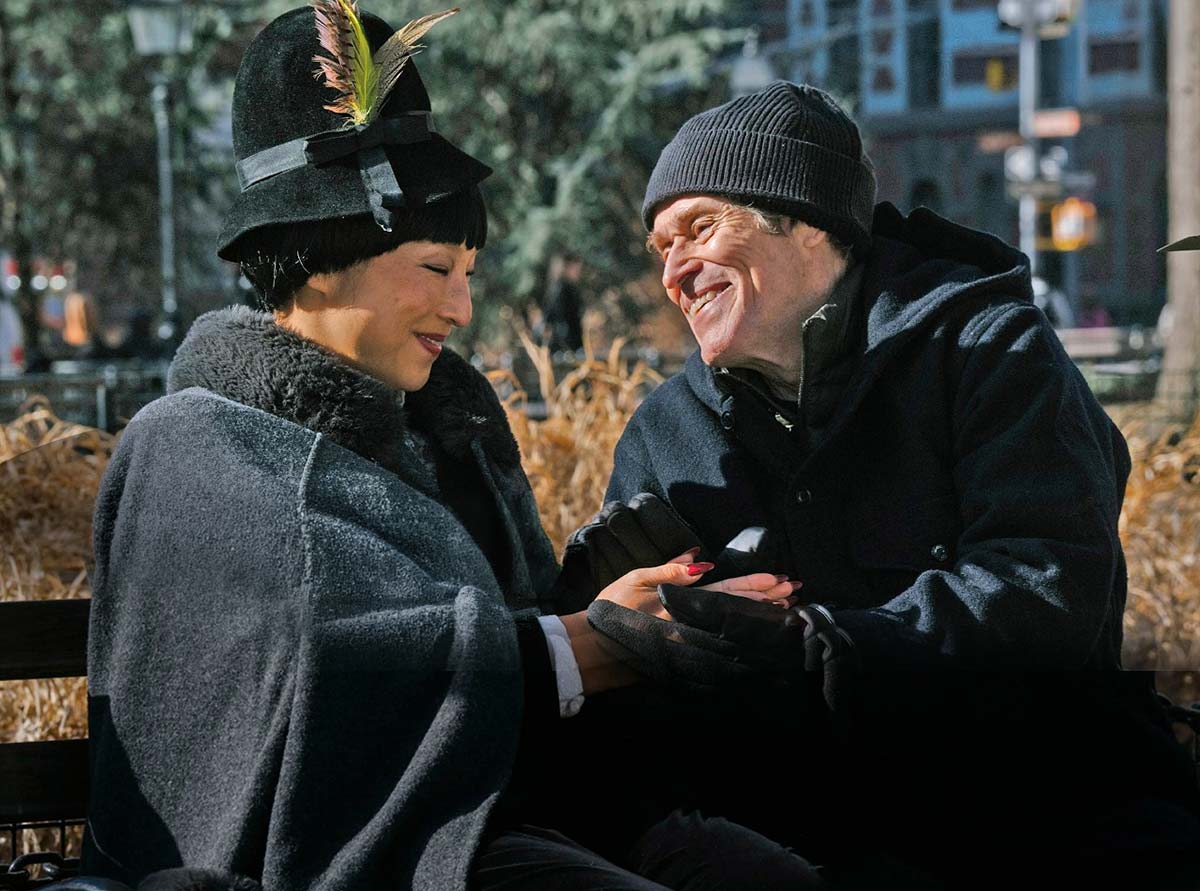
Gloria (Greta Lee), meanwhile, emerges as Ed’s closest kindred spirit. The group’s resident tragedienne, she sings Kurt Weill and turns every room into her private stage. She initially appears to be its most extravagant poseur, but Jones and Burch gradually reveal her theatricality as armor against insecurity and a painful private existence.
Jones never reduces Gloria to victim or manipulator, although she is both. She performs freedom while living without much of it, and Lee moves beautifully between allure, vulnerability, and calculation without announcing the transitions. Ed recognizes the seriousness beneath her affectations, and it does not hurt that he is enamored with her flirtatious attention. Burch’s script keeps their attraction productively unsettled, mingling desire, mutual need, self-interest, and genuine tenderness.
Dafoe and Lee are complementary: her energy spills outward while his remains contained, but each exposes the uncertainty beneath the other’s surface. Their scenes reveal Ed’s more complicated susceptibility—not necessarily to becoming a poet again, but to being regarded as one. Dafoe locates the contradiction precisely: Ed is skeptical of the group’s affectations yet pleased by its approval, resistant to writing yet reluctant to relinquish the identity its attention offers him.
Meyers eagerly converts that ambiguity into the narrative of a comeback. When Ed tentatively considers participating in a reading, Meyers announces his involvement as settled. Similarly, a discussion about another poem becomes a promise of new work, while the suggestion that Ed record his memories mutates into an expected memoir. Burch lets these distortions accumulate until enthusiasm begins to look opportunistic, particularly when Meyers pitches Ed to his publisher friend.

A fabulous discovery, Donovan allows Meyers’ coerciveness to emerge from the excitement that made him endearing. Jones and Burch never recast him as a villain; he believes he is helping Ed. But his generosity reveals self-interest, and his reverence shades into possession. Jake Lacy makes a pointed appearance as the publisher—another perfectly calibrated Lacy douchebag whose affluent history with Meyers illustrates the closed circuit of access sustaining this rebellious community.
By then, however, the adulation has begun to change Ed. In one deliciously observed scene, his longtime barroom friends discover his poetic past and tease him over a game of pool, prompting a mild tantrum and sudden flare of self-importance. Jones plays the moment as gentle comedy, while Dafoe exposes how eagerly Ed has begun protecting this newly restored image of himself.
Ed’s eventual disillusionment does not arrive through one enormous betrayal. Small presumptions, evasions, and disappointments gradually clear his vision, and Dafoe expertly navigates every shift. A wary glance or momentary hesitation conveys Ed’s growing recognition that the group’s version of him may be no more authentic than its performed bohemianism.
Yet Dafoe preserves the ache beneath that realization. The group’s devotion was not entirely false, and Ed enjoyed being seen. His pride and susceptibility to Gloria reveal that he is as flawed and hungry for affirmation as anyone else. He may be unable—or insufficiently motivated—to resume writing, but he savors the idea that he could. Dafoe holds pleasure, embarrassment, vanity, and doubt together, giving Ed a complexity the film wisely refuses to resolve.
There are no explosive confrontations or grand declarations. Dafoe charts Ed’s passage through pauses and flickers of amusement shading into discomfort—a restrained performance built around what Ed cannot admit, even to himself. The filmmakers meet him at that register, threading contradiction through the drama without underlining it.
Jones finds humor in the group’s pretensions without reducing its members to caricatures and remains protective of Ed without sentimentalizing him. Everyone in “Late Fame” is reaching for a more appealing story about themselves. The film is compassionate toward that need even as it strips away the varnish.
Miraculously, there is little conventional plot and almost no overt drama, yet “Late Fame” utterly captivates. Its conflicts live in minute shifts of perception: esteem begins to feel patronizing, generosity resembles control, and Ed’s pleasure in being recognized reveals itself as something more complicated than renewed artistic purpose.

Additionally, a bittersweet longing runs throughout—for a vanished New York, artistic purpose, youth, and unlived lives. Gloria aches to become the liberated figure she performs, Meyers wants to will a literary movement into existence, and Ed is content to wonder whether history underestimated him without proving it wrong.
What he finds is neither triumph nor despair but the consolation of seeing clearly. His unassuming life may lack the romance of Meyers’ salon, but it belongs to him. It was earned and lived rather than curated for an audience. His encounter with late fame cannot restore the past, but it helps him recognize the dignity of his present.
Wryly attuned to artistic pretension yet compassionate toward those caught up in it, “Late Fame” needs no grand catharsis. Naturalistic, funny, and melancholy, it questions its characters’ integrity while retaining an uncommon integrity of its own. [A-]
“Late Fame” is now in select theaters and expands nationally on August 14.

