


If Steven Spielberg had to make “Jurassic Park” with the same budgetary and creative constraints that forced him to make “Jaws,” it might look something like David Robert Mitchell’s “The End of Oak Street.” Check the balance sheet, however, to see that Warner Bros. chiefs Michael De Luca and Pamela Abdy forked over $85 million to a director whose last film bombed at Cannes and only played in two theaters. This could well be the most remarkable bet by the studio heads on their legendary run of bankrolling ambitious original stories.
READ MORE: 53 Must-See Films To Watch Summer 2026
Yet despite the grander canvas and expanded creature budget, “The End of Oak Street” represents a back-to-basics effort for a director whose breakout “It Follows” led the vanguard of so-called “elevated horror.” Mitchell avoids lazy pastiche or homage in his ‘80s-set adventure romp, although he does not necessarily advance or tweak the genre in any meaningful way. The biggest surprise in a film full of dinosaurs that sneak into the frame might be just how straightforwardly events unfold.
“The End of Oak Street” opens with a “Twilight Zone”-style premise burgeoning in its idyllic suburban enclave. Michelle does not overdo the setup with nostalgia or schmaltzy signifiers to set the scene. Instead, a simple street fair on the Platts’ cul-de-sac provides the expository details for how a nuclear family has begun to fray.
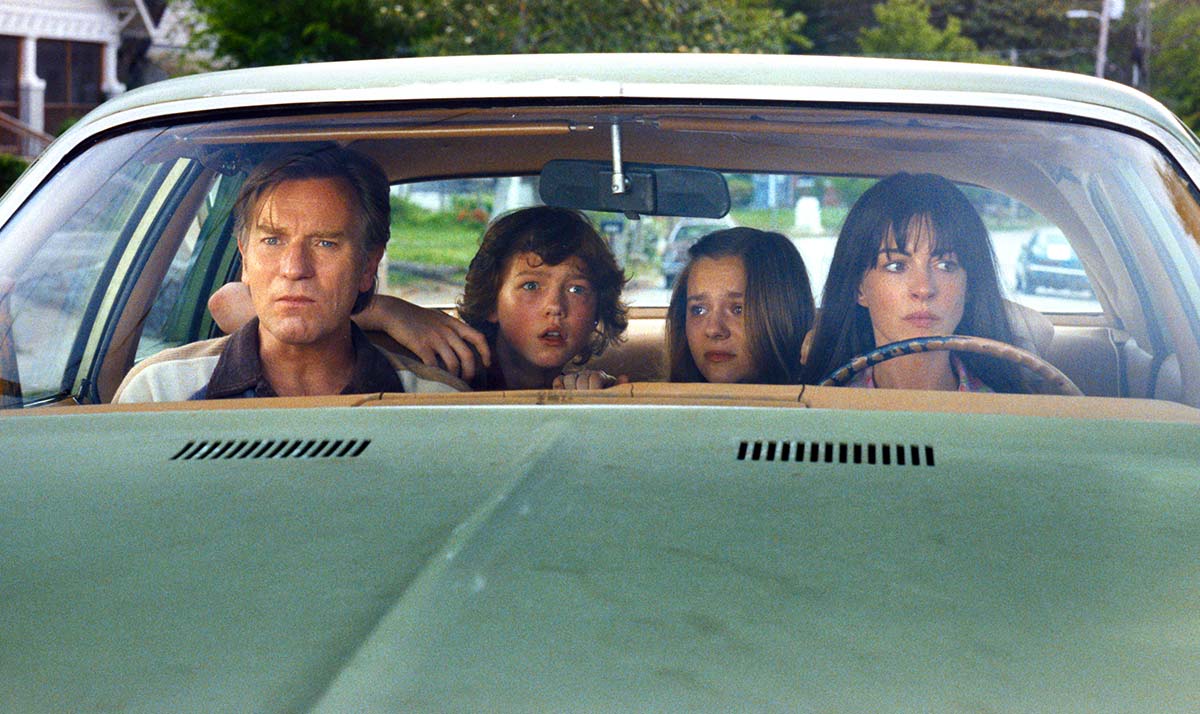
Patriarch Greg (Ewan McGregor) struggles economically and psychologically to hold down a job, straining relations with his wife Denise (Anne Hathaway), an aspiring writer who counts on his financial stability. Meanwhile, their kids Audrey (Maisy Stella) and Brian (Christian Convery) each flirt with teen rebellion as the parents’ tension trickles down. But all those quarrels between the foursome quickly become moot points when a burst of light in a rainstorm zaps the electricity and transports their neighborhood back to a time and place when the dinosaurs freely roamed the earth.
If this is a metaphor – for ecological destruction, for the vengeance of the past, for Reagan-era America – no one talks about it as such. Apart from a brief discussion of how the physics of the cosmic event might work with the Carl Sagan devotee daughter Audrey, everyone is too busy in fight-or-flight mode to contemplate what the dinosaurs “mean.” When these Mesozoic menaces can stomp, slither, swim, and soar, their survival becomes an all-hands-on-deck situation with their limited arsenal of defensive weapons.
The action in “The End of Oak Street” plays out with the same directness as the Maxwell House ad that adorns an analog television screen in the film. Mitchell structures the story around a series of escalating confrontations and escapes from the dinosaurs. They usually progress similarly: a new creature emerges (usually by surprise), places the Platts in peril, and forces them to be ingenious to wriggle out of the threat. Time and again, Mitchell lays his cards on the table for what an audience can expect to happen – and then pays it off predictably but pleasingly.
“The End of Oak Street” is borderline episodic, although the film’s thrills never feel monotonous or schematic. Much of that propulsive energy sustained across the 99-minute runtime comes from Mitchell’s ingenuity in staging the scenes with cinematographer Michael Gioulakis. This is quite the showcase on how to make a lot from a little with simple tricks in staging and composition to maximize visual storytelling. They maximize every inch of the frame for suspense and silliness alike, nestling many beautiful moments in the background of shots for eagle-eyed viewers to spot.
All that is to say: “The End of Oak Street” is a film that’s good enough to wish it were a little better. The fault for this lies not entirely with David Robert Mitchell, however. That lies more with a system that produces so few non-franchise films operating in this blockbuster mode that it foists outsized expectations on a simple story.
For one, Mitchell’s supremely assured eye for dazzling detail can occasionally derail into disconnected, showy moments, like a split-diopter-filled family conversation. (And it has equivalents on the writing level, too, with scenes like Audrey’s private karaoke in the car to Steve Winwood’s“Valerie.”) But the bigger issue is that his knack for tonal control trails his penchant for visual vision in “The End of Oak Street.” This is a film that can careen deliriously, though often delightfully, from sincerity to shock and even outright sicko mode.
The entire cast, especially the shotgun-toting Anne Hathaway, proves incredibly game to play whatever the scene requires. Leave it to a generationally talented actress to figure out the convincing reactions to dinosaurs engaged in both killing and coitus. (Yes, that last part is correct.) One moment in particular seems destined for meme-ified infamy thanks to Mitchell’s willingness to commit to one of the most demented deaths in recent studio filmmaking.
At once tender and trolling, “The End of Oak Street” provides a kick in the teeth that can still inspire a wide-eyed, shit-eating grin. It holds together through a patchwork of craftsmanship and chutzpah, even if its originality and ambition leave a little to be desired. Now that David Robert Mitchell has demonstrated his credentials once again, it’s time for another deep-pocketed financier to step up and give the director a chance to get fully back in his “Under the Silver Lake” bag! [B]
“The End of Oak Street” opens in theaters on Friday, August 14.

Marshall Shaffer is a freelance film critic and journalist based in New York. In addition to The Playlist, his byline can be found at sites including Slant Magazine, Decider, Crooked Marquee, and Men's Health. He is a member of the Critics Choice Association and New York Film Critics Online.

