




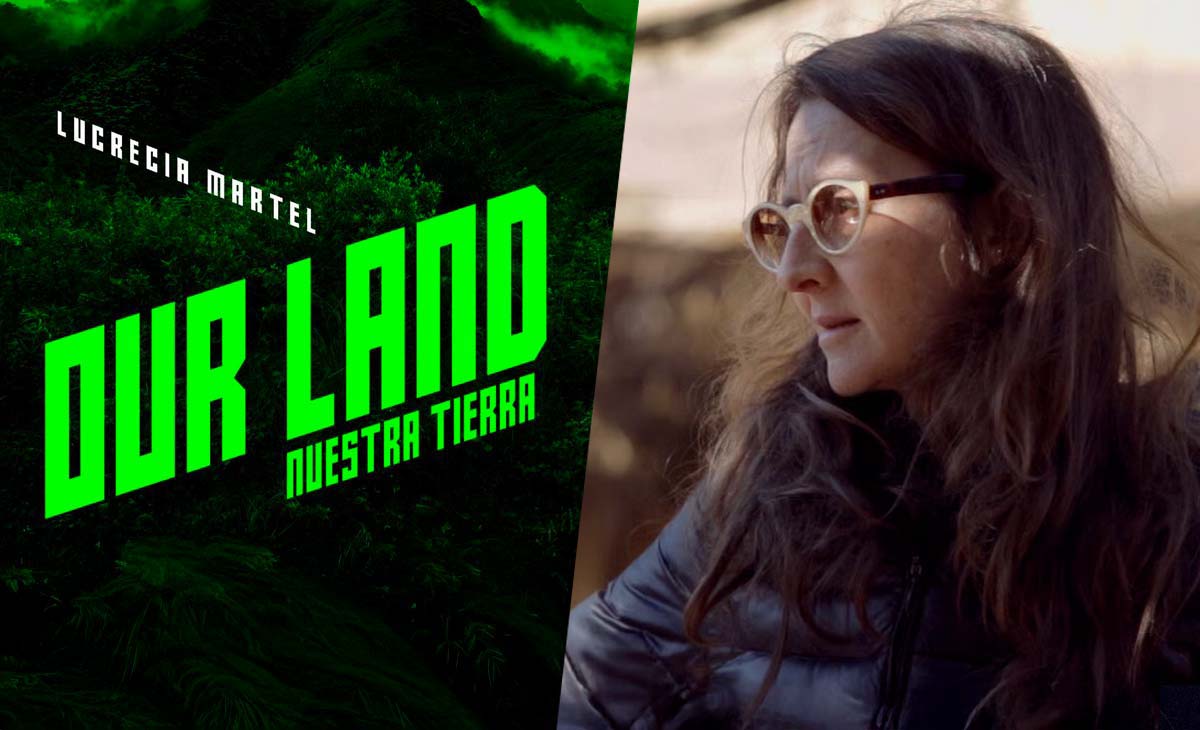
Revered Argentinian filmmaker auteur Lucrecia Martel has only made five features in the 38 years since she began writing and directing films in her home country. The first three—released during her most productive period between 2001 and 2008—established a profound and unified trajectory of style and narrative: original, semi-autobiographical fiction films, shot up close and personal, that follow the lives of women and schoolgirls haunted by mundanity, malaise, medical professionals, and deadly distracted driving.
With her fourth, “Zama” (which came nearly ten years later, after a battle with uterine cancer), she took a new direction: her first adaptation, her first period piece, and her first film about a man—an 18th-century Spanish colonial officer who waits in Paraguay for a transfer to (and better life in) Buenos Aires. For her fifth, which has arrived nearly another decade after “Zama,” she takes on a new direction yet again. “Our Land” marks Martel’s first documentary feature and, perhaps, her first plunge into tangible hope for the future, a tenet severely and intentionally missing from the rest of her oeuvre.
Entangled in the trial of a northern Argentinian Indigenous community known as the Chuschagasta, Martel traces the Javier Chocobar murder case at the center of the trial and the plagued history of the Chuschagasta, whose land has been stolen from them time and time again since 1807, despite constant attempts to go through the proper channels to establish the territory as their own legally.
Ahead of the film’s U.S. release, I sat down with Martel to discuss the nature of documentary filmmaking, the breathtaking camera techniques that define “Our Land,” and the avant-garde approach she took in crafting a true crime documentary that feels both fresh and entirely outside of the genre’s limits
This is your first documentary. Why did you decide to make a documentary, and why did you choose this story specifically?
When I started this, I never thought I was making a film or documentary. I think that decision came about when I knew that what I wanted to do was create an archive for the community. I wanted to create an archive of the judicial and historical materials that my team and I had researched. And also the community materials we had received: photographs and other documents. And in that process, I realized that the best way for me to help was to make this movie.
How did you come across the story in the first place, and what was the level of publicization of the trial in Argentina?
None. The trial was not relevant in Argentina. It happened only during those days and only in the very local media in Tucumán, so it didn’t actually reach many people in Argentina. There was never any political debate around it or anything like that.
How did you learn about it?
I was actually looking for material for “Zama,” a film I had already begun, and I came upon this video. I remembered that I had seen it before, and as I was searching and doing a little more research online, I got in touch with the journalist, and he put me in touch with the community.
At any point in your career, had you considered making a documentary before?
Yes, but honestly, I never thought these two mediums were that different. I never saw it that way. What is different is the production process. It’s very different for the two. And, of course, in a documentary, our characters continue to live with the pain and joy depicted in the film. But in terms of the narrative process, I don’t find them very different.
What are the biggest differences in the production process?
The first thing is that the consideration of time is very different. You don’t get to decide when things happen or in what time period. Producers would tell me, “Okay, but… isn’t it time we close it off?” But I felt like we still didn’t have the elements we needed to close the narrative. In a fiction film, the production decides the order of events. But in documentaries, the research itself decides what that construction looks like. In that sense, a documentary is very difficult to manage within the industry, especially a documentary like this. I feel like the process kind of works against this type of production.
Do you think of the film as “true crime”?
I understand why it could be seen that way. The trial gave us a type of chronology and order, and particular insight into the construction of truth. But I don’t identify myself within that genre, no.
My next question was going to be about the conventions of “true crime” and whether they were on your mind at all during production, but it sounds like they weren’t?
There was a lot of information in the film that was not in the trial. I feel like true crime plays with what the spectator knows about the trial, and most of the information we have here comes from outside the trial.
In the first sequence, we’re looking at the Earth, and then we start to see satellites floating above it. Then, we move down into the Argentinian countryside. It’s a stunning opening. Why did you decide to start that way?
While editing, I would go back and forth between where I lived and where I worked, and during that time, I would listen to a lot of these local bands. I was listening to the song “Misa Criolla,” which was composed by Ariel Ramírez and sung by Mercedes Sosa, and is something that identifies a lot of the type of Christianity that the community is a part of. Because this is a Christian community. So I thought this music was very relevant to Christianity, and I wanted to show, by starting with the planet, that this issue plagues the entire planet. I wanted the spectator to be able to associate it that way. And for the Argentinian ear, the music of “Misa Criolla” sung by Mercedes Sosa—they know that is an Indigenous voice. So I thought that added an interesting complexity to the opening scene.
Where is that satellite footage from?
It’s from NASA, and it’s free.
Did you have to go through a lot of NASA footage?
Gabby, someone from our production team, acquired everything that NASA provided for free, and we went through that to decide.
Was it a long process?
It wasn’t too long, because there wasn’t a lot that was available for free.
The drone footage is remarkable, and it operates both as a brilliant technique and a thematic overlord, especially when it starts to whip its head robotically or when it gets defeated by a bird. Why did you decide to use drones, and how early in the process of making the film did you know you were going to use them?
The idea came to us when we saw the police using drones for crime reconstruction, and we thought it was really absurd, because you would think that for a reconstruction, you would really want to be on the ground. But after looking through the material, we decided to use those visuals alongside the community’s voice. We also thought it was important to make sure we knew this was a machine filming, and we didn’t lose sight of that as we used these.
How much of the drone footage is the police’s and how much is from the production?
We used the police footage from the reconstruction and what they filmed there with their drones. And then we filmed about 26 hours of drone footage, just traveling throughout the territory, not with a specific scene in mind, but rather exploring the territory with the drone, thinking about the stories the community had told us.
Drones have been so poorly used lately. Drone footage has become a staple of bad Netflix movies these days. Were you at all concerned that the drone footage would come out poorly?
The truth is, I wasn’t too concerned about that. I was more concerned about making mistakes in other things than in that. All new technology used in cinema always has an initial period of uncertainty during its use. I think when the use of the tool comes from the demands themselves within the film, I think that’s very different than when you’re trying to impose it or trying to use it simply because you have access to it.
There’s an experimental bent to the film that comes in several forms. For example, watching all of the grainy, lo-res video footage from the actual event, zooming in on that footage later to make it even lower res and slowing it down, and contrasting that with the hyper-hi-res drone and earth footage. Can you speak to that avant-garde element? How did it take shape?
Actually, what we tried to do in the film was keep it really simple, so when we were grading, we didn’t want to exploit those differences. We wanted the visuals to be relatively smooth. Of course, it’s inevitable that, in the time it took us to do this, the cameras and tools we used, and the footage we used, evolved. Still, we wanted to make sure we weren’t highlighting that and that the spectator knew it wasn’t what we wanted to point to.
Did you run into any issues with the government, the police, or anyone else while making the film?
Fortunately not. The trial was public, and the press had access, so we did too. And it was funny because we felt like we were taking the position that journalism has lost a bit of its focus on research and documentation. But actually, on the third day of the trial, before the whole circus comment, the tribunal called to ask why we were there with three cameras all day, and we told them that we thought this was a historical trial. I think the defense attorney just hadn’t watched good films before. I think in her mind, she was thinking more of a reality TV show type of thing.
Do you think the camera is ever objective in a film like this?
No, not at all. I don’t think the camera is objective. It transmits emotionally what we, on the other side of the camera, are feeling, and that is that we considered that there was an injustice, and I think that is what was portrayed. And knowing that, I also felt that it was important to transmit how conflicting it is for the Indigenous communities to accept their identity and then take on a fight for their land. And a lot of the time, the people who get close to the subjects start from the premise that there is this certainty about the Indigenous community and what they’re doing. There is a certainty that they have always been there and that that land belongs to them, but not the implications of the colony. In fact, the triumph of the colony is trying to disassociate us from those Indigenous roots.
What would you say to someone who watched the film and thought the police officers were innocent? Surely, that will happen, right?
I haven’t experienced it until now. I think it would be difficult for anyone to reach that conclusion simply because they insist that they are going there for something related to mining. But if that was the case, why are they going there armed? There’s a contradiction there that’s unquestionable.
Okay, so there is a kind of objectivity to the lens, then?
The documentary doesn’t have objectivity as its premise. But rather—at least this is my understanding of it—the documentary allows you to show how a truth is constructed. Not what is true versus what is not true. I find that conversation futile. But rather, how is a truth imposed? And how was that truth constructed?
Are you working on anything next?
I’m writing in the times that I can. I’ve been traveling a lot with this film, so in the times when I have some quiet time at home, I’ve been working on a bit of a science fiction thing. But, you know, the first thing I write after a film, I never really know if there’s anything that’s going to come of it. It’s really more a matter of starting to order my thoughts.
“Our Land” opens in New York City on Friday, May 1st, at Film Forum via Strand Releasing. Los Angeles and other cities will follow.
This interview has been edited for length and clarity.

Luke Hicks is a New York City filmmaker, film journalist, and musician by way of Austin, TX. He earned his Master’s studying film philosophy, theology, and ethics at Duke University and is the founder of the Brooklyn-based Art Mob Productions.

