


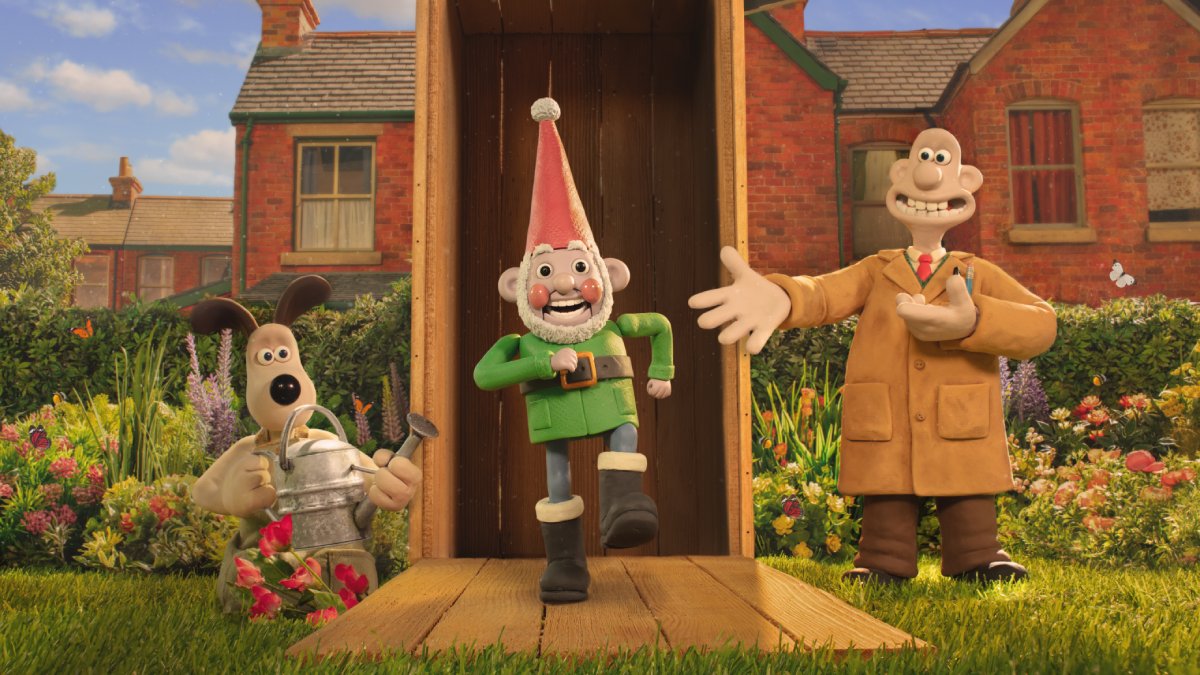
One of the moments that popped to me, and maybe this is easier to do than I thought it was, but the second that the known car turns around and all those gnome feet in unison start moving? That must have been time-intensive.
Merlin Crossingham: Well, yeah, actually the van and the streets are all stop motion, and the feet underneath are CG.
Oh.
Nick Park: It looks like it is. It’s just too tricky to get that all in the car as they animate.
Merlin Crossingham: So they are scans of the actual stop motion puppets, and one of our in-house animators, who was very good at animating in the sort of the stop motion style, put them in. We did try our hardest to do that all in stop motion, but we’d still be making it. It was just something we couldn’t actually do in-camera, but wherever possible, we did try and do it in-camera.
Nick, you’ve been doing this for so long, and you’ve made so many great animated films, but this is not a process that allows you the ability to pivot like traditional animation. In traditional animation, studios will take a non-finished version and test it or show it to people in-house for feedback. It’s not easy to do that with stop-motion. How do you know that something is working? How do you trust that the script is right?
Nick Park: Well, as soon as we’re happy enough with the script, we direct the story artists to draw up every scene and stick it all together in a reel with your temporary voices and scratch voices, temporary music. Disney and everyone does this where we get to see the movie before we shoot anything. And just to test, is the story working? Is the comedy? Are all the character arcs working? All that kind of thing. And then that becomes a constant process as well of repeating if one stuff isn’t working, we go back to writing, and then we go back to storyboarding. And that happens quite a bit throughout the movie, as well as our scenes are turning over. But that gives us a big sense of what we’re up to. But the actual animation itself is very hidden. It’s always like a high-risk thing. You are relying on your actors, your fantastic animators, to perform a scene. There’s no kind of going back and adjusting animation after you’ve done it. It has to work as a performance, and sometimes a bit hit or miss. But we do a lot of rehearsing and videoing ourselves for reference so we can convey what we’re after to the animator.
Merlin Crossingham: But it is one of those things when you talk to animators in other forms of animation, and it really screws with their noodle because they’re used to going back and iterating on a shot. So, it’s very much about knowing our team and communicating clearly. And like Nick says, you don’t always get exactly what you set out to get at the end of a shot, but you do your damnedest to cover all the bases so you get at least most of what you wanted. And sometimes, it comes out better than you hoped the other way as well.
Is there any scene in this film that on paper you may have envisioned one way and then when you animated it you were surprised at how it turned out?
Nick Park: I mean, most things, if a shot may not be quite what you are expecting, but usually the shots around it are you’re having such a good, as Merlin says, “A good go at what we want.” It’s never that far away. I think stop-motion is surprisingly more flexible because in other forms [of animation], they do the storyboarding to the frame, whereas we always shoot a bit extra on each end of the shot. And it gives it quite a bit of flexibility in the edit. So you can get your shots in and then find out is it working in a different order than planned? Or you use half the shot here, half the shot there, and different things. Or you maybe flip the shot or whatever it is because it’s more like cutting live-action. You just don’t have as many takes to choose from. Well, none.
Is there any scene in particular that sort of popped to you that turned out in a different way than you expected in a positive way?
Merlin Crossingham: Yeah, I think, well, one of the things we were never quite sure of was the lion that attacks Gromet. And right up until almost a day of shooting, it was one of Nick’s sequences. But I always remember when the first dailies of the first shots came in of its hero performance, we hadn’t really even seen it perform. And so the whole look of him was, “Oh my God, he’s going to work. And that’s amazing.”
Nick Park: It was all like feeling it at the last minute, wasn’t it? Because we hadn’t had time to plan in person.
Nick, I know you can walk down the street and not be recognized, but when people find out that you are the creator of Wallace and Gromet you must get peppered with questions. What sort of feedback do you get when fans realize who you are?
Gosh, it’s always is always positive. That’s what’s such a blessing in a way. It’s always just so positive in how what we’re getting at the moment is a lot of people who are a lot younger or even thirtysomething who were saying, “It was my childhood, and thank you for bringing it back.” There was such a warm feeling about it all. I did get a letter from a young girl – I think she’s about nine years old in the USA who told me off in a way saying that “Wallace never says thank you to Gromet, never appreciates him. And I want to see him in the next film saying thank you and appreciating Gromet.” I was told in very clear terms there. It wasn’t just because of that letter, but we have got more of a little arc while where he does appreciate him.
I know you just finished this, and I’m sure it was a monstrous effort that all stop-motion animation films are, but do you guys have any ideas for the next one? Now that you have this partnership with the BBC and Netflix, do you have any ideas for a new one, or will it be another 19 years?
Nick Park: I mean, there’s always ideas on, there’s always ideas on the back burner. How soon? I’m not sure, but we’ll see.
Merlin Crossingham: Watch this space.
“Wallace & Gromit: Vengeance Most Fowl” is available on Netflix on Jan 3


