


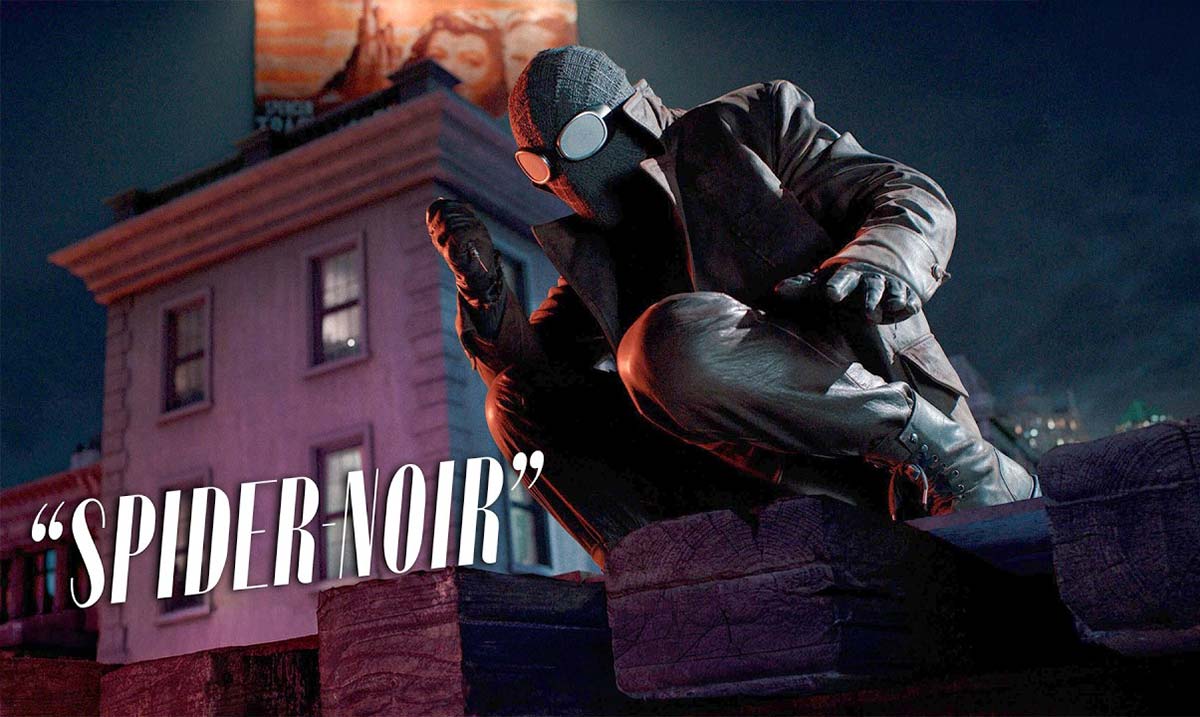
Hollywood still doesn’t understand the bridge, the middle eight. In music, it’s the emotional crescendo before the final chorus, the part of a classic song that hits once and compels you to reach for the rewind button. In Hollywood, the equivalent is the supporting character: special precisely because you get a taste, not the full menu. For example, Chewbacca is beloved, but no one really needs a Chewie movie. The same logic applies to “Spider-Noir,” a character who got a major boost as a fan favorite in the animated Oscar-winner “Spider-Man: Into The Spider-Verse,” where he was voiced with terrific gumshoe zeal by Nicolas Cage.
Before that animated appearance, the character was born in the comics, obviously. Inspired by classic film noir, the original Spider-Man Noir was a Raymond Chandler-esque, hard-boiled Peter Parker who emerged in New York during the Great Depression—a fun genre twist on the Spider-Man myth.
But let’s face it: Prime Video’s “Spider-Noir” exists because Cage’s animated character stole every scene he was in. Cage returns for the live-action series, but strangely enough, he’s not exactly playing that same character. Instead of a 1930s version of Peter Parker, he plays Ben Reilly, a seasoned, booze-soaked, down-on-his-luck private investigator in 1930s New York who has seen far better days.
Following a deeply personal tragedy centered on his Spidey era, Reilly is forced to reckon with his past life as the city’s one and only superhero. Retired from crimefighting, he wrestles with shame, regret, guilt, and the question of whether he can remain on the sidelines as a civilian or rejoin the fight as everyone’s favorite webslinger. From there, the plot finally kicks in.
It’s the 1930s, it’s film noir, it’s classic gangster cinema, and the show is very clearly pulling from that entire cinematic lexicon. So, naturally, there’s a mystery involving a washed-up gumshoe, a local gangster played by Brendan Gleeson (“The Banshees Of Inisherin”), and a singer with loose allegiances played by Li Jun Li (“Sinners”).
The plot, however, is tedious, dull, and painfully familiar: a gangster trying to figure out who burned down his warehouse, a dame who’s his girl but doesn’t trust him, and a pair of the crime boss’ thugs—played by Jack Huston and Abraham Popoola—who have mysteriously developed superpowers. Lamorne Morris and Karen Rodriguez co-star as a reporter and Reilly’s secretary, respectively.
But the bigger problem is the tone. “Spider-Noir” plays like 1930s cosplay, film-noir LARPing, or Dashiell Hammett filtered through an “SNL” spoof. None of it convinces, and most of it feels either ropey or goofy. Cage does his best, and the show occasionally flashes the bizarre, eccentric actor who likes to throw in odd tics and hiccups just to keep himself entertained. But the material is subpar, the aesthetic feels like a costume rather than an inhabited world, and the whole exercise has almost no emotional depth.
Honestly, “Spider-Noir” might have worked as a skit or a 30-minute proof of concept. Stretched across eight episodes, it becomes a drag—thin, labored, and increasingly repetitive.
Developed by Oren Uziel and showrun by Uziel and Steve Lightfoot, “Spider-Noir” is all pastiche cliché filtered through Spider-Man tropes, hoping that this oddball mashup will produce something distinctive on the other end.
It doesn’t. Sets feel like sets, the genre affectations feel secondhand, and some of the supervillain touches are laughably cheap. Never once does the viewer get the feeling they’re watching anything other than actors pretending to play 1930s clichés while delivering phony-sounding dialogue like, “Ah, I oughta give you a knuckle sandwich!”
It’s all heightened, of course, but it never feels authentic, immersive, or compelling. Other than Cage’s growing eccentricities, tics, and spasms—which seem to increase as the series goes on, perhaps because he’s trying to keep himself entertained—the whole thing sits there, airless and inert.
Maybe we shouldn’t be surprised that the makers of Sony Spider-Verse spin-offs don’t really understand what’s special about the middle eight. After all, this is the same ecosystem that gave us “Kraven,” “Madame Web,” “Venom,” and “Morbius,” films that kept mistaking supporting-player novelty for the foundation of a real story. “Spider-Noir” makes the same mistake, and Cage’s oddball charm can’t save it. [D]

