




“What Does That Nature Say To You?”
Hong Sang-soo works at such a breathless clip that even the critics who aren’t yet tired of his shtick tend to take him for granted. The man is given to releasing two, sometimes three, films over the course of a calendar year (he’s a semi-permanent fixture at the Berlin Film Festival), and he shows no signs of slowing down. Every now and then, Hong will casually drop one of his loveliest, most observant pictures in the midst of the many other movies that constitute his output (2022’s bittersweet auto-fiction “The Novelist’s Film” and the wistful chamber comedy “Walk Up,” released the same year, are both recent highlights). Hong’s latest North American release, “What Does That Nature Say To You?,” premiered, yes, in competition at last year’s Berlinale, though despite its characteristically pared-down aesthetic and regionally specific sense of humor, it’s conventionally entertaining enough that we can see this being the rare Hong work that crosses over to a non-Hong audience. Once again, our director is concerned with the romantic hang-ups of the creative class; once again, he turns his eye to the tensions that only family gatherings can dredge up (Hong’s cinema is nothing if not preoccupied). Some have semi-jokingly described this one as Hong’s “Meet The Parents,” and there’s some truth in that description: “Nature” is the story of a neurotic 30-something poet, Donghwa (Ha Seong-guk), who makes up what he lacks in self-awareness with surface-level affability. “What Does That Nature Say To You” is mostly about the inexorable embarrassments that befall Donghwa when he meets his girlfriend’s mom and dad, both of whom see right through his rumpled-bohemian façade. Since this is a Hong film, conversations will unfold in long, static takes, characters will get too drunk and say things they don’t mean, and the director will pause every now and then to admire the astonishing pastoral beauty of his surroundings. What a joy it is to have Hong still working at the peak of his powers. – NL
“The Christophers”
Even great artists aren’t exempt from the brutal demands of the attention economy. How else to explain how Ian McKellen’s Julian Sklar – who makes up one half of Steven Soderbergh’s remarkable two-hander “The Christophers” – supports himself by shilling out Cameo videos for individuals he would no doubt despise if he were to meet them in real life? The other half of Soderbergh’s most recent exercise in brilliant late style – a thrilling commentary on gatekeeping in the modern art world, and the danger of pouring all of yourself into your work – is the marvelous Coel. Coel plays Lori Butler, the steely ice to McKellan’s still-raging fire, who has been hired to forge a new entry in a series of unfinished Sklar masterpieces, The Christophers (named so for a former lover). You see why Soderbergh and his frequent screenwriter Ed Solomon (“Mosaic,” 2021’s criminally underrated noir “No Sudden Move”) built the movie around these stars. Their rapport is electric, and their scenes – engrossingly patient, flush with Solomon’s salty dialogue, and captured in those characteristically crisp Soderberghian hues – are the engine that gives “The Christophers” itself a real sense of authorship. While the characters are brought together by a heist-like plot hatched by Julian’s spoiled adult children (played briefly by “Baby Reindeer” scene-stealer Jessica Gunning alongside none other than James Corden, best-weaponized as a petulant adult baby), “The Christophers” is really about the world of difference that separates two creators who share the same vocation: the hypocrisy, for instance, that dictates that Lori has to work a thankless day job while Julian withers his days away in a London townhouse. “The Christophers” was dismissed by some as minor Soderbergh, but the themes and questions on its mind are anything but. – NL
“Miroirs No. 3”
Christian Petzold is one of our living masters, a filmmaker for whom every choice – aesthetic, moral, or otherwise – is deeply intentional. While his works are all of a piece, no two are quite alike. “Phoenix” evokes the clammy wartime gloom of a Hitchcock thriller, “Undine” is steeped in dreamy allegory and magical realism, and 2023’s “Afire” infused the sexy summertime languor of an Eric Rohmer character portrait with something eerie and unshakeable. On its elegant, cleanly minimal surface, and this is without giving too much away regarding plot particulars, “Miroirs No. 3” shares some creative DNA with 2019’s enigmatic and unsettling “Transit.” Both are stories about furtive, rudderless travelers who are swept into the lives of strangers, only to become existentially and psychologically unmoored by their journeys. Like “Transit,” “Miroirs No. 3” is a film where revelation and epiphany brush up violently against sorrow and regret: where a whisper, heard at the right pitch, can just sound like a scream. Paula Beer, Petzold’s muse for his last few pictures, plays Laura, a music student who survives a grisly car crash in the countryside before being taken into the country home of a lonely older woman, Betty (Barbara Auer, from Petzold’s 2000 drama “The State I Am In,” in what will surely be remembered as one of the year’s most startling dramatic turns). Without dispensing with any spoilers, we’ll say this: “Miroirs No. 3” eventually reveals itself as Petzold’s unusually soulful version of a ghost story, one where the apparitions of past tragedies never stay buried for long. – NL
“Nirvanna The Band The Show The Movie”
Blending the dense, reality-bending meta-fiction of Abbas Kiarostami with the avant-garde man-on-the-street ruckus of “Jackass” or Eric Andre, Matt Johnson’s “Nirvanna The Band The Show The Movie” is a true unicorn of a film: despite the above-mentioned comparisons, it is largely unlike any other work of media to see a release this year, maybe even this decade. Still an ascendant filmmaker, Johnson has made a career out of chronicling the uncomfortable collision of artifice and realism in everyday life. His movies are often sneaky, smartass comedies that chronicle semi-delusional dreamers on the fringes of major historical events (“Operation Avalanche,” the underrated “BlackBerry”). If the trailer for his forthcoming Anthony Bourdain biopic “Tony” registers as potentially “one for them,” “NTBTSTM” is a project that is clearly near and dear to its maker’s heart: an audacious high-low art prank that, without ever stooping to anything so low as a cheap gag, brings the theatrical comedy roaring back to life. The plot is relatively straightforward, at least at first. Johnson and Jay McCarroll play cash-strapped funhouse-mirror versions of themselves, the latter perpetually resigned to the former’s many hare-brained schemes. The duo’s lifelong dream? Playing a gig at the Rivoli in Toronto. What will these men do to play the Rivoli in Toronto? Just about anything, including jumping off the CN Tower into the Sky Dome in one of the movie’s many gasp-inducing, how-did-they-actually-do-this stunts. Without revealing too much, Johnson’s most accomplished cinematic experiment to date weaponizes belly laughs, bizarro sight gags, and “Tenet”-adjacent sci-fi conceits in service of a sneaky rumination on strained friendships, the relentless passage of time, and the joy of making art simply for its own sake. Johnson remains a true original – one of the funniest, strangest, and most open-hearted filmmakers we have – and “Nirvanna The Band The Show The Movie” might be his masterpiece. – NL
“Send Help”
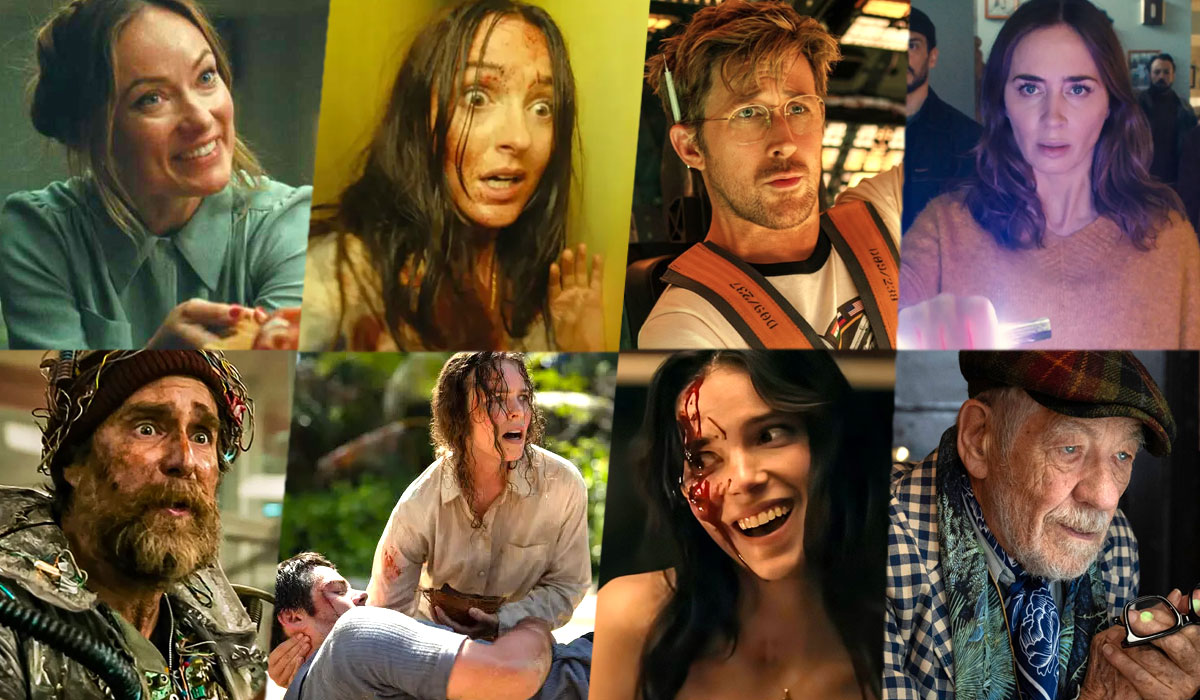
There was a substantial contingent of Sam Raimi’s fanbase who responded to his return to the MCU via “Doctor Strange In The Multiverse of Madness” with a sigh of defeat. Here was the man who directed two of the great comic book movies of all time (the original “Spider-Man” and its sequel), being reduced to the thankless task of infusing his malevolent prankster’s imagination into an overstuffed script that couldn’t have possibly made less sense to any poor soul who lacked the foresight to sit down and binge “WandaVision” in one sitting. Having said that, there’s something gratifying about the very idea of “Send Help”: the notion of the renowned sicko known for gorehound classics like “The Evil Dead,” “Army of Darkness,” and “Drag Me To Hell” getting carte blanche to make an icky, mean-spirited, proudly R-rated splatter horror featuring two A-listers, one of whom just so happens to be Rachel McAdams? Sign us all up. It helps immeasurably that “Send Help” is a genuinely terrific audience picture: front-loaded with shocks, packed with sadistic laughs, and flush with gruesome sights designed to either trigger a viewer’s gag reflex or compel them to howl in shameful laughter. Why not both? That, after all, is the Raimi sweet spot. What’s more is that “Send Help’s” trenchant commentary on the callousness of the tech bro ghouls who are currently destroying our planet feels more authentically biting than many other contemporary films that pass themselves off as honest-to-goodness satires. That’s the goodwill you buy yourself when you know how to whip an audience into a frenzy, and if there’s one thing that Raimi knows how to do, it’s exactly that. – NL
Honorable Mention:
Joel Alfonso Vargas’ “Mad Bills to Pay,” a Sean Baker-inspired independent about a streetwise hustler confronting the prospect of fatherhood and its associated responsibilities, is one of the more purely arresting debuts of the year: a big-hearted and stylish indie comedy packed with compassion, rude humor, and unmistakable New York flavor. “The Sheep Detectives” will no doubt be remembered in time as one of 2026’s more purely out-of-nowhere success stories, while Gus Van Sant’s socially conscious crime thriller “Dead Man’s Wire,” while not perfect, offered continued proof that the indie veteran still has his fastball.
Some of us dug Daniel Goldhaber’s twist on “Faces of Death,” which updated one of the most notorious cult objects of the 20th century for our nightmarish era of doomscrolling, online brutality, and performative cruelty. “Mother of Flies” was another lovingly handmade experiment in dread from everyone’s favorite family of D.I.Y. horror filmmakers, John Adams, Zelda Adams, and Toby Poser. Harry Lighton’s “Pillion,” a kinky, funny, and surprisingly tender queer romance about submission, power, and self-worth, gave Harry Melling and Alexander Skarsgård two of the year’s more fearlessly exposed performances. Elsewhere, Cherien Dabis’ crushing humanist drama “All That’s Left Of You” poignantly traced displacement, revolution, and unthinkable loss across three generations of a Palestinian family.
The year thus far has also brought us some rock-solid meat-and-potatoes entertainment. “Mike & Nick & Nick & Alice,” whose poster art suggested a forgettable streaming trifle, is a genuine blast: a spirited time-travel action-comedy powered by three terrific performances from Vince Vaughn, James Marsden, and Eiza González, not to mention a scene-stealing turn from the most seasoned of scene-stealers, Keith David. Joe Carnahan’s “The Rip,” whose release was tainted by some unfortunate news coverage, is an otherwise agreeably unpretentious dirtball crime yarn given a big boost by a troupe of highly overqualified actors. It may not earn its hype as Quentin Tarantino’s favorite movie of 2026 so far, but as for a Netflix original, it’s got the juice.

Nick Laskin is a film, music, and culture writer who lives in Los Angeles. His work has appeared in The Playlist, Indiewire, Pitchfork, Little White Lies, "Noir City," Collider, and AFI Magazine.


