


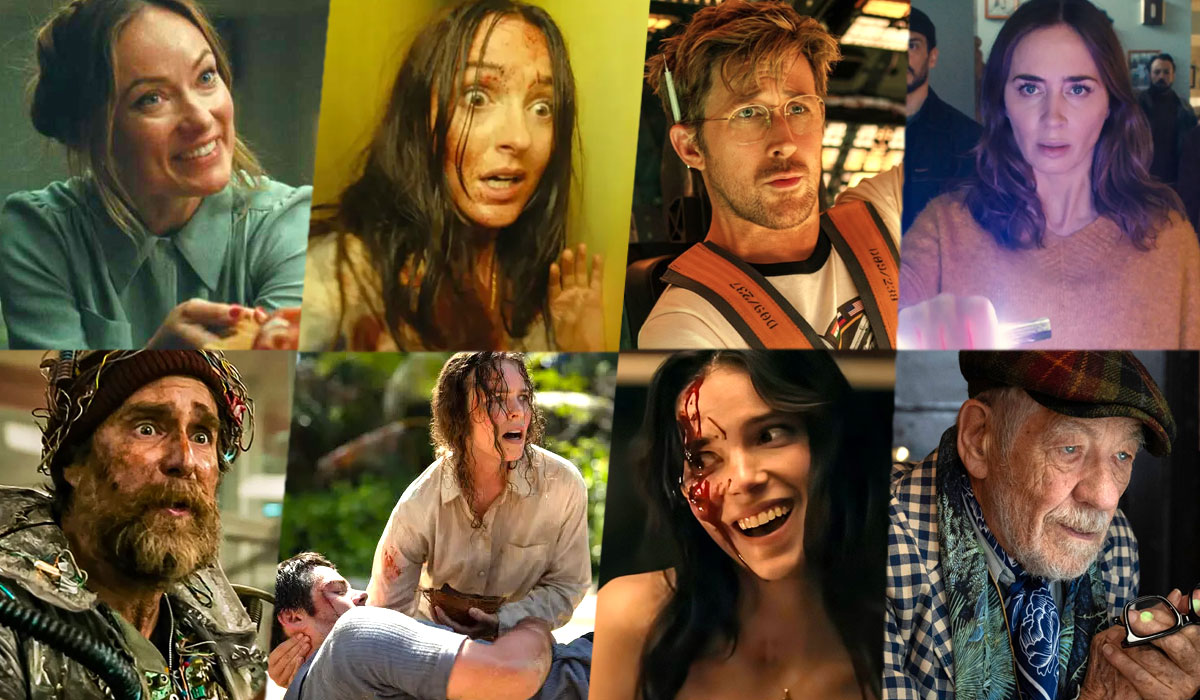
“Disclosure Day”
It feels almost strange to call Steven Spielberg’s “Disclosure Day” a return to first contact, if only because the movie is less interested in the simple question of whether we are alone than in the more terrifying follow-up: what happens when the answer arrives, and humanity is too divided, paranoid, and institutionally broken to absorb it? Working again with David Koepp, Spielberg imagines a world already on the brink of collapse, where a buried extraterrestrial secret threatens to detonate every fragile assumption that holds civilization together. The chase framework is simple enough: Dr. Daniel Kellner (Josh O’Connor), a savant cybersecurity expert, has stolen evidence of alien visitation from WARDEX, a clandestine military-industrial agency determined to keep the truth locked away. Noah Scanlon (Colin Firth) believes disclosure would destroy society; Hugo Wakefield (Colman Domingo) believes the opposite; and Margaret Fairchild (Emily Blunt), a weather anchor suddenly awakened to something vast and unknowable, becomes the movie’s emotional and metaphysical key. What makes “Disclosure Day” so overwhelming is not just Spielberg’s preternatural command of suspense, though there are chase sequences here that would shame filmmakers half his age. It is the way the film folds terror, faith, empathy, and cosmic astonishment into the same trembling question. In lesser hands, this might have been a sleek UFO thriller about cover-ups and classified footage. In Spielberg’s movie, it becomes a plea for compassion in an age of mistrust, treating the unknown not as an extinction event but as a moral test. That “Disclosure Day” still believes humanity might pass is part of what makes it so moving. – RP
“Hoppers”
Pixar may never top its game-changing run from the early to late 2000s: while “Toy Story 5” clearly marked something of a comeback, the notion of the studio producing a work of animated genius as bleak as “WALL-E,” or even one as devastating as “Toy Story 2,” is difficult to fathom now. The once-unstoppable juggernaut has been in a bit of a dry spell over the past few years, after a series of so-so offerings yielded diminishing returns from a brand whose biggest selling point used to be consistency. Then again, maybe there’s no reason to fret, because something like the charmingly back-to-basics “Hoppers” is just what Pixar needs to get back on track creatively (a total box office gross just under $400 million dollars suggests these movies still have plenty of juice in the tank). Whereas lower-tier Pixar entries like “Elemental” and “Inside Out 2” get bogged down by superfluous lore and world-building, “Hoppers” is content to pitch straight down the middle. It’s a sweet, unusually funny adventure about a girl named Mabel who – for reasons that are both too stupid and too complicated to fully unpack here – transfers her consciousness into the body of a robotic beaver. From here, Mabel, in the body of said beaver, ventures into the forest, where she befriends an array of beaver pals led by a jolly monarch voiced by Bobby Moynihan. Did we mention that the back half of the film unfolds as a beaver uprising against the mayor of Beaverton (voiced by none other than Jon Hamm), whose plans for expanding a new beltway will destroy the animals’ natural habitat? “Hoppers” does admittedly come packaged with a good message to send the kiddos home with – that, while not all people may be fundamentally good, it’s important to fight for a future in which good people can be emboldened – but its selling point as a late-career Pixar gem lies in its embrace of sheer silliness. – NL
“Mile End Kicks”
If you’re old enough to remember when American Apparel was the unofficial uniform of the indie sleaze movement but young enough to appreciate an ensemble that includes a cast member from “Euphoria” and another from “Diary of a Wimpy Kid,” you may be in the target demographic for “Mile End Kicks,” Chandler Levack’s witty and tremendously warm remembrance of one female music journalist’s endless summer amidst the indie rock boom of Montreal in the mid-aughts. Levack’s unapologetically autobiographical second feature is her follow-up to the lovely and similarly confessional “I Love Movies,” a tender-hearted dark comedy about a socially inept 17-year-old cinephile whose journey toward personal growth hits a few bumps along the way. This is Levack’s second feature of 2026, along with the bawdy female-led college comedy “Roommates”; that she can balance the winsome, Cameron Crowe-indebted tone of “Mile End Kicks” with the demands of mounting a Happy Madison production for Netflix only offers continued proof of her versatility. The plot beats of Levack’s sophomore outing might sound familiar to anyone who’s seen “Frances Ha” or Lena Dunham’s “Girls” – an emotionally intelligent young woman prone to making bad decisions moves into a new apartment, dates some regrettable men, and briefly loses herself before rediscovering her joie de vivre – but Levack’s winning sophomore comedy makes up for what it may lack in incident with the richness of lived experience and an authenticity that can’t be faked. – NL
“Obsession”
All that Bear (Michael Johnston) wants in life is for his co-worker Nikki (Inde Navarette) to like him, and not in an “I tolerate you when we’re at work” way. Bear’s unhealthily hyper-fixated on Nikki, though he fears his romantic obsession (hey, there’s the title) may be entirely one-sided. When Bear buys a One Wish Willow from a local gift store, its sinister powers compel the girl of his dreams to fall immediately and aggressively in love with him. This should be Bear’s dream coming true – so why does it unfold like a living nightmare? Cue the dead cats, skull-smashing, and skin-crawling smiles. Curry Barker’s “Obsession,” arguably the great box office success story of 2026 so far, is a film that plays its audience ruthlessly and without mercy. This runaway horror smash works so beautifully precisely because it’s a genuinely incisive statement on the thrill of wanting something versus the disappointment of actually living with it (and yes, it’s a condemnation of nice-guy incel entitlement as well). Infatuation is addictive because it exists largely in the imagination of the infatuated. Once confronted with the complex realities of accepting another human being, a callow weakling like Bear is all but destined to fold like laundry. As the descriptors mentioned earlier would indicate, “Obsession” is not for the squeamish. Still, Barker’s breakout never feels sadistic for its own sake: Bear is simply getting exactly what he wished for. What’s undeniable is that Navarette gives one of the most scarring, star-making performances of 2026 thus far: a galvanic turn that genuinely earns the descriptor “fearless.” – NL
“Backrooms”
Internet horror is rarely built to last. Its natural habitat is the fleeting digital glimpse: a cursed image, a few seconds of impossible geometry, the suggestion that reality has a seam and something terrible is humming just beyond it. That is what makes Kane Parsons’ “Backrooms” such a startling achievement. Rather than inflate creepypasta mythology into empty lore, Parsons turns the phenomenon’s infinite yellow corridors and fluorescent purgatories into the architecture of a broken mind. Set in the early 1990s, the film centers on Clark (Chiwetel Ejiofor), a bitter, divorced man working a dead-end job at a furniture warehouse, still nursing grievances over the life he believes was taken from him. His therapist, Dr. Mary Kline (Renate Reinsve), tries to pull him out of his loops of resentment and self-justification, but Clark’s desire for escape proves more seductive than any path toward healing. When a hidden doorway opens inside the warehouse, revealing a ceaseless maze of illogical offices, shifting corridors, electrical hums, and malformed spaces, “Backrooms” becomes more than an expertly mounted nightmare machine. It becomes a mental-health tragedy about memory, loneliness, emotional paralysis, and the dangerous comfort of retreating into your own distorted version of events. Parsons, somehow only 20, shows an unnervingly mature command of sound, spatial terror, and atmosphere, refusing to over-explain the mythology or flatten the monsters into easy metaphor. Ejiofor and Reinsve keep the movie emotionally grounded even as reality collapses around them. What could have been disposable internet-horror junk food instead emerges as one of the year’s most haunting debuts: a film about mistaking isolation for refuge and losing yourself inside the maze you built to survive. – RP


