




“Pasolini” (2014)
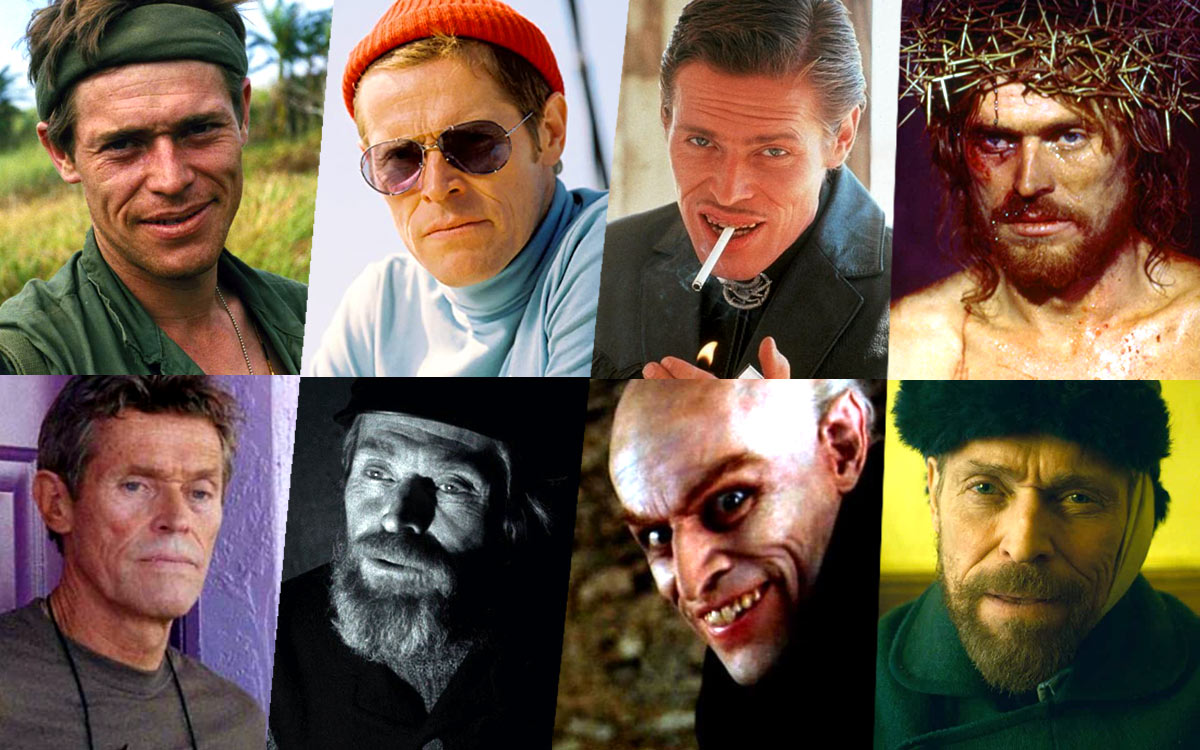
“Pasolini,” one of the best recent Abel Ferrara films, spends a few uneventful days with its subject, Pier Paolo Pasolini, before the iconic, disreputable director’s corpse was discovered on a seedy beach in Rome. Dafoe is the glue that holds this expressionistic movie together: he’s one of those actors who can be fascinating while doing absolutely nothing; this is true whether he’s fawning over a newborn baby, editing a film (the infamous “Salo,” in this case), or cruising the squalid nocturnal avenues of his neighborhood in search of carnal connection. “Pasolini” is a despairing, unconscionably artful curtain call for one man’s extraordinary life and also a consideration of how we continue to live on through our work after we’ve shuffled off our mortal coil. And Dafoe’s turn is “Pasolini” itself in a nutshell: haunted, privately amused with itself, and ultimately, impossible to forget.
“The Florida Project” (2017)
Willem Dafoe’s miraculous work in Sean Baker’s vibrant masterpiece of social realism is significant since it marks the “Tangerine” director’s first attempt at integrating a Hollywood star into his streetwise world of largely nonprofessional performers. In that regard, Baker casting Dafoe in this role was a stroke of genius. The actor has played everyone from Spider-Man’s arch-nemesis to a lascivious rat to the Christian messiah himself, and yet he’s arguably never been as vulnerable onscreen as he is here. Dafoe is the sobering anchor of “The Florida Project,” in which he plays Bobby Hicks: the understanding but overleveraged manager of the Magic Castle Motel where most of Baker’s movie unfolds. Bobby, a consummate everyman, might also be the most valiant character Dafoe has ever played: he’s almost uniformly generous to tenants who can’t afford to pay rent on time, and how he handles a potential sexual predator hovering around the margins of the motel property is devastating in its matter-of-factness. Dafoe’s turn in Baker’s film is not the flashiest he’s ever given, but it very well might be the most empathic and human.
“At Eternity’s Gate” (2018)
“Sometimes, they say I’m mad… but a grain of madness is the best of art.” So said Vincent Van Gogh, the subject of Julian Schnabel’s rapturous “At Eternity’s Gate,” although it would be more accurate to posit that Schnabel’s film is less about the linearity of the Dutch painter’s life, and more a psychological excavation that attempts to unpack how exactly its subject saw the world. As Van Gogh, the actor’s eyes burn with the single-minded conviction that comes from devoting your entire life to a single pursuit. It makes sense that an art film about a painter is also visually elegant, but Schnabel makes ample time to interrogate the considerable emotional cost of being misunderstood in one’s time. “At Eternity’s Gate” is the story of a man whose vision of the world made him an exile, and Dafoe gives one of his more spiritually penetrating performances alongside castmates Mads Mikkelsen and Oscar Isaac, who is electrifying as Paul Gauguin.
“The Lighthouse” (2019)
Thomas Wake, the bellicose “wickie” who is one half of the duo at the center of “The Lighthouse,” is the last guy you’d want to be stuck on a desolate crag of island rock with. He doesn’t shut up. He won’t stop farting. His cooking is awful. Being the canny, self-aware performer that he is, Dafoe leans into the more insidiously comical components of his character’s persona in “The Lighthouse,” never more so than when Wake adopts the resentful cadence of a spurned lover whilst asking Robert Pattinson’s increasingly irritated fellow lighthouse keeper if he’s “fond of his lobster.” “The Lighthouse” is another example of Dafoe going above and beyond in the name of his craft (the shoot sounds like it may have been the most taxing of Dafoe’s career). If the result produces a performance as joyously batty as this one… well, hot Promethean plunder, them’s beans that were well-spilled.
“Tommaso” (2020)
“Tommaso” might just be the maniacal Abel Ferrara’s most leisurely movie to date; it’s also a drama where the autobiographical parallels to the filmmaker’s life are impossible to ignore. Dafoe, in the lead role, is so effortlessly magnetic that the movie ends up being riveting even as we see Tommaso going about relatively quotidian, everyday tasks like shopping for produce at a local market, sipping espresso at a café, or taking his young daughter for strolls in a local park. Dafoe is at his most persuasive in the movie’s quieter moments: we begin to sense that Tommaso is keeping his idle hands busy so he doesn’t retreat to the devil’s playground and that his habit of chugging bottled water is a half-hearted compromise for that other bottle he wishes he could drink from. Here’s to hoping that Dafoe and Ferrara keep making films together until one of them retires.
Honorable Mention:
Dafoe gets a lot of praise for his work in “Platoon,” but he’s just as electrifying in Oliver Stone’s “Born On The Fourth Of July,” leaning into a handful of uncommonly rattling meltdown scenes that qualify as some of the most painful in cinematic history. Dafoe also brings a quiet sensitivity to Abel Ferrara’s otherwise kinky and depraved “New Rose Hotel,” and he ably acquits himself to the workmanlike thriller environment of a Tom Clancy adaptation like “Clear and Present Danger”; he arguably does a similar thing in Spike Lee’s “Inside Man,” where he imbues a tertiary part in a familiar, effective genre exercise with a sense of lived-in specificity and New York grit.
Dafoe chortles his way through a deliciously passive-aggressive comedic performance in “American Psycho,” where he plays a dogged law enforcement official trailing Christian Bale’s homicidal Wall Street bro and loving every second of it. He also makes some rather… interesting choices in “Boondock Saints,” a toxic, terrible Quentin Tarantino ripoff where Dafoe, who may or may not know what a bad movie he’s in, shines like a diamond in a sea of murk. Dafoe is also terrific in “Mississippi Burning,” to the point where one could argue that his performance has aged better than the rest of the film on the whole (definitely a film we contemplated adding to the main list).
Even those who aren’t crazy about Lars Von Trier’s divisive “Nymphomaniac” would have a tough time disputing that Dafoe is rather excellent in that button-pushing cinematic experiment and that he also makes the most out of a somewhat underwritten but nevertheless intriguing supporting part in Anton Corbijn’s moody spy thriller “A Most Wanted Man.” Dafoe dives into the part of a drug-abusing sadist and career criminal with borderline-pornographic zeal in Paul Schrader’s “Dog Eat Dog,” perhaps his most scurrilous collaboration with the director, and he even brought some mordantly funny flashes of life to Edward Norton’s otherwise overly self-serious work of noir homage, “Motherless Brooklyn.”
As we said, Dafoe’s next major role is in Ferrara’s “Siberia,” and he’ll make an appearance later this year in “The French Dispatch,” out in cinemas on October 22nd. He also has Guillermo del Toro’s hotly-anticipated “Shape of Water” follow-up, “Nightmare Alley,” on his schedule, as well as yet another collaboration with his old pal Schrader; in the form of the gritty-sounding, Oscar Isaac-starring “The Card Counter.”
“Siberia” is available in select theaters and everywhere movies can be rented on June 18 and on Blu-ray, DVD, and Digital June 22 from Lionsgate.

Nick Laskin is a film, music, and culture writer who lives in Los Angeles. His work has appeared in The Playlist, Indiewire, Pitchfork, Little White Lies, "Noir City," Collider, and AFI Magazine.


