




 “Rock ‘n’ Roll High School” (1979)
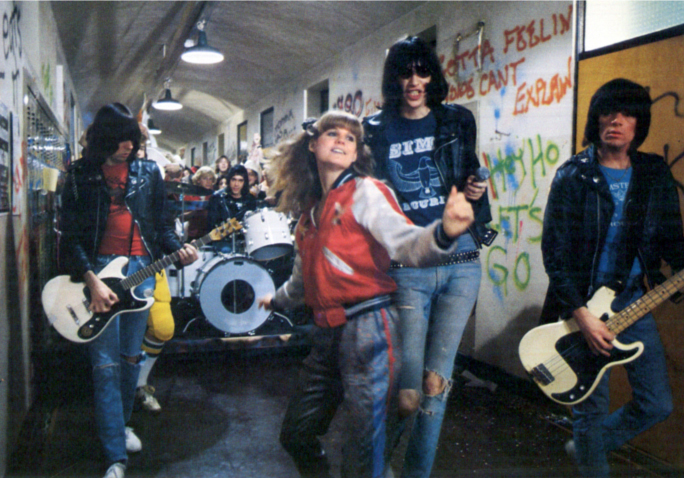
For a film that started life from a script with the working title of “Disco High,” it’s hard to believe that the musical vehicle that would end up driving what was to become “Rock ‘n’ Roll High School” through to completion were The Ramones. But then again, they were a band that personified goofy humour and celebrated freaks, geeks and pinheads alike; they fit the tone of a screwball high school comedy to perfection. The film follows former cheerleader Riff Randall (played adorably by P.J. Soles), Vince Lombardi High’s resident Ramones fan, and all-round rock n’ roll rebel, as she goes up against the new super-tough Principal Togar (Warhol alumnus Mary Woronov) and her two goons, who try to stop Riff from going to a Ramones concert and giving Joey Ramone the songs she wrote for him. Though she succeeds in attending the concert, Togar then tries to burn all the students’ Ramones records, so enough is enough; time to destroy the school, which pre-1999 was an innocent enough idea. Produced by B-movie master Roger Corman and directed by frequent Joe Dante collaborator Alan Arkush, “Rock ‘n’ Roll High School” is the perfect mix of good-bad gags, surreal humour and lots of music. None of the Ramones could act (especially Dee Dee, who gets two cringeworthy lines about pizza), but The Ramones sure could play. In fact, the sheer number of live tunes that Arkush crammed in around the narrative is to his credit, and includes everything from “Blitzkrieg Bop” to “Teenage Lobotomy”. Gabba Gabba Hey! [B]
 “Fast Times At Ridgemont High” (1982)
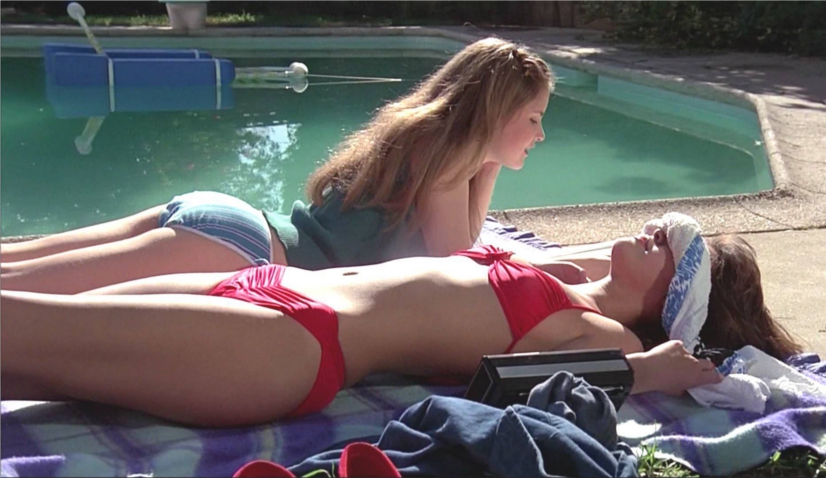
Like a real-life “21 Jump Street” (without the cop angle, clearly), the young Cameron Crowe, at only 22 a veteran Rolling Stone journalist, posed as a student, and enrolled at Clairemont High School in San Diego, documenting the experiences of his peers in a book, “Fast Times At Ridgemont High.” Before it was even in bookstores, the rights had been snapped up, with Crowe adapting the screenplay for director Amy Heckerling. As such, it’s no surprise that Crowe’s journalistic background meant that the film felt far more authentic than anything that had been seen in the genre up to that point, with a frankness that, while not exactly Larry Clark, remains a little shocking even today (one forgets that Jennifer Jason Leigh‘s character is only 15, for instance). Thankfully, the film also contains the warmth and sweetness (and a killer soundtrack, including The Cars, Tom Petty and Led Zeppelin) that Crowe would become known for in later years as a director; the tentative romance between Brian Backer‘s Rat and Stacy is the template for much that would follow, while the not-as-wise-as-she-thinks-she-is Linda (Phoebe Cates) gives added dimension to a whole generation. But arguably the most indelible creation (in a cast that also includes early turns from Nicolas Cage, Anthony Edwards and Forest Whitaker) is Sean Penn as the perma-stoned Jeff Spicoli. His sunny disposition virtually created an entire archetype, and still serves as a reminder that before his image became so self-important, Penn was a gifted comic actor. [B+]
 “The Breakfast Club” (1985)
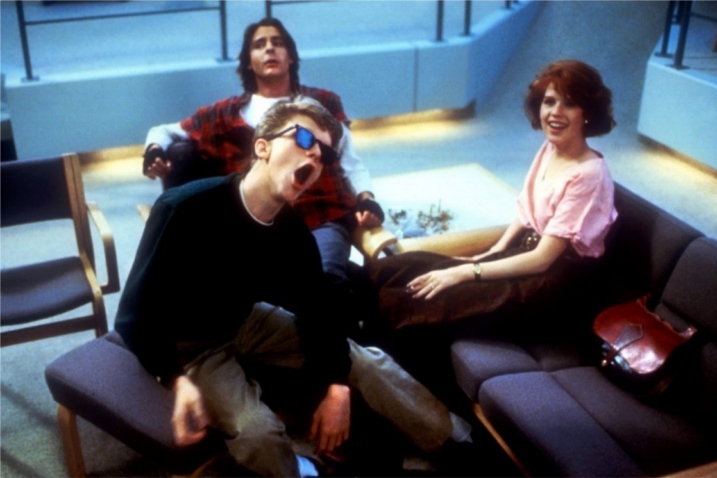
So, not entirely sure we even need a list here, folks. “The Breakfast Club” is truly all the high school movie any of us could ever want. The apotheosis of acknowledged master of the genre John Hughes’ teen pics (and the second in a directorial run of four, back-to-back), the film may not be subtle, but then the teenage years are hardly known for their subtlety or restraint. From the opening voiceover “you see us as a brain, an athlete, a basket case, a princess and a criminal…“ the film ranges from genuinely funny to occasionally cringeworthy in its sincerity (though we’ll defend to the death getting verklempt over poor Anthony Michael Hall’s inability to get the elephant lamp to work in shop). But what’s truly endearing is the honest faith it displays in the fundamental goodness of youth. White youth, that is, ahem. Diversity issues aside, the setup is inspired: a bunch of stereotypes (the defining ’80s high school movie cast of Hall, Molly Ringwald, Emilio Estevez, Judd Nelson and Ally Sheedy) are thrown together into the pressure cooker of a Saturday morning detention, overseen by absentee teacher/nemesis/stooge Mr. Vernon (Richard Gleason). Over the course of a few hours they bond across social divides, discover that rich kids can be just as miserable as poor kids (parents do not come out of this well) and, in a scene destined to be referenced and parodied a hundred times, get high and dance around the library. To try and analyse why any of this works beyond simple nostalgia (and we’ll admit to a healthy dose of that) is really a fool’s errand: somehow Hughes managed to capture lightning in a high-school-shaped bottle on several occasions, and never more enjoyably than here. Somehow by the time we get to the pat philosophical wrap up of “we discovered that we are each of us a brain and an athlete and a princess…etc” we are too caught up even to notice how truly horrible that Simple Minds song is. [A]
 “Ferris Bueller’s Day Off” (1986)
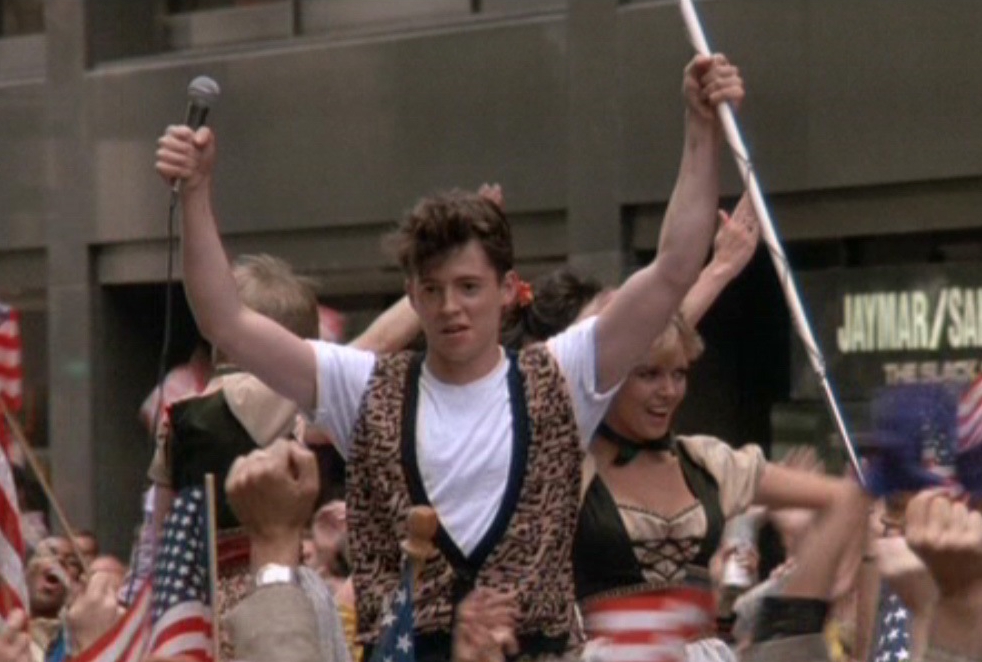
Sometimes a film is such a cultural touchpoint that it’s hard to see it’s actually pretty atypical of the kind of movie it has come to represent. And so it is with John Hughes’ 1986 sine qua non of the high school film, “Ferris Bueller’s Day Off.” Without doubt deserving its spot in the pantheon, one of the things that makes ‘Ferris’ so enduringly popular, and endlessly referenced is that, in one of the most formulaic of genres, the particular trick it pulls off has never really been repeated. Other movies on this list deal with the pain of being an outsider, the longing for acceptance, and the cruel alienations and humiliations that seem world-ending when viewed through the magnifying prism of hormonal teenagerdom. But Ferris? Nope. Ferris is popular. Crazy popular, no less, with a pretty girlfriend (Mia Sara), a doggedly loyal best friend (Alan Ruck) and a school seemingly stuffed to the brim not just with admirers, but with fans; if his bitchy sister (Jennifer Grey) and arch adversary principal Rooney (Jeffrey Jones) don’t buy into the hype, they are the only two. Ferris is beloved by all, manipulative to the point of smug, extroverted, self-confident and ridiculously lucky: by all rights we should hate the hell out of him. But we don’t, because Matthew Broderick is so guilelessly adorable in the role, and because Ferris, winking and wisecracking to camera, wins us over too, damn him. Long before he leaps in agonising slow-mo over that backyard fence to the strains of Yello, long before Cameron has wrecked his Dad’s Ferrari (but is gonna be OK), long before sister Jeanie has had the bitch snogged out of her by a winning (sorry) Charlie Sheen, we are totally with Ferris. Still simply one of the most exuberant and strangely innocent celebrations of how fucking great it can be to be young and cool, block your eyes and ears to the puffy middle-aged defeatism of the recent Honda ad and rediscover the original. Save Ferris. [A]
 “Three O’Clock High” (1987)
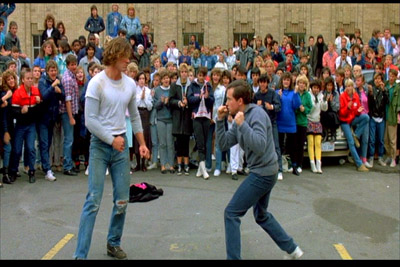
Director Phil Joanou is probably best remembered as a co-conspirator with U2 in the late ‘80s and early ‘90s (he directed “Rattle & Hum,” plus iconic music videos like “One”), and to a slightly lesser degree, 1990’s “State of Grace,” an awesome, but undersung New York crime drama starring Sean Penn and Gary Oldman (we remembered it here, its worth tracking down). Then after that came a lot of unmentionable work (“Final Analysis,” “Heaven’s Prisoners,” “Gridiron Gang”), but what almost everyone forgets is that Joanou’s feature-length debut was the cult-classic teen comedy, “Three O’Clock High” starring Casey Siemaszko, Richard Tyson, and featuring appearances by Jeffrey Tambor, Philip Baker Hall and even a young Paul Feig as a hall monitor. Featuring Joanou’s manic and inventive camera movements and staging, “Three O’ Clock High” is like high school on amphetamines, and features a wicked synth score by Tangerine Dream. Style aside, the teen comedy, all of a brisk 97 minutes long, centers on a high school nerd (Siemaszko) who is assigned to write a piece for the school paper about Buddy Revell (Tyson), a new transfer who has a fearsome reputation for putting unwelcome students into the hospital for what seem to be trivial reasons. Buddy doesn’t like to be touched. As in ever. So when Jerry, Siemaszko’s nerd character tries to bond with him with a pat on the shoulder, he is challenged to a do-or-die fight after class, at three o’clock on the dot. The rest of the picture is a manic chronicle of Jerry doing his best to get out of the fight — by ditching school, trying to plant knives in his adversary’s locker, and hiring tough guys to (unsuccessfully) vanquish his opponent before the final bell rings when he must face his doom. And of course, there’s an all-out brawl at the end that’s rather comical and memorable, but most of all, “Three O’ Clock High” is like a weird oddity; a speedy, adrenalined-out teen comedy unlike most you’ve ever seen. [B+]

