


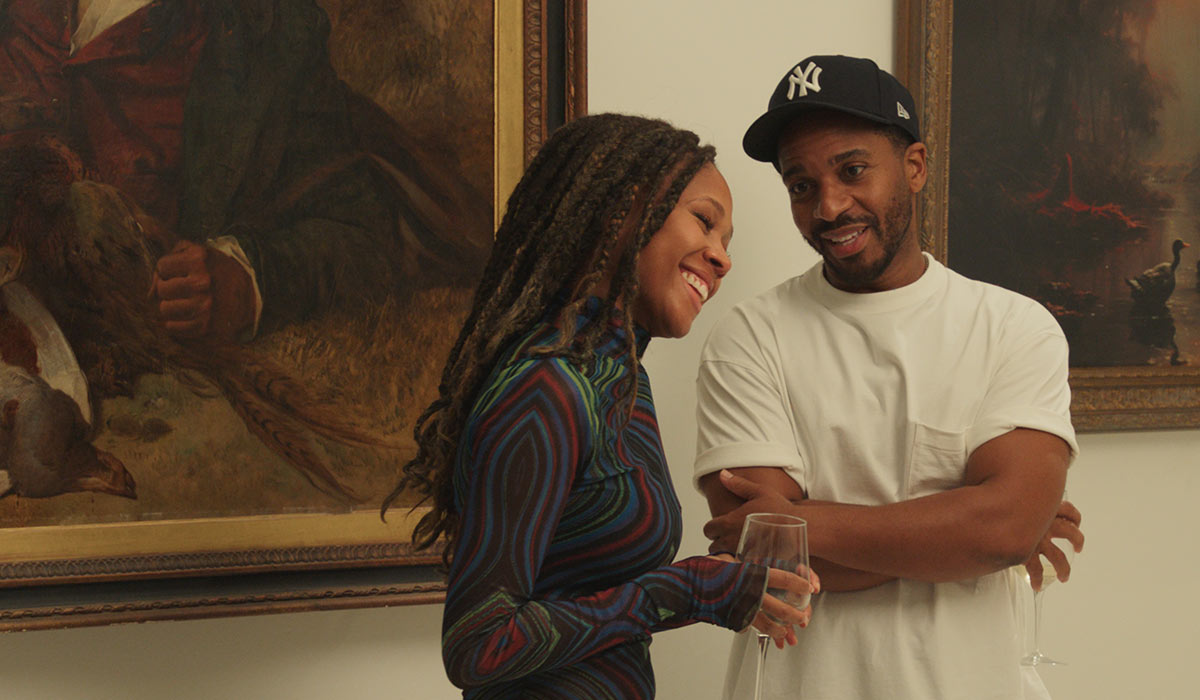
Culture-loving New Yorkers may find actor André Holland inescapable in late summer 2025 – at least on their phones. As we spoke in late July, Holland was preparing to enter rehearsals for the play “The Brothers Size,” written by “Moonlight” scribe Tarell Alvin McCraney. But the show’s venue, The Shed, had already prepared audiences for the show by blanketing ads across social media with nothing more than a professional headshot of Holland.
Before I began chatting with Holland about his latest screen performance in “Love, Brooklyn,” which hits theaters starting August 29, I had to pull out my phone to show a screenshot of just how omnipresent he had become when scrolling Instagram. He chuckled and mentioned that he’d heard from many friends about how pervasive his presence had been in their devices … although Holland had yet to experience it himself.
That digital ubiquity poses something of a contrast to Holland’s professional output, which errs on the side of conscientious selectiveness. The result is that the 45-year-old actor has cut a path toward having a contemporary version of what film critic Roger Ebert deemed the Stanton-Walsh rule: “no movie featuring either Harry Dean Stanton or M. Emmet Walsh in a supporting role can be altogether bad.” From the aforementioned Best Picture-winning triumph to roles in “Selma,” “Passing,” or “Bones & All,” Holland’s presence in any given picture carries real weight for discerning cinephiles.
“Love, Brooklyn” is not the first time Holland has taken the lead in a film, as fans of work like “High Flying Bird” or “Exhibiting Forgiveness” know. But he identifies Roger, a Brooklyn-based writer struggling to juggle his relationships with women while running late on a manuscript, as a conscious leap into playing romantic leads. Like all other acting elements, Holland excels at making his character feel as lived-in as the on-location sets in Rachael Holder’s debut feature about a trio of Brooklynites trying to figure out life and love.
In our conversation, Holland admitted to doubting his ability to carry a film like this but explained how his process brought him through his qualms. He also discussed what guides his choice of projects, why he likes working with emerging cinematic voices, and how “Love, Brooklyn” inspired him to recommit to living in New York for the long haul.
As you’re heading into the rehearsal process for “The Brothers Size,” what are you most excited to discover along the way?
The first time I did this play was back in 2009. It’s a three-person play with two younger guys and one older guy. In 2009, I played the young guy, and now, I’m coming back as an old dude, Marshall. I’m excited to see how that’s gonna go! But I love this play. Tarell McCraney is one of my favorite writers and has been for a long time. To be honest, when I played the younger guy, I really wanted to be playing the older dude, so I’m excited to get a chance to take a crack at it.
What guides your choice of projects and the mediums that you’re working in?
I tend to be attracted to things that allow me a chance to do something new. The older I get, the more the people who are making the project and the people I’m going to be working with nowadays are guiding it. I really want to spend my time with people that I want to be around and have a similar ethic, who don’t necessarily buy into the hierarchical Hollywood thing, but who just want to make great work, be fair, and have a good time.
You’ve been working with a lot of first-time solo narrative feature directors recently. Is that a conscious choice?
For sure, I’ve always been interested in trying to find new voices and championing people. That’s very much a part of it, but it’s also been an act of necessity, too. I am very ambitious about my career. I know I want to make all kinds of things. I have a lot of stories I want to tell and parts I want to play, and I’m not a person who likes to wait for opportunities to come. I’m much more like, “Let’s get out here and try to figure out how to make something.” I have found that usually it’s the younger, first-time directors who are also eager to get in the muck and figure that stuff out. If I were getting called by like major directors every other day begging to work with them, then my career may have gone that way. But it’s gone this way, and the necessity has borne a real passion in me to continue nurturing younger voices.
Is there a difference in being an actor on the set of a film like that? Does it give you more opportunities, as someone who’s a little bit more seasoned in knowing how things are run, to help set the tone?
It always depends on the person. With Titus Kaphar on “Exhibiting Forgiveness,” he had never directed or been on a set before, so he was starting from the beginning, but had a real grasp of visuals. He knew what a shot was and wasn’t afraid of the things he didn’t know. He was always asking questions and trusted his actors and his producers to help him make the best movie he could make. Sometimes, you encounter directors who aren’t necessarily that way, who really want to control things themselves. They feel like, “This is my thing, and I want to do it my way.” It just depends on the person. What I try to bring to the set is a sense of openness to like, “Let’s try it your way, and then I also want there to be space to try it some other ways so that we give ourselves some options.”
I know Rachael Holder is also a playwright. Do you find that there’s something different about working with cross-disciplinary artists who are very fluent in other mediums as well?
I think there can be. Like I was saying with Titus, his being so fluent with visuals was really cool. I knew no matter what, it was going to look great! That was really comforting. I think sometimes people who come from theater writing, there can be a tendency to hold on to ideas tightly and not be as nimble in terms of pivoting to what’s in the room. That’s something I appreciated about working with Steven Soderbergh. Working with him for 20 episodes of TV, and then “High Flying Bird” taught me that one has to be nimble in this business. Things always go wrong, and you’ve got to be able to pivot and make it work no matter what.
How has your partnership with Steven Soderbergh evolved over time? It’s been a while since you’ve collaborated directly, acting in one of his projects, but he’s a producer on “Love, Brooklyn.” It seems like you all are still in touch and working together in some sense.
He’s been such a wonderful supporter over the years, not just of me as an actor. When I expressed an interest in producing, he was the first one to be like, “Alright, let’s do it. Let me help you figure it out.” That has meant everything from late-night discussions over wine about movies and shot selection to me calling and saying, “Hey, man, I really want to make this movie. Can we put it together?” And his stepping up to help me, it’s meant all kinds of things. It’s really evolved, and of everybody I’ve met in the business in the film, he’s probably been the biggest ally for me personally. I feel really indebted to him for believing in me and being willing to stick his neck out for me.
You’ve mentioned that you trust your process to get ready for a role. I did a good chunk of research, but I couldn’t necessarily find any place where you’ve really elucidated what that process is. Not to make you give away the magic, but how do you get into a role like Roger in “Love, Brooklyn?”
My process always evolves depending on what the project is. My training is the classic American teachers of the Stanislavski method and way of working – and I don’t mean like capital-M Method. That was the grounding, foundational work when I was starting. But from that, I’ve also done a lot of work in physical theater, using the body as a way of accessing emotion and character. I’ve done a lot of Shakespeare, which obviously is very language-forward. The technique often reveals the emotion. When I approach a role, I feel like there’s a big grab-bag from which I can pull depending on what the needs of the role are. There’s no real set process, except that there are these things that I put myself through in order to come into greater contact with the role and with the world of the story. I’m kind of obnoxious and unrelenting about that.
One thing that drives me nuts is when there is a lack of specificity in the work. Sometimes, there are younger folks who think that that specificity can be replaced with charm or a clever idea. But, in my experience, there’s positively no replacing specificity. It reveals everything, and when it’s not there, everybody suffers. I think if I had to sum my process up, it’s a process of moving into greater specificity.
More from this interview on the second page.


