



If you are a movie fan, you are about to be inundated with numerous distractions from all corners of the world. Studio films with big stars looking for attention in September, and a plethora of new world premieres from Venice, Telluride, and TIFF that will dominate your social media feed for weeks on end. But we insist you don’t let James Sweeney’s “Twinless” get lost among the red carpet and controversy distractions vying for your attention. Don’t let its insane September 5 release date ruin your chance to see it in theaters. It’s too good to be forgotten that quickly. Really.
READ MORE: “Twinless” Review: Dylan O’Brien Has The Range In This Funny And Twisty Dramedy [Sundance]
The winner of the Audience Award at the 2025 Sundance Film Festival and, at this writing, still one of the most acclaimed films of the year, “Twinless” follows Dennis (Sweeney) a single thirtysomething gay in the Pacific Northwest as he begins an unlikely friendship with Roman (Dylan O’Brien), a very straight everyday guy who is in mourning over the death of his gay twin brother, Rocky (also O’Brien). Sweeney’s super smart screenplay has two big twists that can make the movie difficult to discuss in detail, but it inherently is about the bonds of friendship and how they can form under the most unlikely of circumstances.
The project took four years to get in front of cameras, and O’Brien stuck with it not only because he couldn’t believe every actor his age didn’t want to play Roman, but also for one specific scene. The film is often hilarious, but it is full of raw, grounded emotion. At one point, a still vulnerable Roman lets all his feelings out about his complicated relationship with his brother to Dennis, who role plays as Rocky to console his new friend. O’Brien says he was “dying” to do the movie if they’d have him “because nothing hit me harder than when I got to that page.:
“I instantly knew this was something that I needed to do and would also be the most challenging and naked, scary thing that I’d ever have to do,” O’Brien says. “And that was even before I knew how James was going to shoot it, which was very technically scary as well. I remember coming in for blocking, and he had the cameras. The plan was for it to just be a straight push in directly at me, and that I wouldn’t even be able to really see [James]. So there’s always this bumbly awkward thing. I remember them having this idea at some point of putting him on the dolly, moving in with me, and I was like, ‘No, no, no. It can’t be that. That’s crazy.’ So, there are these technical things that go into it, too, and then you have to lay out this extremely bare, raw thing. I feel really grateful for not only the opportunity to do that, but just the hands that I was in.”
O’Brien also eloquently adds, “I guess that I’ve been through this enough to know that I wouldn’t necessarily know what was going to come out or how it was going to happen, but I knew how to approach it and get myself ready for that moment, and then to just let it go. It was kind of a really special moment for me in my career, to still, I don’t know, at age 33, to still have these moments of evolution as an actor. It’s nice. It feels good.”
During our extended conversation, the genuinely affable O’Brien also reflects on his super busy year shooting Sian Heder’s follow-up to “CODA,” the new drama “Being Heumann,” Sam Raimi’s “Send Help,” and much, much more.
This interview has been edited for length and clarity.
_____
The Playlist: We were just talking about how we’ve both gotten back from vacation and about how you needed time to sort of unwind from a busy year so far and one super social project. Do you try to do that for every project, or was it just one that made you want to jump into that?
Dylan O’Brien: It can depend, I guess. I think this year, particularly very luckily, I’ve been on a long run of work. So yeah, after I’d say if it’s ever a run that exceeds the four to six month range in succession, I can really use a good committed unwind time, and sometimes coming back to living in New York doesn’t provide that, so you’ve got to go find it in the woods, which I really love. I really do. I love nature, and I love solitude. Depending on the time, I definitely have my ebbs and flows sort of bandwidth.
I was going to ask you at the end of the interview, but were the projects “Send Help” and “Being Heumann”? Back to back?
Oh wow. Yeah, they were not too bad. About six weeks, I think, from wrapping one, about five or six weeks of wrapping one and starting the other. So, that’s a nice chunk of time that’s not going right to something. “Help” was across the world. So it is nice to come home, and then “Being Heumann” was in my backyard, it was Toronto, so I was able to, and with putting “Twinless” out, I was kind of able to, I had to sort of be around for some “Twinless” stuff anyway, so I was kind of back and forth a little bit. Toronto is basically uptown.
Wait, so is there another project that you shot around “Being Heumann” that you just finished before this vacation that I missed…
No, no, no. You nailed it. Okay. Yeah, I was actually impressed. You knew my schedule.
Someone on Wikipedia knows your schedule!
Oh, copy.
But we need to talk about “Twinless,” which, by the way, as of this, we are recording this on Monday, August 11th, is still one of the most acclaimed films on Metacritic’s top films of 2025. It still has a stellar 82 Metacritic score.
Wow.
And it debuted at Sundance eight months ago. How did the script come to you, and what made you want to say yes to it?
From what I’ve heard from James, he saw me do a “Social Network” reenactment with my friend Sarah online. This was kind of during the height of the first quarantine during the pandemic, and I don’t know, he was toying around with who to send the script to, and that was something that put me in his head. And then they floated it to me, and I just happened to catch it in my Email. It was not particularly highlighted for me. It was sort of like a “read for interest” kind of thing, and I read it, and I was interested. [Laughs.] No, but I mean I read it and was very sort of taken with how fantastically written it was and how original it was. I was like, “There’s got to be a problem at some point in this process, in this vetting, that I will find a problem because this makes no sense that this is this good and this is open and available.” So, I had seen that James had previously directed a feature already, and I’m like, “O.K., it’s probably terrible. That’s probably what’s going on.” And then I go and I watch it and it’s fantastic. And it was a really small film, but it’s filled with qualities that I think signify a really special filmmaker. I mean, he made it for no money, but it’s really intentionally crafted, and I just was really impressed, and it has such a distinct voice. Such a different one than “Twinless.” So I was like, “This guy’s got something. I need to meet him.” And I’m like, “He’s probably horrible. That’s where this will finally come to an end.” And he was so intelligent, and I felt like we were the same age and just felt like we really had a great conversation about how we would want to approach the making of the film. A lot of those conversations at first surrounded scheduling time between the roles that I would play. I do have to play one and a half roles.
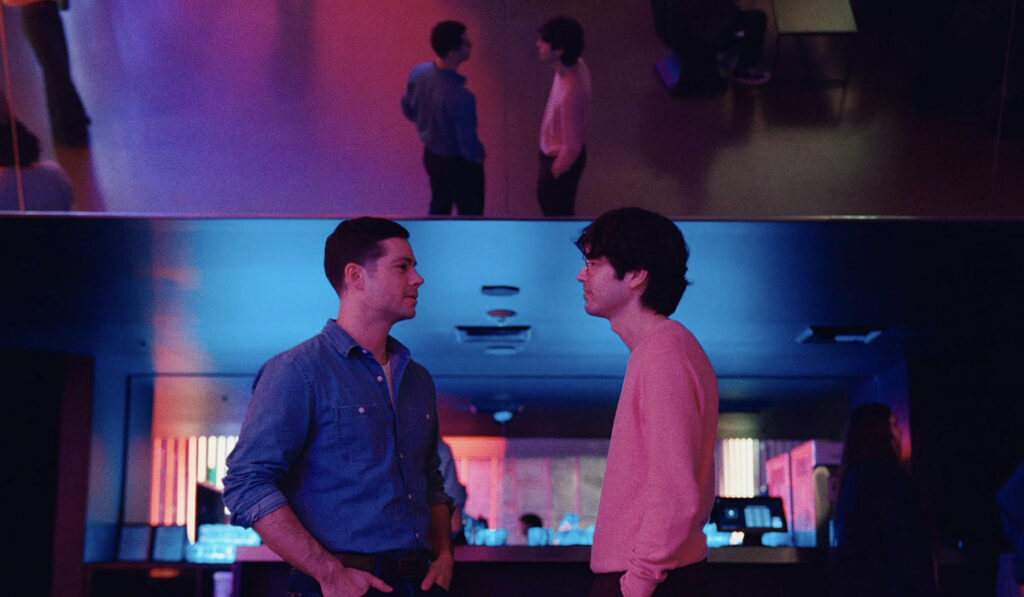
And that ended up taking four or five years of those conversations, and we became really good friends, and it was an abundance of things that made me say “yes” to the script again. It was really like I kept questioning whether or not I was crazy because I was like, “Why isn’t every actor my age in town wanting this part?” I just feel like this is so filled with such a grounded sort of emotion that I really connect with. I really loved the themes of loneliness and friendship, and how these were all sort of toyed with in this really original and cinematic way. The tenor, the tone, and the voice of the script, and particularly Roman, the character. I think when you connect to the voice guiding you through the story and inherently understand the sense of humor, I think that’s a big way in for me.
Two follow-ups to that. I didn’t realize this took four years to make. Are there some projects that you have on the side or that you’re “attached to” that different filmmakers are trying to make? Or is this a rarity in your career?
It’s not usual for me, really. If I’m attached to something, I really like to feel like I’m doing it. I don’t like to sort of dangle these attachments and then kind of do away with them if they don’t work out for my schedule or whatever. I do think that is common in the industry, but not for me. So, this was definitely something that I was attached to with a full intention of doing. It took a while for us to get the financing, to be honest. It wasn’t a hot ticket. We spent a lot of time…listen, it’s hard to get things made independently. Especially with new filmmakers coming into the fold, right? And you do question along the way, though a little bit, you kind of go, “Are we seeing something that’s not here?” At some point, you can’t help but ask that sometimes. So, it’s been really amazing to finally have this moment of it being received so well, which I don’t know that we ever even expected. Even when we made the film, we were above and beyond proud of what we accomplished with it. It’s still, at the end of the day, a film that we felt like wouldn’t be for everyone. So it’s really been just such a wonderful experience to see the great reaction that it seemingly has had so far.
The other follow-up I was going to ask is you note the difference in tone between his first film and then reading this script.
Yeah.
Do you feel that the tone you read in the script is what we are seeing on screen? Or was that something that came to life on set?
Not like you have an idea, right? Making things is funny, and I think especially with something like this, where it really doesn’t fit into your typical genre. I certainly saw something when I read it, and James, I’m sure, had his own vision as well, but it did evolve. I mean, I remember even while we were making the thing, we had just both seen “May December,” and we were obsessed with it, and we were like, “Oh, there’s this eerie kind of filmmaking aspect to that thing that we kind of want to weave into.” I remember James and our DP, Greg Cotton, all of a sudden, we were like, “Oh, we got to do Zooms. That’ll be an aspect to the perspective shift when we get to Dennis.” Things like that, filmmaking devices that evolve. And the thing kind of just became what it was on the day when we shot and took on a new evolution in the edit. And I think ultimately James made something really unique and hard to define, but something ultimately that I think was the ultimate hope from the get go, from first reading this script, it had that potential of being so many things that really blend well together and can really work at the end of the day telling this story of all these human themes of human nature.
So, talking to you now, watching tons of interviews you’ve done over the years, the two twin brothers that you play are very different than you, and you had four years to think about how you would potentially play them. Did you have a friend inspiration, or someone you met that made you think, “Oh, this guy might be like Roman,” or “This guy might be like Rocky”? How did you put together the two divergent personalities?
Well, for four years, I was just trying out skins. It’s funny you say the kind of inspiration thing I’ve always felt, I won’t reveal who, but I’ve always felt a very innate understanding of the Roman character in particular, which does come from someone very specific from my personal life. It’s funny because one of those things where I sort of only realized this in hindsight, kind of. It’s not like I identified this person and then was going to follow that spirit guide. I kind of just knew the guy. I had so many instincts inside me that felt really comfortable, authentically tapping into that person. And then it took time to go back and unpack the experience and just be like, “Oh, you know who this so is for me? It’s this person I know dearly to my DNA. And is someone who exists in my life.” I’m sure we all come at it so many different ways. This is a weird job. I feel like I’m constantly still even just learning about how the hell I engage with my thing. You know what I mean? And this was a prime example of that for me. I really learned to be comfortable with the aspects of myself that I engage with a character from the body up. I don’t know if that makes sense, but from the inside out, I kind of have to really feel internally [that] I understand this person to their core, and I probably do know them to some degree. I think I do pull from everything. It either comes from me or it’s relationships that I have, people that I’ve come across, whatever it is. But it always comes from people who have affected me one way or another that I’ve learned from, that I’ve engaged with, that I’ve had in my life.
Well, I can’t even remember if James is a twin. Is he?
He’s not.


