



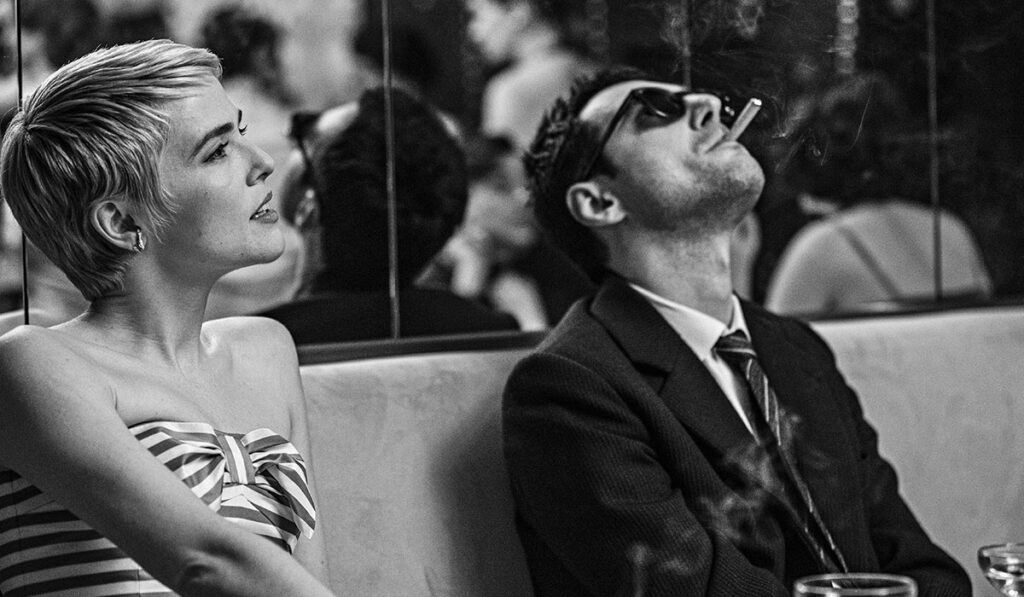
If you’re looking for a palate cleanser to wipe away the daily stress of the current political environment, may we suggest escaping to the streets of Paris? It’s 1959, and a young, upstart filmmaker, Jean-Luc Godard, is finally getting to make his feature debut, “Breathless.” A movie that will change the art of filmmaking forever and turn stars Jean-Paul Belmondo and Jean Seberg into cinematic icons recognized around the world for decades. The making of this wonder is captured in Richard Linklater’s “Nouvelle Vague,” a standout at the 2025 Cannes Film Festival and, most recently, a Gotham Awards nominee for Best International Feature. One of the standouts of “Vague” is Zoey Deutch, who gives a revelatory performance as a young and brash Seberg. And it’s a role Deutch waited almost a decade for.
_____
The Reviews are In: “Insightful,” “Smart, Funny, Easy To Digest, And Always Newsworthy,” “Always Informative And Honest”
SUBSCRIBE to THE BREAKDOWN Newsletter For Exclusive Entertainment Industry And Awards Season Commentary. It’s Free And Just Twice A Week. Sign Up Here.
_____
First cast in Linklater’s now underrated 2016 comedy “Everybody Wants Some,” Deutch kept waiting for the director to follow up on his off-the-cuff suggestion for her to play Seberg in “Vague,” a movie he’d already been working on for years. When the call eventually came, she realized she’d need to be as fluent in French as soon as possible. She laughs, admitting, “It definitely did not come naturally.”
“I just worked at it for hours and hours and hours and hours every day, and I had a wonderful French tutor,” Deutch says. “And then also our producer, Michèle [Pétin], she helped me and came on as an additional tutor, and she was able to really hear the differences.”
This attention to detail was important because “Jean had a pretty famous dialect and way that she speaks French in France. We’re not hearing that difference [in America]. But yeah, that language barrier was one of my great connectors to her. I mean, she was also learning how to speak French when she made ‘Breathless.’ So, making a movie, improvising, and having no script for a movie in a language that you’re just learning how to speak?. I mean, that’s very, very intimidating, and I felt that tether and that connection because I too was intimidated.”
You’d never know it from Deutch’s performance, however. During our conversation last week, she reflected on working with Linklater, what stuck with her about Seberg the most, recreating that legendary “New York Herald Tribune!” scene, and much more.
This interview has been edited for length and clarity.
_____
The Playlist: I don’t know if Richard approached you individually or if you just heard about it as in the works, but what were your initial thoughts when this project came your way?
Zoey Deutch: Well, I made a movie with Rick 11 years ago called “Everybody Wants Some”…and is that a Red Bull?* I love you for that.
*your interviewer takes a shot of Red Bull Zero
Yeah.
You’re a wild, wild one. I love that. Yeah, I made a movie with Rick 11 years ago called “Everybody Wants Some.” I have a really sh***y memory, but I remember this moment very distinctly. I was so sure I was going to be cut out of the movie because I was 19 and spiraling. And also, I just felt like he wasn’t giving me a lot of direction, and I thought maybe it was because I was just terrible, and he was like, “I’m just going to cut her.” I kept reading the script, being like, “The movie works without my character. If you need to cut out time, just cut out my character!” I was so sort of in my head, and I remember this moment because of that. He came up to me and he said, “I’m making a movie about the making of ‘Breathless,’ and I think you should play Jean Seberg.
And I was like, “Oh, if he’s saying that, maybe he’s not going to cut me out of this movie, maybe he likes me.” So, he mentioned “Nouvelle Vague” to me then, and I didn’t hear anything about it again for another maybe five years. And again, it was just quickly in passing from a mutual friend who called me and said, “Rick said you’re going to play Jean.” I said, “Oh, O.K. I guess it’s real.” And then, another two years later, we started to talk more about it, which is when I started to think maybe I’ll get a French tutor. At that point, he told me the movie was going to be in French. I did not speak a word of French. So, that was sort of first on my mind of how will I do that if I am lucky enough to actually get that part. So, that was my journey with getting the part. Kind of unconventional, but also that’s just Rick in general. His casting style is generally not through the typical you get a breakdown from your agent, and you see it, and you’re like, “Ooh, I’m going to audition.” He does things a little bit different. I was at dinner with him two nights ago in Austin, and I said, “How much of a casting is the performance in the audition or the vibe you get from the actor in conversation with them?” And I said, “Is it 50/50?” And he said, “I would say it’s 80% the conversation in the vibe of the person and 20% the performance in the audition.” And I just thought that was a really interesting that he’s so in tune with his instrument and his radar, and it’s not like personality, meaning he likes the person. Just that he can get a sense [of] whatever he needs to get out of or essence or performance.
I did not realize, after all these years of covering Richard Linklater films, that how he works is somewhat similar to what Godard is doing with “Breathless.”
Well, Rick and Godard work very differently. They’re the complete opposite in the way that they work. I mean, Godard is very, it’s all about spontaneity, and it’s all about improv, and it’s all about see what happens. Rick is very rehearsal-focused, and on both the movies I’ve made with him, we had just as many days of rehearsal as we had shooting. Everything is pretty meticulously planned, and I think people are surprised to hear that, given how natural and real his movies feel. They feel like he just turned on a camera and that it was just easy. I mean, I think that’s the genius of him. He makes it look really easy, but there’s not a word of improv in his movies, really. But it’s all sort of worked out and played with and thrown against the wall, and you see what sticks in rehearsal. He brings his actors to the set, and you rehearse in the space, and you play with the words in rehearsal, but not on set.
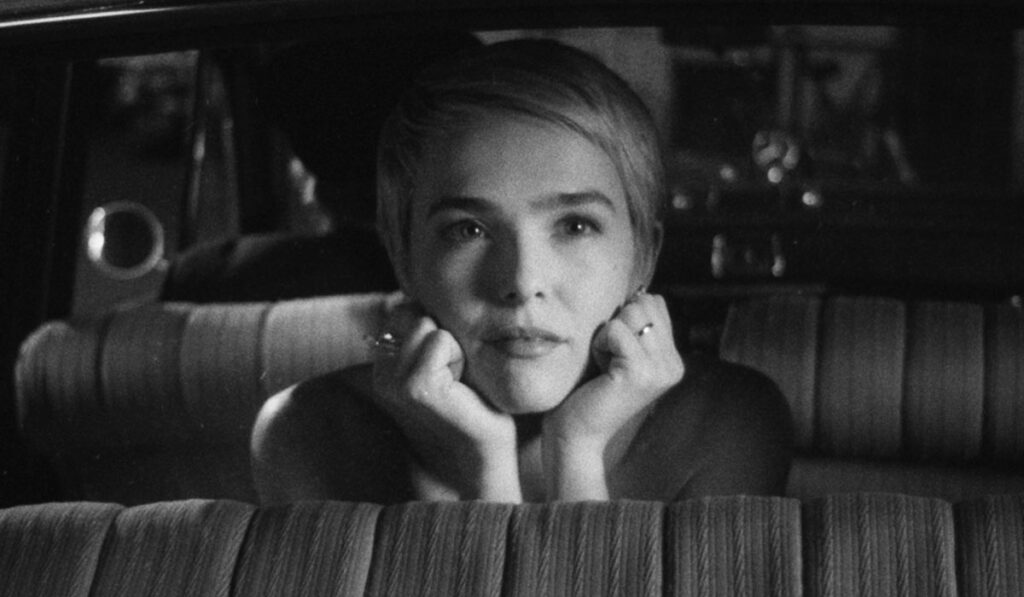
I mean, it was so fun for me to get the opportunity to work with him again, 10 years later. One for the obvious reasons that you are friends and you are less afraid. You have a foundation and a relationship, which is obvious with him. But it was cool for me because I’m such a different human being and such a different actor, and 19 to 29 is a pretty big jump. So, I thought it was a really awesome opportunity to identify the differences in myself, actually.
So, returning to an earlier point you had made, you did not know French before getting cast. Personally, if I had to shoot a role in a different language, I know I would completely panic unless I had five years to learn it. This wasn’t a line or two. You had to be conversational with it. Was it harder than you thought it would be, or did it come naturally?
It definitely did not come naturally. [Laughs.] I don’t think anything comes naturally to me. Honestly, I wish I could say that. I just worked at it for hours and hours and hours and hours every day, and I had a wonderful French tutor. And then also our producer, Michèle [Pétin], she helped me and came on as an additional tutor, and she was able to really hear the differences. Jean had a pretty famous dialect and way that she speaks French in France. We’re not hearing that difference [in America]. But yeah, that language barrier was one of my great connectors to her. I mean, she was also learning how to speak French when she made “Breathless.” So, making a movie, improvising, and having no script for a movie in a language that you’re just learning how to speak? I mean, that’s very, very intimidating, and I felt that tether and that connection because I too was intimidated.
Are you conversational now?
I just have to learn the lines in French, speak them as best as I can, and know what I was conversational when I was shooting the movie. Then I was just paralyzed with fear. But the truth is, I couldn’t learn it just phonetically. That was not really an option. I thought maybe it would be when I really, when I was really struggling with the language, but it doesn’t work for other people’s lines. Obviously, if they say it in a different order, if they talk a certain way or faster, and acting is reacting, I can’t just learn it phonetically.
Totally get it. This movie changed Jean’s life, and then years later, she went through a lot of struggles. Her story is sort of incredible. How important was it to you to frame this performance as a particular Jean Seberg at this time in her life and to not hint at anything else? Was that something you were cognizant of, or was it just inherent in the material?
Well, I think both, but you obviously want to be intentional that you’re not reading ahead. And Rick was pretty clear. Godard is not this icon. Jean is at the beginning of her career. Reminding everybody that these are not who they are now to us, and that we’re portraying a very particular moment in time.
And I’m assuming you researched…
No, I just guessed. No, of course.
I mean, obviously. But was there anything you discovered in particular that you held with you during filming?
Yeah, there’s a lot. But I mean, one thing that’s of the things that she’s most famous for is her hair. And it was interesting to find out it wasn’t intentional. It wasn’t, “I’m going to be iconic.” It was an accident. She made a movie called “Saint Joan.” She was playing Joan of Arc, and they shaved her head to play Joan, and that was just the awkward grow out from that haircut. I didn’t know anything about the trauma of her life, the two movies before with “Saint Joan” and “Bonjour Tristesse” with Otto Preminger, and how he treated her, and that she was just plucked from obscurity in Marshalltown, Iowa. And she had one of those crazy, crazy tales of having no foundation or community as an actor, beginning as a young woman and just being torn to shreds, which is obviously something that history repeats itself and really just tragic in the way that she was handled in the media. I dunno how that still happens and why that’s still happening.
Yeah, it’s sadly still going to happen. My last question for you is sort of my favorite question to ask people nowadays. I know you’ve been doing press all day, but if I were just to meet you on the street and say, “Nouvelle Vague,” what would be the first memory that you think would pop into your mind?
That’s a good question. I mean, the first thing that popped into my mind was in rehearsal. Me and Aubry Dullin, who plays Belmondo, we were in the production office with a little TV. It was me, Aubry, and Rick. And we were watching the New York Herald Tribune scene on a loop because we were recreating that in the “Breathless” scene. So, we were doing the choreography, but we’re like, “O.K., her left foot is there, so now it’s going to be her right foot. And her hand goes up, she puts her hand up for four seconds.” We were timing out the choreography of how it looked in ‘Breathless” so that we could recreate it. And it was just a couple of hours of obsessively watching that scene and writing it down. And that’s the first memory that pops into my mind.
“Nouvelle Vague” is now in limited release. It will debut on Netflix in the U.S. on Nov. 14.
Follow Gregory Ellwood on Bluesky
Follow Gregory Ellwood on Threads
Follow Gregory Ellwood on Instagram
Sign Up For The Breakdown Newsletter

Editor-at-Large Gregory Ellwood is one of the entertainment industry's most respected journalists and critics. Based in Los Angeles, he's the only current awards expert who previously worked on Oscar campaigns at a major movie studio. Over the years, he has written for the LA Times, Variety, The Hollywood Reporter, and Vox, among others. He also co-founded the entertainment news site HitFix, which spawned a legion of influential Emmy and WGA Award-winning alumni.


