


3. While classmate Jake Brackman claims the extensive voiceover in the film was used to patch up holes in the narrative, Billy Weber & Malick feel otherwise.
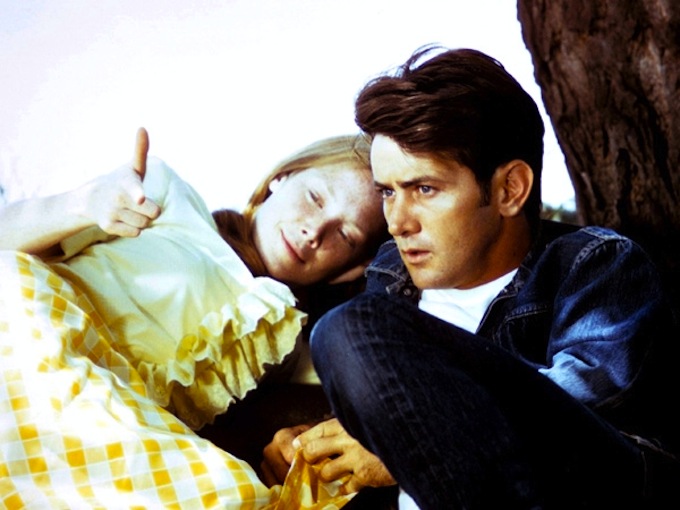
The audience is guided on the strange journey of Holly and Kit in “Badlands” by Sissy Spacek’s evocative and not particularly plot-driven voiceover, but according to Jake Brackman, a Harvard classmate of Malick’s and a screenwriter, it was more by necessity than design. “There were so many holes in the storytelling because of the constraints and difficulties of the shooting that it entailed a tremendous amount of fooling around with the voice-over to tell the story, and also to conceal the expositional nature of the voice-over by putting in a lot of oblique voice-over that was not at all expositional,” he told GQ. “It was like patching the holes in the road.”
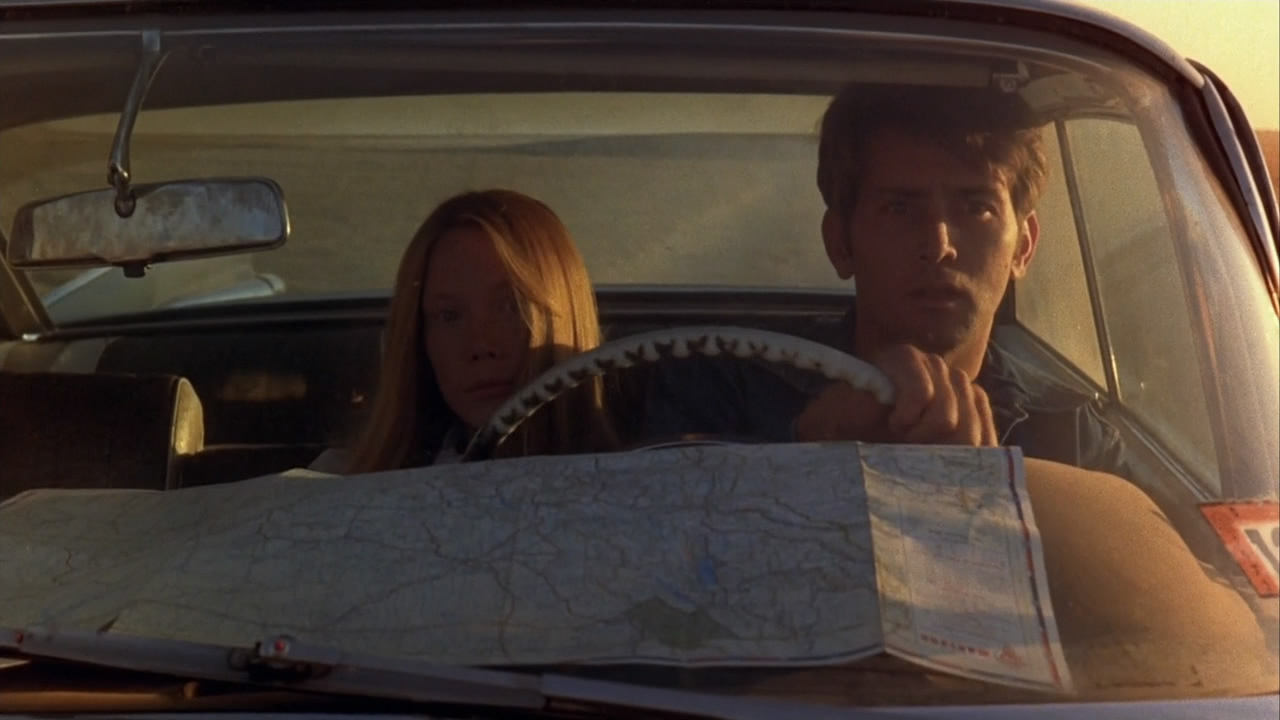
But this is likely just Brackman’s opinion. In speaking to Sight & Sound, Malick says he had a very specific purpose for Holly’s narration. “There is some humor in the picture, I believe. Not jokes. It lies in Holly’s mis-estimation of her audience, of what they will be interested in or ready to believe. She seems at times to think of her narration as like what you get in audio-visual courses in high school. When they’re crossing the badlands, instead of telling us what’s going on between Kit and herself, or anything of what we’d like and have to know, she describes what they ate and what it tasted like, as though we might be planning a similar trip and appreciate her experience, this way.”
And Malick’s long-time editor Billy Weber concurs, saying the voiceover in Francois Truffaut’s “Wild Child” was a big influence. “The use of the voice-over is very dramatic and really good” he said on the Criterion DVD extras. “And we loved that voice-over, so we tried to refer to it often with each other.”
“What it meant it was, sometimes Truffaut would talk about something the wild child had done in the voice-over — you’d see him writing in his journal and you’d hear his voice,” Weber said. But then Truffaut would use voice-over to ask more esoteric questions, and this became a key influence on Malick and Weber. “It gave the movie a real, wonderful, dramatic quality,” he said.
Weber added that use of voice-over in Malick’s film had been an evolutionary process of experimentation, and notes that, for example, the filmmaker had never intended to use voice-over for “Days Of Heaven,” but through experimentation, it too became an integral part of the film (for more on that film, make sure you read our “Things You Didn’t Know About Days Of Heaven” feature).
“A voice-over is like adding music,” Weber said. “It really changes things and you realize it gives you an overall different rhythm to the movie. So you end up wanting to recut based on the voice-over and then maybe changing the V.O., redoing some of it. So it’s a such a big influence. It also allows you to create montages in areas that weren’t intended to be montages or won’t be intended to be split up.”
4. While the anti-hero concept wasn’t exactly new in cinema, it was still startling, and some were blow away with how the audience sympathized with the lead character.
Actor George C. Scott saw it in previews and told Martin Sheen that he was in awe. “ ‘You are the most charming villain I have ever seen!’ ” Sheen recalled Scott telling him. “ ‘You’re pulling for this horrible mass killer. You’re concerned about him, you feel for him. You’re attracted to him.’ I was like, ‘Wow, that’s Terry Malick.’ I could never have conceived of that in a million years. I didn’t have a clue where he was taking me, but I was smart enough to know he was onto something and just follow him; do everything he said. Sissy would agree. We both knew to trust him.”
5. Jack Fisk hadn’t seen “Badlands” in almost four decades.
Jack Fisk, the legendary production designer married to Sissy Spacek — they met during the filming — took half a lifetime to see “Badlands” again, but doesn’t seem to have any hard feelings or issues about the making of the film (indeed, not only did he find a wife during the filmmaking, he’s gone on to be a constant Malick collaborator and worked on every one of his films since). “I went a long time without seeing it,” Fisk said on the Criterion making-of documentary, noting that he saw the movie just a few years ago at a film festival (probably the LACMA screening). “I hadn’t seen it in 35-40 years. It was more like looking through a photo album, looking back at an early part of my life. Through Terry I learned that filmmaking could be art.”
“I’ve always approached art direction through character, and I just started filling up all the drawers of Holly’s house with stuff,” Fisk told GQ in 2011. On the DVD, Spacek recalls this vividly and almost suggests this was Fisk’s way of flirting with her by providing a bedroom for her character that was totally alive, rich and full of things and trinkets that she might use. He was also one of the few unquestionably loyal people on the film crew. “The whole crew changed over several times, except for the art department and the actors. The people that money was important to left early, and the rest of us made a great film.”
Criterion has posted the first four minutes of “Badlands,” which you can see below.
6. The iconic music in Badlands’ was originally intended for Irvin Kershner’s “Dirty Harry,” which Malick was hired to rewrite the script of.
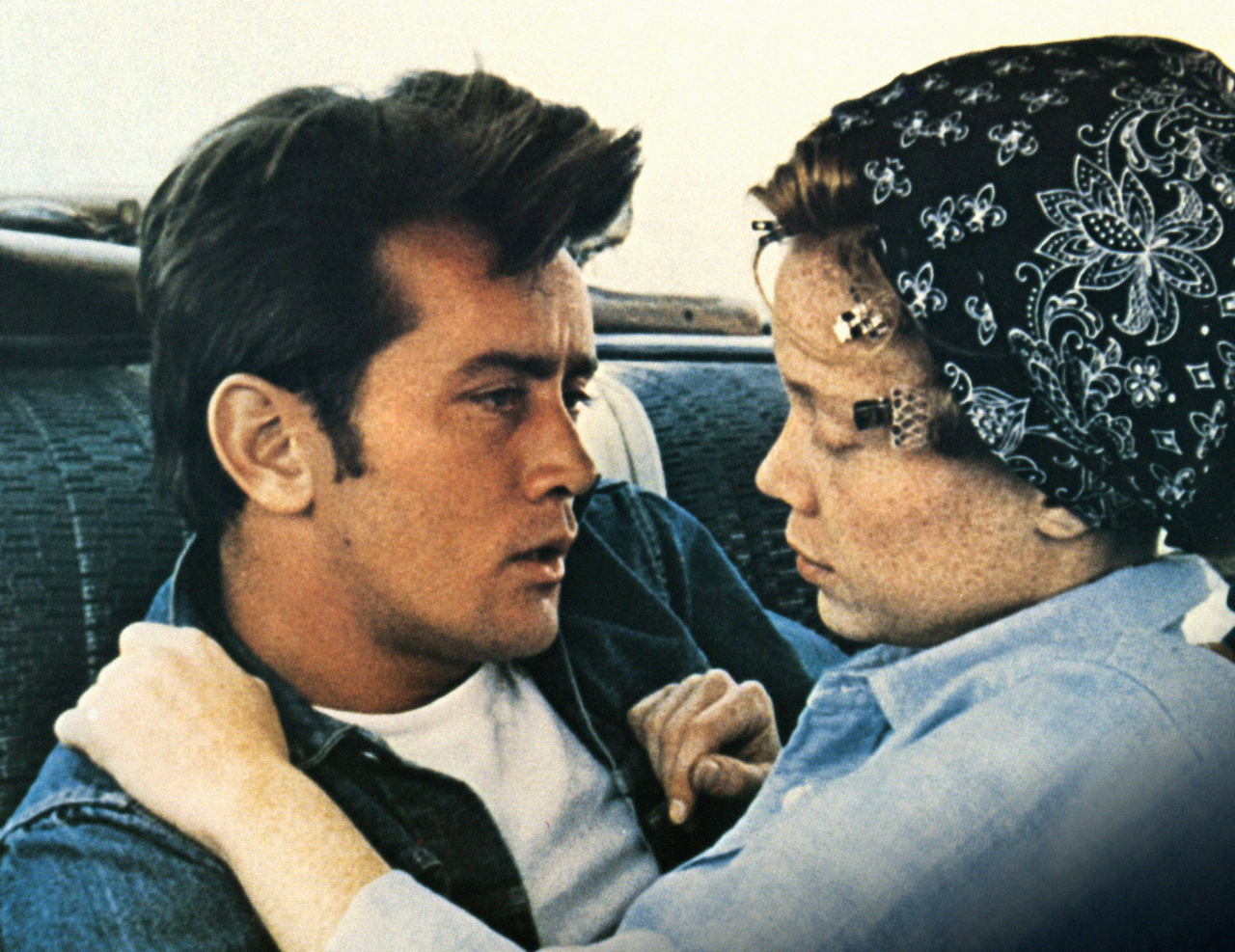
The indelible piece of music used in “Badlands” is Carl Orff’s “Gassenhauer.” The way Malick came upon the piece of music points to one of the historical bits of trivia about the filmmaker.
“Terry had heard the Carl Orff music earlier when he was he was writing a movie for Irv Kershner,” Billy Weber revealed on the Criterion Extras. “And Kershner knew the music and played it for Terry and said he was thinking of using it. It was a movie that never got made. And so Terry fell in love with it and thought it would be perfect for Badlands.”

The Irvin Kershner project (he directed “The Empire Strikes Back”) was an aborted attempt at “Dirty Harry.” In his time studying film (pre-“Badlands”), Malick worked as a rewrite man and helped shape, among others, an original script for “Dirty Harrry” intended for Kershner to direct. It never happened — the now famous 1971 movie was eventually directed by Don Siegel with a script by Harry Julian Fink said to have featured some uncredited rewrite work by John Milius — but both Marlon Brando and Frank Sinatra were considered for the role of Harry Callahan. One would love to look at that script and see if there were any similarities, if any, to “Badlands.”
What Malick loved about Orff’s song is that it was performed by children and had a naive and innocent quality to it perfect for “Badlands.” While the movie made the piece of music iconic, it’s perhaps better known by modern audiences for its use within another lovers-on-the-lam film. In a Quentin Tarantino-esque move, Tony Scott nicked and reappropriated the Orff piece for “True Romance,” only in his movie it’s slightly different, reworked by that film’s composer Hans Zimmer and retitled “You’re So Cool.”

