


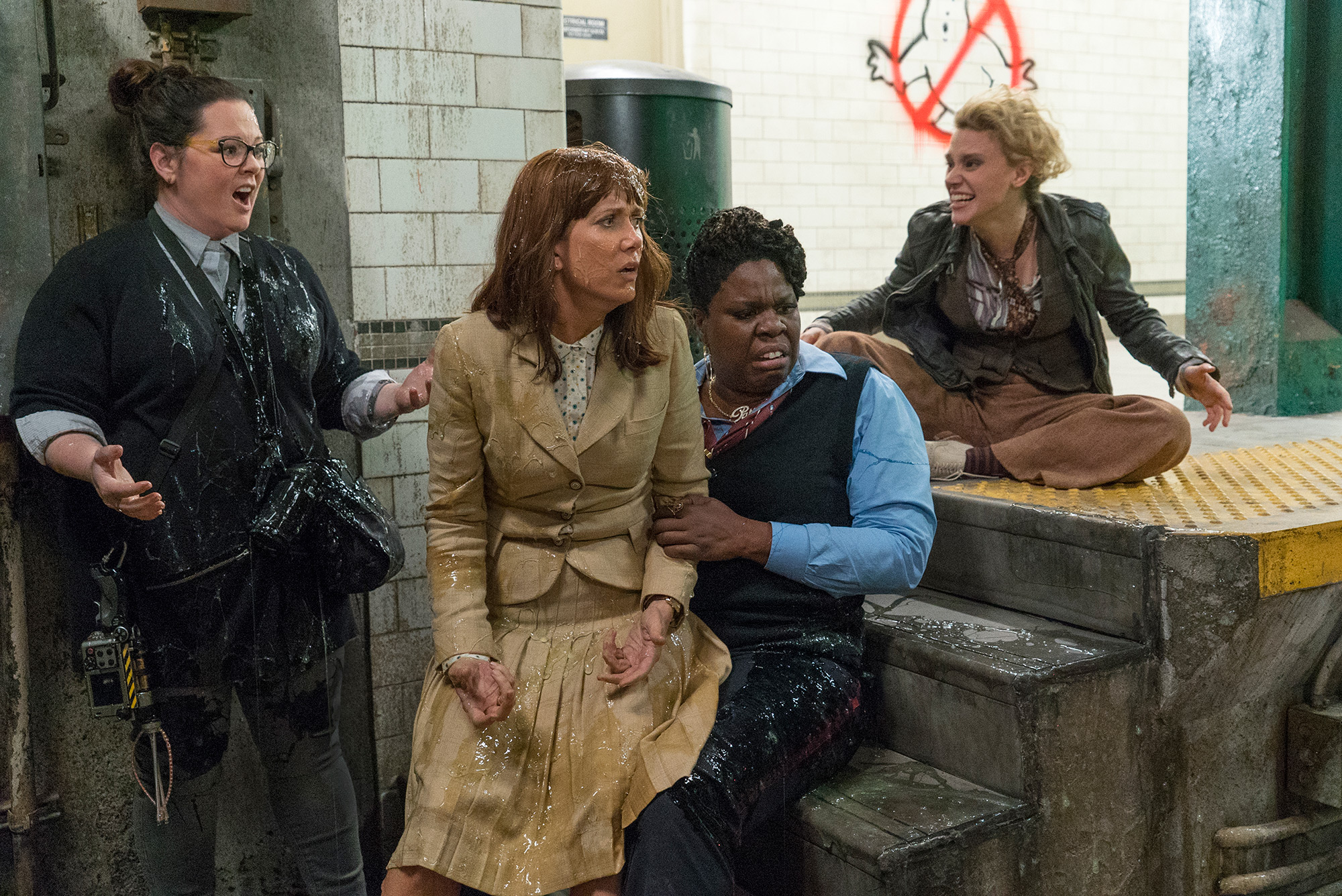
The Telegraph‘s Robbie Collin wrote an elegant 8-tweet precis that incisively tracks the evolution of the “Ghostbusters” backlash, identifying the opening of the film to largely positive reviews (73% on Rotten Tomatoes) and not-stellar-but-solid box office ($46m opening weekend) as merely another in a long line of hills that this particularly vocal gang of bigots were willing to die on, until they saw that they would actually die on that hill and moved the battleground elsewhere. Here they are in full:
https://twitter.com/robbiereviews/status/755323025676009472
https://twitter.com/robbiereviews/status/755323291393556480
https://twitter.com/robbiereviews/status/755323513699958784
https://twitter.com/robbiereviews/status/755323810203697153
Collin is absolutely right in locating the vitriol of the “Ghostbro” movement in a wider culture of bigotry that preexists the new “Ghostbusters,” but that found in it a convenient star to which to hitch its wagon of shit. Like ‘Batman vs Superman,’ the film is all but erased from the chatter around it, which takes on a life of its own. Reviews of “Ghostbusters” (even our own, which was one of the more negative) are critiqued on the basis of how much they do or do not contend with these wider implications, and along with news articles, box office reports, twitterstorms and op-eds simply become grist for a far bigger mill in which much deeper bigotries and much broader ideologies can duke it out.
Some of this might sounds eerily familiar to anyone who’s been keeping even half an eye on the world news recently. It’s quite analogous to the phenomenon dubbed “post-truth politics” that has been gaining some traction, especially in 2016. It’s a doctrine that suggests that the “truth,” or factual basis of a policy, doesn’t matter nearly as much as the politics and politicking that surrounds it. Hence we get Donald Trump, whose popularity remains undimmed despite the multitude of demonstrable untruths and fictions he has spouted, and in the U.K. we get Brexit, a force for massive destabilization which was ratified democratically despite many of the claims of the pro-Brexit advocates being proven to be false. None of this is to suggest an equivalence in terms of the worldwide importance of an all-female reboot of a 1984 comedy-sci-fi-horror to the U.S. Presidential race or Britain leaving the European Union. But it is to say that the disturbing social shift that underpins both those phenomena is also making itself felt in the tributary of society concerned with cinema. And it should be troubling to anyone who loves film culture, of which blockbuster culture is a crucial part.
In his 1964 book “Understanding Media: The Extensions of Man,” Marshall McLuhan cautioned against being so distracted by the content of the “message” (here, let’s call it what-goes-on-in-a-film) that we fail to notice its “medium” —that is, the manner in which it is presented and received. That doesn’t really seem to be much of an issue any more, when it’s much more likely we’ll get so hung up on the medium, as he defined it, that we lose the message altogether. McLuhan’s thesis is a plea to consider cultural objects in their entirety, but that’s hardly possible in this case, where the film has become so dislocated from its meaning in the world. If we live in an era of post-truth politics, is “Ghostbusters” the first volley in post-film film culture?
We can hope not, and when the general provides very little comfort, how about the anecdotal: the biggest “Ghostbusters” (1984) fan I’ve ever met —let’s call him Elliott, because that’s his name— turned 10 last month. Long before “Ghostbusters” (2016) was announced, he had a vast, exhaustive (and genuinely exhausting) knowledge of the original film: he’s collected the toys, he’s watched the old cartoons (as close as the ’80s got to an “expanded universe”), he drove his mother to the brink of financial ruin acquiring every single brick of the 30th anniversary Ghostbusters Lego line. Elliott, who by virtue of his age is maybe not the most critical thinker in the world, but also hasn’t been sullied by all the noise, thinks “Ghostbusters” (2016) is the best film ever made. Here’s an actual child whose summer (if not his entire childhood, because you know, he’s 10, he’s not a moron) has not just not been ruined, but has been made by the reboot of his favorite-ever film. And he genuinely doesn’t care or even seem to really notice that all four of the leads are women. He’s the last person I’ve spoken to about “Ghostbusters.” And now I’m kind of looking forward to it.

- Jessica Kiang
- Jessica Kiang
- Jessica Kiang
- Jessica Kiang
- Jessica Kiang
- Jessica Kiang
- Jessica Kiang
- Jessica Kiang
- Jessica Kiang
- Jessica Kiang
- Jessica Kiang
- Jessica Kiang
- Jessica Kiang
- Jessica Kiang
- Jessica Kiang
- Jessica Kiang
- Jessica Kiang
- Jessica Kiang
- Jessica Kiang
- Jessica Kiang
- Jessica Kiang
- Jessica Kiang
- Jessica Kiang
- Jessica Kiang
- Jessica Kiang
- Jessica Kiang
- Jessica Kiang
- Jessica Kiang
- Jessica Kiang
- Jessica Kiang
- Jessica Kiang
- Jessica Kiang
- Jessica Kiang
- Jessica Kiang
- Jessica Kiang
- Jessica Kiang
- Jessica Kiang
- Jessica Kiang
- Jessica Kiang
- Jessica Kiang
- Jessica Kiang
- Jessica Kiang
- Jessica Kiang
- Jessica Kiang
- Jessica Kiang
- Jessica Kiang
- Jessica Kiang
- Jessica Kiang
- Jessica Kiang
- Jessica Kiang
- Jessica Kiang
- Jessica Kiang
- Jessica Kiang
- Jessica Kiang
- Jessica Kiang
- Jessica Kiang
- Jessica Kiang
- Jessica Kiang
- Jessica Kiang
- Jessica Kiang
- Jessica Kiang
- Jessica Kiang
- Jessica Kiang
- Jessica Kiang
- Jessica Kiang
- Jessica Kiang
- Jessica Kiang
- Jessica Kiang
- Jessica Kiang
- Jessica Kiang
- Jessica Kiang
- Jessica Kiang
- Jessica Kiang
- Jessica Kiang
- Jessica Kiang
- Jessica Kiang
- Jessica Kiang
- Jessica Kiang
- Jessica Kiang
- Jessica Kiang
- Jessica Kiang
- Jessica Kiang
- Jessica Kiang
- Jessica Kiang
- Jessica Kiang
- Jessica Kiang
- Jessica Kiang
- Jessica Kiang
- Jessica Kiang


