


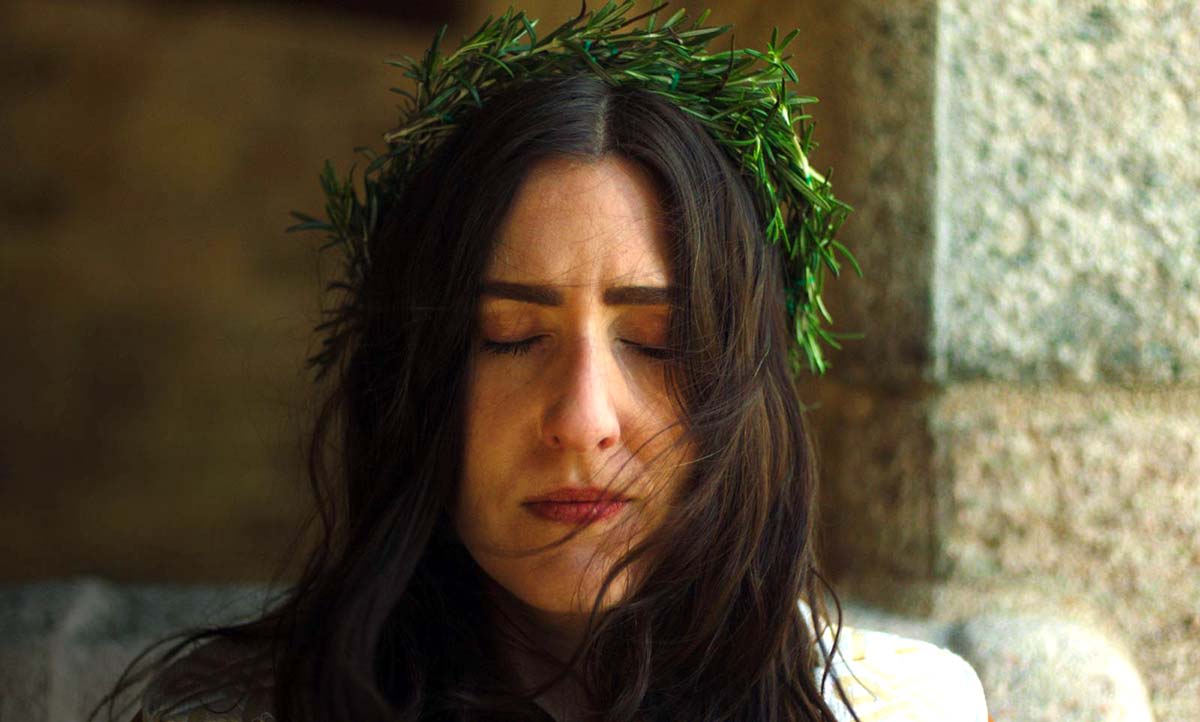
Director Caroline Golum is having a full-circle moment. Raised by cinephiles in L.A., she moved to New York for its indie filmmaking and art house cinema scene; now, she’s debuting her second feature film at one of the repertory theaters she first called home. “Revelations of Divine Love,” an exultant adaptation of a medieval Christian text, will have its U.S. premiere at the Anthology Film Archives on March 27th, following its international premiere at the 2025 Festival International de Cinéma de Marseille.
The film follows Julian of Norwich, a mystic played by Tessa Strain, as she writes about her deathbed visions of Christ from a church in 14th-century England. While she puts her ecstasy to paper, the world rages on outside her window as the Black Death and the Peasants’ Revolt sweep the country. With folk-art visuals and a script that draws heavily on the original text, “Revelations of Divine Love” exudes sincerity and high-level craftsmanship in every scene, from the performances to the camerawork.
You hardly have to spend a minute with Golum to figure out that she knows her shit — one must, if she’s going to make a gorgeous movie with $100,000 and a warehouse rented from Craigslist. No topic was too obscure as we discussed Jewish authorship, directing on a micro-budget, and how to cast the role of Jesus Christ. (Pro tip: Send your casting team portraits of mummies!)
This interview has been edited and condensed for clarity.
How did you arrive at this source material?
I found out about Julian of Norwich because my co-writer, Laurence Bond, who acted in my first feature, “A Feast of Man,” went back to school to study medieval history and read me a paper he had written about Julian in the spring of 2017. I was unhappy about my job and the state of the world, and then I heard him talk about Julian, and I went, “Holy smokes, this would make an incredible movie.”
I read more Christian theology, and the theologians who really love Julian, like Thomas Merton, John Henry Newman, and C.S. Lewis, those are the people who I think have the right beat on it. Reading about Christianity from their perspective made me realize that I can apply those principles to my everyday life without being a believer. I can choose to love people that I otherwise wouldn’t give a shit about, I can choose to forgive, I can choose grace. Growing up in the shadow of the Iraq War, it was nice to read theology that was about rejecting power and rejecting capitalism, because American Christianity is all about embracing those things.
“Revelations” has a very distinct visual style. Did you have a sense of what you wanted the film to look like going in, or is that all thanks to the art department?
It was a combination of things. Laurence and I established some basic aesthetic principles while we were writing. And what we were drawing from was — get ready — St. Augustine’s duality of man.
Hell yeah.
Yeah, let’s go, right? So St. Augustine describes the city of man, where we live, as being fake, but says that true existence is in the city of God, in heaven. Working with that as our framework, we decided that Julian’s visions would be in natural light, outdoors, in real spaces that would be way more expansive and recognizable to a contemporary audience than the film’s actual realm. We also figured that, for any modern audience watching this movie, their first inclination would be that Julian was mentally ill or that she’s hallucinating. So if we made her visions look more recognizable to a contemporary audience, and then the real world that she inhabits look more stagey, it would flip that script of, well, what is the reality and what is the hallucination?
From the beginning, I wanted to do something that was very stagey. The medieval films I love really played with the era’s innate artifice. Our cinematographer, Gabe Elder; our art director, Grant Stoops; my producer, Kate Stahl; and my assistant director, Sydney Buchan, all did the set building. It was a lot of carving up insulation foam and painting it to look like different things, painting backdrops, striking and dressing sets for different scenes. We did not have much space, but we built it all ourselves and tore it all down ourselves. It was a lot of work, and it shows.
Tell me about some fun shortcuts you used to try to convey the time period on such a tight budget.
There’s a shot of a baptismal font that’s not even a real font; it’s a candle holder that I bought on Etsy. We tried to maximize old photography tricks like that. Julian’s book of hours is a reproduction of a book of hours that Laurence gave to me a bajillion years ago, and I bound it in green ribbon to make it look older. The hazelnut in the film that Jesus hands to Julian in one of her visions is from the real Julian’s shrine. I got that when I went to Norwich for the first time. I went to Oxford for a conference where I talked about the film, comparing Julian’s description of her visions to Paul Schrader’s “Transcendental Style in Film,” and while I was there, I did a jaunt up to Norwich for the first time.
Wow.
A lot of this stuff came from my house. Two of the chairs are my dining room chairs. I was basically bringing in anything that wasn’t bolted down.
How long did it take to film “Revelations”?
There was a month of set building, then a five-week shoot of five-day weeks, so maybe 25 days. And then we had three days at Glen Cairn, this splendid mansion where we shot Julian’s visions, and then one pickup day on the eclipse for the crucifixion scenes.
Were you like, “This crucifixion requires an eclipse,” or was it just happening and you were like, “Let’s take advantage”?
An eclipse allegedly occurred at the real crucifixion of our Lord and Savior Jesus Christ, so I thought it would be a nice little historical detail to include.
Cool! I didn’t know that, even though I was raised Christian.
Mazel.
[Laughs] Thank you. You have obviously studied the religion a lot more than I have, but still, how did it feel to tackle this movie as a Jewish woman?
Our motto on set was that most of the biblical films that you love from Old Hollywood were made by Jews, queers, commies, queer Jewish commies, and lapsed Catholics. Who the fuck do you think was making all these sword-and-sandal movies? A bunch of Jews! There’s a rich tradition of us making these movies. “Hail Caesar!” is a great film about Jews making a movie about Christ and going, “Ahh, do we do this right?”
Did you ever wonder, “Am I doing this right?”
My ace in the hole was that I wrote this film with Laurence Bond — sorry, Dr. Laurence Bond, PhD. He just defended his dissertation a couple of weeks ago, and we are very proud of him. We wanted to be historically accurate where we could, and that meant having a brown Jesus, shooting an eclipse at the crucifixion, and relying heavily on the primary sources that we knew of from Julian’s time. The rest of it is just us winging it.
Speaking of, how did you cast Jesus Christ?
I sent my casting agents pictures of the Fayum mummy sarcophagi, which are sarcophagi from the 1st century C.E. Instead of a sarcophagus with a carved face, as you would see in ancient Egypt, these featured portraits of the person who was in the sarcophagus. If I had to guess what Jesus Christ looked like, living in Palestine in or around the 1st century C.E., he probably looked like one of the Fayum mummies. So I sent my casting agents those portraits, and they came back and sent me a bunch of people, and Abraham Makany gave a fucking killer read.
I also thought it was really important to have a hot Jesus in this movie. People tend to regard Christian films as being weird and reactionary and sexless and strange, and I’m not making one of those movies. I would direct one of those if the check were big enough. I want the evangelicals to see this and be like, “Damn, this Jewish girl was right! We’ve been living a lie!” But anyway, I wanted people to look at this and go, “Man, I can’t wait to see this guy’s face again,” because that’s how Julian is. She’s thinking, “I can’t wait to talk to my Lord again. I want to get back there.” As the audience watching this happen to her, we’ve got to want to get back there, too.
As I was reading up on Julian for this interview, I love that she was one of several mystics working at the time.
Oh, it was a very common thing.
We need more fucking mystics!
I think the world we live in now is much less permissive about these things. There’s an impulse to diagnose everybody retroactively, but it’s foolish of us to apply our contemporary understanding of the mind to people who were living and working 600 years ago. Who am I to say that this woman didn’t have a real engagement with the divine? I believe that she did, or else there wouldn’t be a movie. It’s stupid to just be like, “Oh, she was crazy. Isn’t that crazy?” That’s a boring story. Isn’t it more interesting to accept the mystery?
My final question is, on a scale of one to ten, how sick do you think your friends and family are of you talking about medieval history?
How sick am I of talking about it? The answer is: on a scale of 1 to 10, an 11. But I’ll leave you with this anecdote: Last Halloween, Grant and I went to see “Phantom of the Opera,” the 1925 silent film, at the Cathedral of St. John the Divine, and I said, “Why do we love this stuff so much?” And he said, “Because it’s high effort.”
How sick are my friends of hearing about it? I don’t know, but everyone that we made the film with keeps going, “When are we making another movie?” If I had my druthers, if money were no object, I would make a movie every two or three years, and I wouldn’t change a fucking thing about the cast and crew. It would be the same people, and we would bop from genre to genre, making whatever the hell we want.
“Revelations of Divine Love” opens on March 27th at Anthology Film Archives in New York City, where it will play through the weekend as part of the series “Revelations of the Middle Ages,” programmed by Golum. It will then play at Nitehawk Prospect Park on Easter Sunday, April 5th, then at Low Cinema on April 11th, then at Roxy Cinema from April 17th to the 19th, and finally at Spectacle Theater from April 24th to the 26th.


