


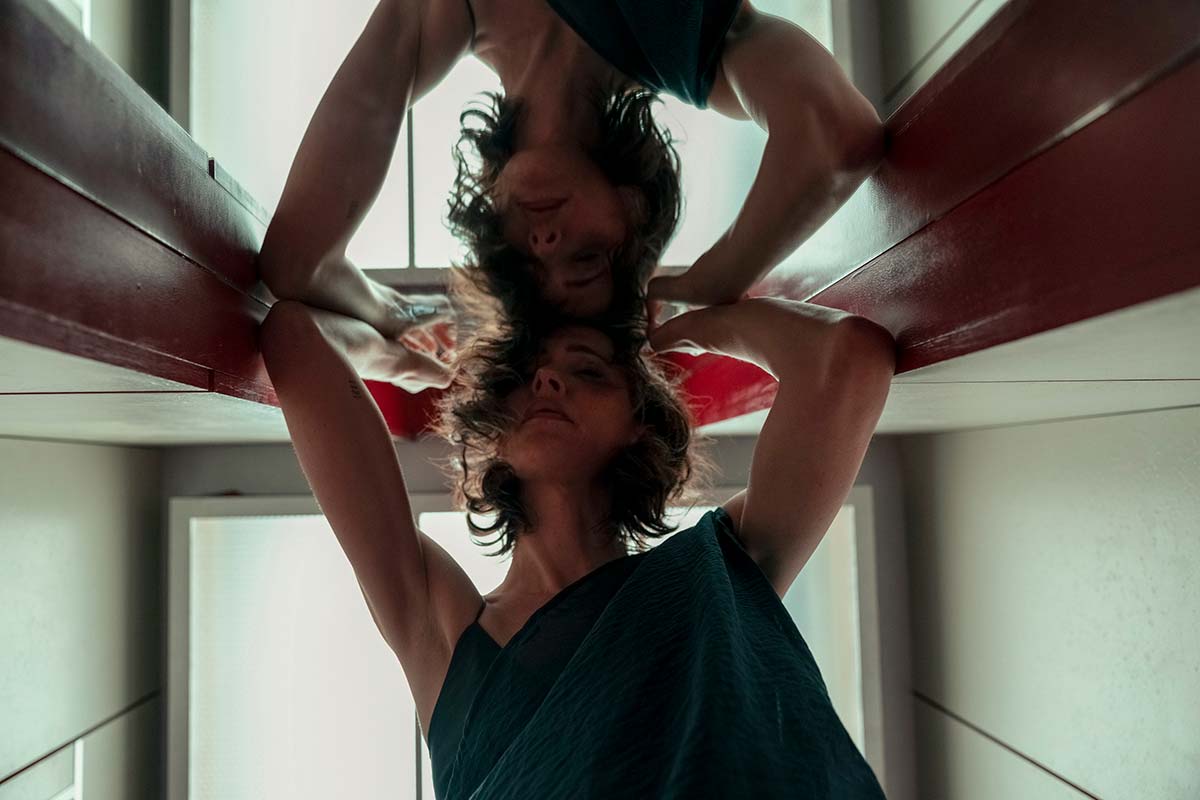
Michael Schur built one of the great endings of contemporary television with “The Good Place” by defying the allure of immortality. At the height of platitude, William Jackson Harper’s Chidi Anagonye decides to end his eternal life, beautifully explaining his reasoning to soulmate Eleanor Shellstrop (Kristen Bell): “The wave returns to the ocean, where it came from and where it’s meant to be.” The heartbreaking moment encapsulates the thesis of the Netflix show, which Maria Martínez Bayona attempts to somewhat replicate in her feature debut, “The End of It.”
READ MORE: 27 Most Anticipated Films From The 2026 Cannes Film Festival
Somewhere in the near future, death is optional. Rebecca Hall’s Claire has reached the big age of 250 years by tethering herself to a blood-renewing machine during breakfast and getting every single bone in her body replaced by a sturdier, non-brittle material. But the milestone birthday only further exacerbates a growing emptiness within the formerly provocative artist turned jewelry designer. A few minutes after lacklustrely blowing out the candles on her personalized cake, Claire declares to her loved ones: she will immediately curb all life-extending treatments and let nature run its mechanically faulty but spiritually perfect course.
Claire’s decision causes opposed reactions from her unnamed husband and estranged daughter, played by Gael García Bernal and Noomi Rapace. While the husband refuses to let go of his longtime companion, the daughter sees in her mother’s death the chance to become a mother herself, as, in this world, one can only be born once another has passed away. It is an interesting enough setup for the lo-fi sci-fi subgenre that prods at the grandeur of the existential through the clean aesthetics of the high-tech.
However, Martínez Bayona falls into the trap of a first feature by muddying her premise through overcomplication. It is not enough for Claire to decide to die; she must suffer a gruelingly rapid decay resembling that of Demi Moore in Coralie Fargeat’s “The Substance,” her nails meeting rotting teeth at the bottom of the sink as she washes it all down with bloody water. But that is not enough either. Claire must have a big death, a death becoming of an artist that was once great and who has spent several natural lifetimes futilely seeking that elusive brilliance. So Claire decides to turn the offer of a career retrospective at a MOMA-like museum into one final performance art hooray. She will die in front of an audience to remind the defiant immortals of how visceral and ugly the biological can be.
The Spanish director populates her big co-production with an international talent roster that also includes Brits Susan Wokoma and Jyuddah Jaymes as hip gallerists and Frenchman Vincent Paquot as a stern bureaucrat. American indie darling Beanie Feldstein plays Claire’s humanoid personal assistant slash server, dressed in sack-like outfits and often portrayed as a punchline, among many examples of the film’s misguided treatment of women existing outside the exclusive, claustrophobic confinements of perceived perfection. In a scene meant as a defiant takedown of this very notion, Martínez Bayona has Claire dress in a silicone suit that resembles the sagging body of an old woman. Standing atop the pulpit of a modern-day church led by an infant preacher, the artist shakes the polymer body to shock an audience of sculpted beauties in a feat of such needless hagsploitation that it causes whiplash.
This bitter throughline extends throughout the film, sucking all semblance of profundity out of it, leaving in its place a hollow carcass. As the countdown to her heavily publicized death ticks down, Claire begins to feel the kick of pre-mortem surge, plucking at the deepest innards of sentimentality to extend a sliver of grace towards her daughter and briefly reigniting a long-dormant passion in her marriage. Those sequences, on top of being dissonantly saccharine, also expose how dreary the usually great García Bernal and slightly more oscillating Rapace are here. The Swedish actress plays the daughter as if mockingly emulating a six-year-old, her gaze always turned downward and her voice hesitantly emerging from her chest with baby-like affectation. The Mexican star limply tries to find a little substance in his thankless role, but ends up relegated to a narrative crutch for his much more well-developed wife.
To her credit, Hall does not phone in a performance in a film that often seems to push her towards that easy exit. The actress lends much-needed gravity to Claire’s grand philosophical question, shifting from anguished mania to mellow contemplation with effortless skill. It is only in the grand final number that the “Christine” star drops her carefully balanced ball, finally succumbing — literally and metaphorically — to the superficiality of Martínez Bayona’s affair. [D]

Rafa Sales Ross is a Brazilian film journalist, critic and programmer currently living in Scotland. She contributes to Variety, BBC Culture, Sight & Sound among others, and can often be seen writing about Latin American Cinema and explorations of death and desire.


