


 “Les Enfants Terrible” (1950)
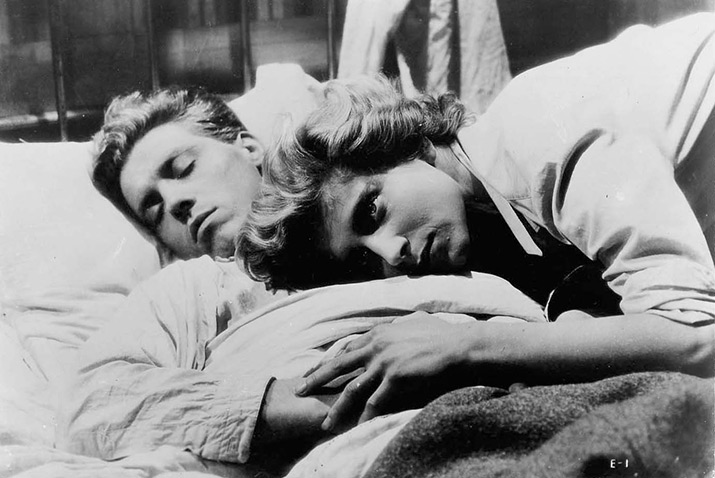
If his first film has little relation to his gangster pics, “Les Enfants Terribles” is a complete stranger in Melville’s oeuvre, a deformed statue looming gloomily amongst his collection of more refined sculpture. But, what compelling gloom! Written by legendary poet-filmmaker Jean Cocteau, the film closely follows the relationship between a sister, Elizabeth (Nicole Stéphane, a ferocious performance that rotates about 540 degrees from her role in “La Silence de la Mer”) and her brother, Paul (Edouard Dermithe, devoured by his on-screen sister in more ways than one) as they move from their claustrophobic urban apartment and into a grotesquely lavish villa. Along the way, they laugh in the face of decency and embroil two innocent friends, Gerard (Jacques Bernard) and Agathe (Renee Cosima), in their debaucheries. Cocteau’s own exalted narration of this morbid world hangs over the entire picture like sweetly-scented poison, as gender (especially through Paul’s crush on schoolboy Dargelos, also portrayed by Cosima), death, innocence, and sibling rivalry are redefined through Melville’s lens and Cocteau’s fascinating imagination. Melville’s go-to cinematographer Decaë does some of his finest work here, especially once the story shifts to the mansion, and Vivaldi is all abrasive magnificence on the soundtrack, at times almost too overwhelming. The characters’ personalities make it a tough watch, but “Les Enfants Terrible” remains an awe-inspiring collaboration between two enormous filmmakers, and an unforgettably poetic exorcism of the spirit of youth.
 “Bob Le Flambeur” (1956)
This is the grand opening of Jean-Pierre Melville’s seedy criminal underworld. Silver-haired gentleman and compulsive gambler, Bob Montagné (Roger Duchesne) is down on his luck and dangerously close to being completely broke. Together with a team of thieves, including young Paulo (Daniel Cauchy), long-time chum Roger (Andre Garet), and foreign commandant McKimmie (Howard Vernon), he cooks up a plan to steal 800 million francs from the Deauville casino safe. The narration, by Melville himself this time, is sparse compared to the previous two major entries of his career, almost as a sign of things to come; it’s a world best left to speak for itself. “Bob le Flambeur” is the first taste we get of Hollywood’s influence on Melville’s stories; the mood evoked by America’s gangster pictures gets a sly and witty reinvention here, held together by Eddie Barclay and Jo Boyer‘s nostalgic saxophone (hugely pleasing to the ear), Duchesne’s debonair portrayal of a criminal holding on to his reputation with stoicism, and Melville’s compassionate modus operandi when it comes to criminals and their demimonde lifestyles. It’s something of a love-letter to the Montmartre district too, and interestingly enough has a romanticized conclusion (with one of the more brilliantly saucy final lines of the period) that seems perverse compared to the tragedies of Melville’s later crime films. Remade into “The Good Thief” starring Nick Nolte, influencing the likes of “Ocean’s 11” and Paul Thomas Anderson‘s “Hard Eight,” ‘Bob’ is also assured of its place in history for being an essential precursor to the French New Wave, with its use of chic swipes and jump cuts leaving an indelible impression on a young Jean-Luc Godard.
 “Leon Morin, Priest” (1960)
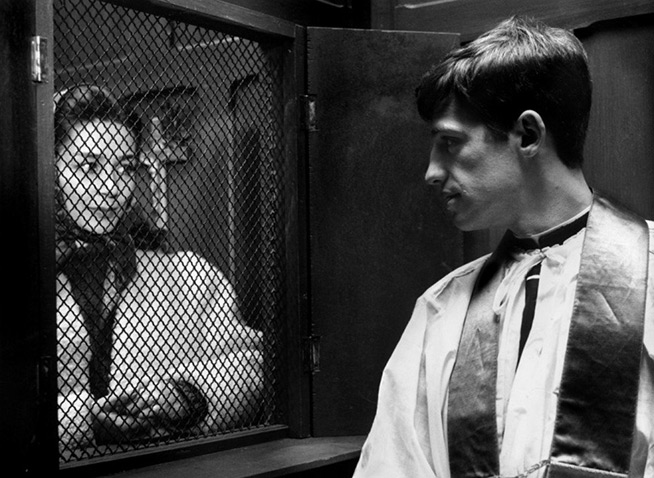
Referring back perhaps to “La Silence de la Mer” in terms of its intensely personal nature, this intimate picture really sees Jean-Pierre Melville bearing his soul. “Leon Morin, Priest” is set in a small nook of the French Alps, during German occupation, and tells the story of Barny (Emmanuelle Riva), a widowed single mother with a carefree attitude towards pretty much everything. After baptizing her half-Jewish daughter as way of protecting her from the Nazis, the atheist Barny decides to give a sort of mock-confession, a way to confirm her belief that churches are “living off false currency.” She walks into the booth of young Leon Morin (Jean-Paul Belmondo) and is knocked off her high horse by the handsome priest with his impregnable morals and wits quick enough to dodge every barb she throws at him and his church. And so, “Leon Morin, Priest” examines a relationship that evolves into something complex, intimate, and life-changing for both (but, one gets the impression, especially Barny). It’s a cinematographically torpid picture, not unlike ‘La Silence,’ because of the long stretches of dialogue and single-room setting, and while Riva radiates in her role, Belmondo looks like he’s winging it after a hard night of partying half the time. As their relationship grows, however, his performance sobers up, and by the time the climax creeps up on us, the emotional and psychological weight is almost too much to bear, and certainly unlike anything else in Melville’s career. The theological debates massage the intellect while the tension of forbidden love ignites emotions, and here the two collide to deliver the filmmaker’s most intensely provocative picture.

