





Needless to say, it was worth the wait. Vince Gilligan’s acclaimed “Pluribus” was literally years in the making, but has given the latter half of 2025 one of the best new drama series of the decade. At the center of this unconventional apocalyptic series is the fantastic Rhea Seehorn, who is either Gilligan’s new muse after this and “Better Call Saul,” an incredible actor who found the perfect creative partner, or both. Whatever the case, the Apple TV+ smash ended its nine-episode run on Christmas Eve with a tantalizing but semi-subdued cliffhanger.
Please note: There are spoilers ahead regarding the season one finale of “Pluribus.”
You’ve been warned…
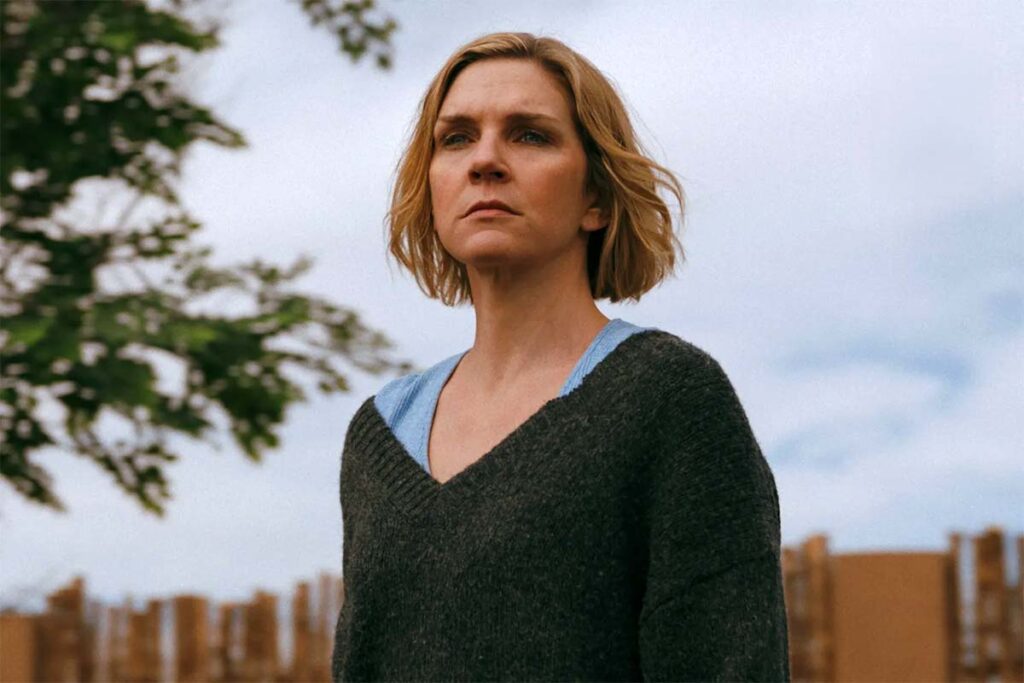
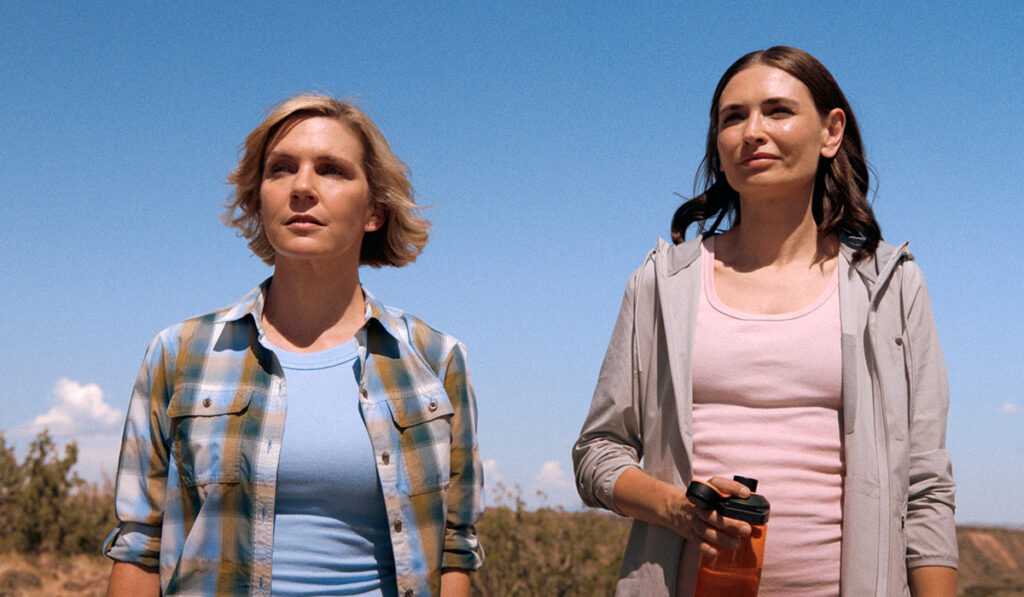
Gilligan’s contemporary set Sci-Fi tale centers on Carol Sturka (Seehorn), a middling but popular enough fantasy author who dreams of taking her career in a different direction. When an alien-spawned A.I. entity connects almost every human being on the planet into a collective hive mind, Carol is one of 13 people not affected by the infection. With the rest of the population insisting it won’t hurt her and only wanting to make her happy, Carol wrestles for most of the first season attempting to figure out a way to free the human race, not upset the other non-hive “survivors,” and stop herself from romantically falling for her handler, Zosia (Karolina Wydra). All while her one potential ally, Manousos (Carlos-Manuel Vesga), another non-infected person, refuses the hive mind’s assistance as he makes his way from Paraguay to Carol’s home in New Mexico.
During our conversation last week, Seehorn reflected on her excitement over Gilligan’s initial pilot script, how she kept herself in the dark regarding spoilers for most of production, how she’s avoided reaction to the show online, why she knows viewers may be very frustrated with Carol in the finale, if Carol can ever be happy, and her thoughts on what happens next. Oh, and much, much more.
This interview has been edited for length and clarity.
_____
The Playlist: Congratulations on the show. I know working in the entertainment business is often about waiting and patience, but how hard was it to wait for this show, considering Vince first brought it up to you during the filming of the final season of “Better Call Saul” in 2001?
Maybe I’m wrong. The harder wait was Vince telling me, “I wrote something for you, but I don’t want to pitch it to you. I just want you to read the script, but I’m not ready to send you the script yet.” And then it was like six to eight weeks later, that was very hard. I was like, “What is it?” I mean, he told me there’s a Sci-Fi element, and that was it. Nothing else. No idea what it was going to be whatsoever. I said, “Yes,” and he was like, “No, you can wait and read it.” I was like, “I don’t care. I don’t care if I’m playing a chair in it. Yes.”
But what I had read, and maybe this is wrong, is that Vince had mentioned to you while you guys were finishing “Better Call Saul,” that he had a show for you. Was this the same project?”
We had wrapped shooting “Saul,” but it hadn’t aired, and they were in post-production, and that’s when he told me, “I wrote something for you if you’re interested.” I was asking my writers, “What are you guys up to next? What are you doing? I’ll follow you anywhere to the ends of the earth.” And he said, “I wrote something for you if you’re interested,” which was hilarious because, of course, I’m interested. And yes, that was this project, but he didn’t tell me anything about what it was about. He just said, “I’m not ready to share the script yet, though. I’m still working on it.” I was like, “O.K.” But for six to eight weeks, I was like, “What is the show? I wonder what it is.” He said it wasn’t Kim Wexler [or a “Saul” spin-off]. He did say that, and he said there was a sci-fi element. So, that’s all I knew.
When you got the script, what got you excited the most?
A couple of things. One was the suspenseful ride. His scripts are written with a lot of, I’m not sure of the right word, novel or narrative-like language. So, instead of it being a slog to get to the dialogue scenes describing everything or whatever, they have pace in them, they have tone in them, they have point of view in them. And so I went on the ride that presumably you went watching the pilot. It is very breathless. It’s very like, “What the hell?” And then in the same vein, the other thing that caught me was I was like, “Wow, he is swinging for the…” He has always played with tone and genre, going in and out and making big swings. I was like, “He is swinging for the fences in this one. You cannot pin down what kind of show this is. What is this show?” And then I could sense the really dark comedy that was in it in the middle of a very traumatic scene. And then there’s this action stuff like running for your life, and this post-apocalyptic genre type stuff. And then tremendously painful private moments when her wife passes away, and I was just like, “Holy crap.” This would be the show for me as a fan. It’s the kind of show I would watch, and then immediately I’m thinking, “Oh my gosh, I get to do this, and I’m going to do this with him, and we’re going to find this crazy ass tone together.” I was over the moon, just could not wait.
When you actually did get on set, was it easier to step into that tone than you thought it would be? Or was it something you sort of felt like you guys had to work on in context on set? Was it just inherent to the material?
Good question. It’s both. It was both. So, it was exactly the challenge I thought it would be, which means we’re really going to navigate these scenes. But the relationship that I had with Vince was not only as easy as I thought it would be, but it was even better. For instance, we do multiple takes of the same scene, pushing the comedy as far as it could go, and then takes pushing the dramatic part and the darker parts of it as far as it could go, and then asking yourself, “How far can each of these go?” While they still can suspend each other and be in the same show before you’re losing the thread of like, “O.K., this show doesn’t know what it wants to be, right?” And how far can you take something if you’ve just come out of a very dramatic moment? So, it was very challenging, but in a very rewarding way as an actor to get to play things a myriad ways, the same scene, but really fun and joyful even when it gets hard. The fun kind of hard with Vince to say like, “O.K. That’s too far,” or “No, it can’t support that. Let’s try this.” I can’t express to you the incredible feeling. I’m sure you have it in different journalism spaces where you’re working with people who actually are assuming you’re going to be brilliant instead of waiting for you to prove that you deserve to be there. He creates an environment where you’re like, “Jesus Christ, I hope I’m half as good as these 350 people think.” But it makes you try. You feel safe to take much bigger risks.
I am assuming that all the scripts were written or close to written before you guys began filming. Was that the case?
You would have to ask them because I know they break all the stories, and no, I can’t define that for your readers because sometimes I get different answers. I’m not entirely sure. They do the whole note card stuff. The story beats of every scene of every episode. They break all of that before we go, but there aren’t finalized scripts. I’m pretty sure that’s what it was on “Better Call Saul,” and there is room to change things. There is room to see what’s working and what’s not as far as a storytelling thing. And Vince has been very public about the fact that he loves to paint himself into a corner with some story seed and have no idea what the payoff is going to be for it, and then have to figure it out later.
To clarify, then, when you went to film, you did not know what was happening necessarily in the final episode. Or had Vince told you what Carol’s arc was going to be?
No, I had no idea. I had no idea, only because of the strikes. Did I have three episodes? Normally, I would’ve only had one. It ended up being a really big blessing because they had three fully in the can, not just broken down in beats, but fully in the can before the writer’s strike happened. And so, because we weren’t going to go film, they let me have those, and it did help me get a head start on prep because then you get a snowball effect once you’re shooting normally on his shows. I get the next script about halfway through shooting the one I’m shooting. And in the case of being the lead of the show, much like Bob [Odenkirk] went through on “Saul” with so much “A” story. I’m in all I think but a handful of scenes in this one. You’re going to constantly fall behind on the prep for the next one. So I was happy to get a little ahead, but after that, no, I got my scripts one at a time. I had no idea where it was going, no idea where I ended, no idea of what was going to happen ever.
Did you want to know? Or is Vince’s thing like, “Nope, you’re going to find out when you find out.“
He told me that if there are things you need to know that would help you in any way in your process, tell me. But during “Better Call Saul,” I really, really didn’t know, and they’ve since said publicly that they didn’t even know if Kim Wexler would stick around or if she would just be the girlfriend that got away. So, I knew not to ask. I also was just trying to make sure that I got to stay in the sandbox by doing my job and not worry about anything else. But I learned a new way of working. I have a lot of friends in the business who are like, “I would definitely want to know where it’s going.” And sometimes, especially as women, I think, because are you going to do anything with my character or am I just going to be sitting around, or what is the plan, and blah, blah, blah, blah. I already trusted that even if I wasn’t the lead that Vince and Peter and all of their writers, all of their characters are onion layers that keep getting peeled. They’re always complex, they’re always interesting. They always get to evolve, and they certainly were going to do that with me being the lead of the show. So I was like, “You know what? My RAM space is perfectly full figuring out what the hell I’m doing today. I don’t think I want to know what’s going on tomorrow.” I mean, I would always tell ’em if there’s something I decided to play as the subtext in the scene. If that is not going to work because of what’s coming, obviously, tell me. But otherwise, I’m just going to keep doing my little squirrel brain thing I do, which is looking for the whys in the subtext between everything that’s going on, and I’ll just keep chugging away. So, I didn’t ask.
There’s maybe up to 30 minutes into the final episode where I’m like, I’ve been rooting for you, Carol, but what are you doing? You’re driving me crazy. This is crazy. What was your reaction to that final episode script, and are you aware that viewers will sort of, I don’t know if they’re going to turn on Carol for a minute, but they might be like, “Girl, what’s going on”?
Yeah, although I’ve been told I am too thin-skinned to deep dive on the internet about the show, but I’ve been told there is a contingency of people who are like, Carol should just join them. What is her problem?
Oh, no.
Yes!
No, no.
Yes! And I love that these questions and discourse exist, but I started those questions that you’re asking. I started them in eight when she even gave into the relationship, and Johnny Gomez wrote that episode, and Melissa Bernstein was directing it, and we had a lot of navigating to do with that, with the brilliant Karolina Wydra playing Zosia, like it even backed up to the diner scene because Carol is, I know it’s an act of manipulation, right? Carol knows. Absolutely does. She says she does. However, it is also an act of kindness and was the first kind of lovely, joyful memory moment that we’ve even seen Carol have, which then to me starts unwinding into these very heady, intellectual, and philosophical unsolvable things that for someone as smart as Carol. I do think she would wrestle with, “Well, what is kindness that isn’t ever manipulative? When is anybody doing anything for anybody without an objective? Is there true altruism anyway? What is real love? Why? What they feel for me is real love, but the fact that they have an objective for why they’re being kind to me, does that erase any of this love?” And then you add to it this incredible burden of the isolation she just went through that not only lasted forever or lasted a very long time in her head, but existentially will go on until the day she dies.
Good for you! You fight the good fight, you get to die alone on your couch watching “Golden Girls.” No one’s ever speaking to you again. That’s the alternative she thinks she has. So, there is a willingness to live in this delusion, I think, and also this intellectual push-pull with, I’m sure, there’s a primal need to be hugged, to be loved. And I hope people do do what you did, I hope they white knuckle it a little bit, going like, “Please don’t go to the dark side,” or I guess in this case it’s to the light side. But I hope they also can understand a little bit of why she’s going on that journey because the alternative is just too bleak. And also even when she had genuine love, the love of her life, Helen played by Miriam Shore, and a career, it was still, “I’ll be happy when?” She wouldn’t let herself experience any joy then the ice hotel, all of it. So, maybe you’d better just start trying to find joy somewhere that didn’t seem to result in anything good.
We get to the end of the season, and it’s still two people against what, 7 billion? Or whatever the number is. Have you asked Vince if there is a way that they can win?
No, I haven’t asked it. It seems insurmountable.
It does, but do you have hope that they can win at least?
I mean? Of course, I have hope. I have hope. But I know that it’s not going to be that easy. Not only the task at hand, but also what is the solution? What is deemed the right way to get this done is still going to be an open-ended question. I know it is. I mean, we at least saw that Diabaté, Samba Schutte, whom I just adore, has at least admitted that he doesn’t want to be changed. Maybe he’ll come help us. I don’t know. Maybe if he has time to stop sleeping with all of ’em, he might come help us. Manousos? I’m there, but I don’t even like him, and he just wants to obliterate everybody, which is not the solution Carol wants. It does seem insurmountable.
And no, I don’t know why I have an A bomb in my driveway either. I don’t know.
“Pluribus” season one is available on Apple TV
Follow Gregory Ellwood on Bluesky
Follow Gregory Ellwood on Threads
Follow Gregory Ellwood on Instagram
Sign Up For The Breakdown Newsletter


