


In 2015, for his short film “Bronco’s House,” writer/director Mark Jenkin wrote a 13-point bulleted list of self-imposed rules for filmmaking. A manifesto of sorts, it forced him to work within extremely rigid confines. Among those rules: the film “must be shot on small gauge film,” and there should be “no extraneous grip equipment other than a tripod.” This process has allowed Jenkin to find a purity of image, shooting only what he needs, and has helped create a textual and metatextual throughline for the rest of his work. From “Bait” to “Enys Men” to his latest, “Rose of Nevada,” Jenkin has narrowed his focus to fishermen, the Cornwall Coast, and the ways in which the passage of time warps and mangles institutions, livelihoods, and minds.
Shooting everything with a 16mm Bolex camera, he has synthesized a unique brand of nostalgia all his own, the kind that innately feels poisonous yet wistful. His grainy images, with eerie sound always added in post, evoke bygone people at odds with modern living.
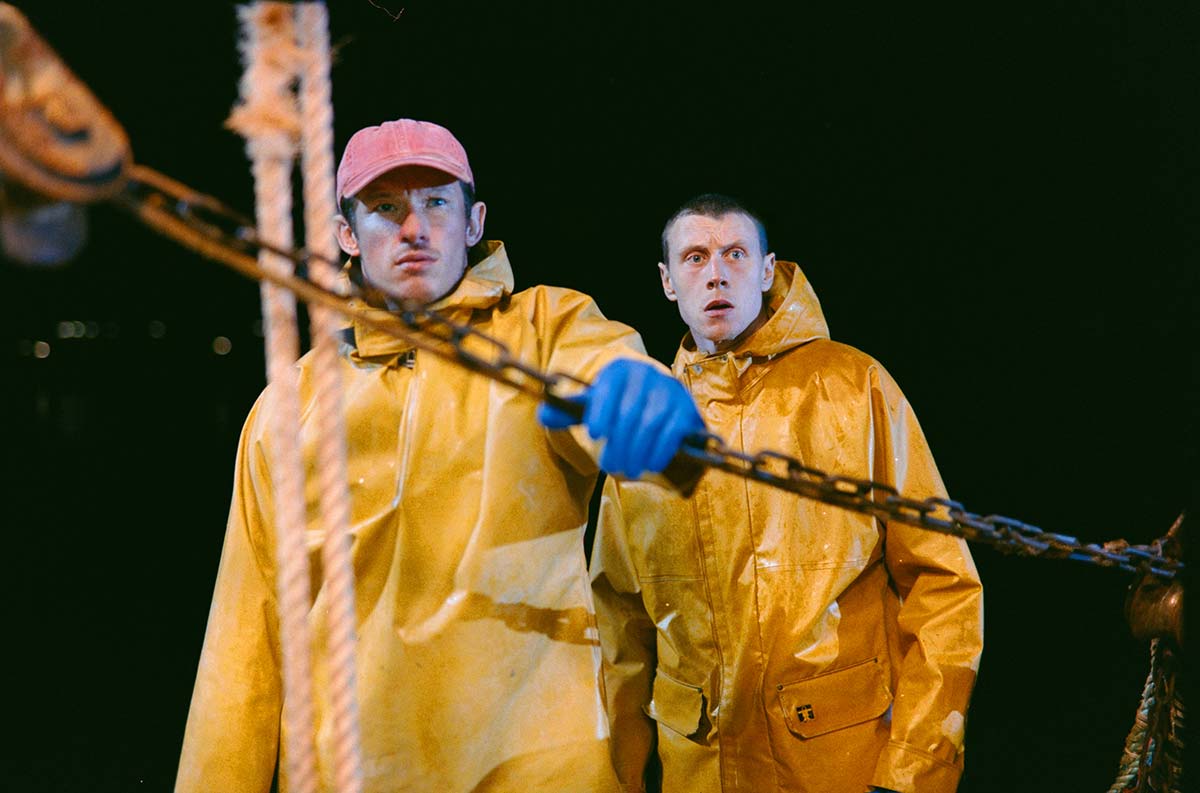
“Rose of Nevada,” in particular, may be his magnum opus. When a fishing boat, the titular Rose of Nevada, reappears on a Cornwall dock decades after going missing, a fisherman refurbishes it for work. Hiring two aimless young men, Nick (George MacKay) and Liam (Callum Turner), the three set sail looking to make a living. Soon enough, they’re transported back to 1993 with no idea why they’re there or how to get home.
Jenkin’s commitment to small-scale, intentional filmmaking is tested here, as he’s working with both his biggest budget and biggest stars. The result is a fascinating odyssey into moving on from what once was and realizing that you can’t go “home” again, especially if that home is the past. Cornwall is a county seemingly stuck in time, even for England. Its way of life is slowly disappearing. The magical atmosphere that permeates the air creates an odd push and pull between gleefully staid living and a melancholy ache to jump forward. Jenkin’s Cornwall is a place where you can disappear into the mist, a substitute for living in the past, and never return, calcifying into something forgotten.
His style, still adhering to that manifesto, creates the most compelling living document on empty nostalgia. The 16mm is both warm and cold, welcoming you into days gone by while scratched with a tinge of uncanny dread. It’s an astonishing work that lives alongside ongoing conversations in England’s political sphere: a country ostensibly living in the 21st century yet fighting tooth and nail to retain old, dusty traditions.
Ahead of the release of “Rose of Nevada,” I spoke with Jenkin about the film, what Cornwall means to him, the value of adhering to his own restrictions, and the thorny realities of “Quantum Leap.”
After seeing the film at NYFF last year, I was reading a friend’s thoughts on the film. She’s from Cornwall, and she talked about how much your work evokes the county’s inability to move forward, while still capturing the magical pull it has on a person while there. So I wanted to start with Cornwall. What compels you to keep coming back home to make your films there?
The original draw to making films in Cornwall was nothing conscious. It’s just because I’m here, and it’s my home, and it’s where I was born, and I’ve lived my entire life. I’ve been away for certain times. I worked in London for three years. I went away to college for three years. Even when I was away, this was still my home, and I always knew that I wanted to make movies here. So it’s not a conscious thing. It’s not something that I’m looking to investigate or interrogate necessarily. It’s just born out of my fear of making films that people think are phony in terms of their setting. The only place I can set a film where I can get anywhere near a level of authenticity is Cornwall. Audiences are very smart, and I think they sniff out something fake very quickly, even if you don’t know why.
As an audience member myself, I don’t buy things if they don’t feel real and won’t go with the story. I’m quite paranoid about that in my own films. I’m quite happy for people to tear my films to pieces and say, “Oh, I don’t like the script,” or “I don’t like the camera work.” I read a thing on Letterboxd the other day saying, “Oh, why has he spent so much time pretending that it’s shot on old film?” [laughs]
I kind of love that because that’s what I love about Letterboxd. Even if you’re getting absolutely nailed to the wall for something you’ve done, it means people are watching the work and expressing themselves about the work. All of that is cool, and I know I can’t control that. I can, however, control its authenticity. The only criticism that stings would say, “This feels fake.”
So that’s my original draw to Cornwall. Having said that, since I’ve had work out there and people are writing about it, watching it, and talking about it, that forces me to have a look at what it is, what Cornwall is. Not higher or better than any other place, but what is Cornwall, and why do I portray it on the screen as I do? I’m fascinated by, like your friend was saying, the fact that it’s in some ways timeless, ancient, and timeless, but yet everybody’s moaning about the fact that it’s not like it used to be. I do that too.
![George MacKay On Mark Jenkin’s ‘The Rose Of Nevada,’ The Magic Of Cornwall & The Nerves Of One-Take Filmmaking [Interview]](https://cdn.theplaylist.net/wp-content/uploads/2026/06/19111945/RON-Production-029_Ian-Kingsnorth-1024x687.jpg)
I turned 50 the other week. I’m going to a lot of 50th birthday parties with my mates, and we all get together, and a lot of us haven’t seen each other for a long time. Sometimes I’ll go, “Oh, you remember that summer of ’94 or whatever? That was the heyday of the beach,” or whatever place we’re talking about. I also know that back there in the mid-’90s, when we were there, there was a generation going, “Oh, it’s not like it was in the ’60s.” And in the ’60s, people were saying, “Oh, it was not like it was in the ’30s,” or whatever. There’s a danger attached to romanticizing the past, which I’m quite careful to stay away from in my films because we have a bit of a political movement in the UK at the moment, which I think you may share in your country, where there’s some romanticized past that we’re trying to get back to, which one, wasn’t all that great anyway, and two, probably never even existed.
And if it did exist, the question is always, “Well, for whom?”
Exactly. So there’s that, but yeah, I’m obsessed with the past. Like many Cornish people, I was born nostalgic. There’s a saying that people are born nostalgic here. That’s to do with being one of the Celtic nations in the UK, along with Scotland, Ireland, and Wales, the Cornish. We’re all defeated nations. We’re all nations that were defeated at one point or another by the English and quite often forced out of our land for different reasons. The Celts were pushed back into the extremities of the country, which obviously is not within my living memory or anybody I ever met, but I think it’s there in the culture. This idea that when you’ve been defeated, what you’re left with, you cling onto very, very tightly.
I was over in America in March doing a road trip because I’m writing a movie that’s based over there. I was traveling through many of the places in the Midwest where the Cornish exiles went when they left Cornwall. It’s really interesting because the Cornish and the Welsh both have a name for a specific feeling. The Welsh word is “hiraeth,” and the Cornish word is very similar, “hireth,” and it’s got no direct translation into the English language, but it roughly means “a longing for home.” Home can be a literal home, or a time, a place, a feeling, a person, a piece of music, or just an atmosphere. That’s what I’m interested in, the Celtic notion of hiraeth or the Cornish notion of hireth. It’s a kind of obsession with the past, but I’m desperately trying not to over-romanticize the past.
You spoke of authenticity, and having grown up in the ’90s, I was astonished by how real it felt watching the film. I know I’m from a different country, but I’m from a working-class, blue-collar town like Cornwall, and the aesthetics were so familiar to me. How did you approach that?
The huge credit goes to Flo Hickson, who’s the production designer. She’s quite a bit younger than I am, but we talked early on about how the world would look in 1993. The danger there is that you fall into the trap of creating a world based on 1993 pop culture. So here, it was a little bit of an in-between time between when the Manchester scene, the Stone Roses, the Happy Mondays, and all of that had died out. I’m talking about the youth culture here, but before Brit Pop had kicked off.
So it’s a little bit of a space where we were getting a bit overrun by grunge and terrible imitator bands. If you were going to base it on the pop culture, then you would replicate exactly 1993, but there’s always a lag, I think a three- or four-year lag. We decided to make it look like maybe 1990, and got more specific about what 1990 would’ve looked like. Then an extra lag, because we were in Cornwall, an extremity far away from the big cultural centers. It looks like the ’80s, really, the 1993 that we tried to portray. It is all in the production design. I never wanted to do anything different in how it was shot, between the contemporary and the ’90s. I didn’t want to change the color palette in terms of how the film was lit or shot. All of that was just changed in the production design.
Your desire to adhere to certain rules or authenticities is, of course, reflected in that manifesto you wrote a little over ten years ago. I remember it being very popular in film circles at the time. Is there a tension in still working within those restrictions when you’ve got a bigger budget and cast?
No, not really, because I was really stuck from day one with the equipment that I wanted to use, which really dictates how we do everything. If you’d wandered onto the set of “Bait,” “Enys Men,” or “Rose of Nevada,” and you’d come speak to me, you wouldn’t really have noticed any difference. It’s still me holding a clockwork 16mm Bolex camera in one hand, a light meter around my neck, and a bag of cans of film in the other hand. That didn’t change at all.
If you stepped back, you’d see a larger support team. The art department was much bigger in this film. That was partly due to, although I didn’t accept this for a long time, the fact that we were making a period drama. It took me many months to accept that 1993 was now a period drama, but that fills up the art and construction departments as well. We shot quite a bit in the studio. We shot for over a week in the studio. All of the boat interiors below deck were built on a set in a studio on a gimbal. So that increases the film’s size.
Denzil Monk, my producer, if you’d gone and chatted to him, the team he had around him was much bigger, the production side of it, than we’d done before. In anticipation of this question, we made sure we protected ourselves and went, “Well, we’re going to do this, but we’re going to do it in the way that we want to work, in this handmade way.” That will impose certain limitations on how much money we’re going to be given. It was like, “Well, how much money are you going to give us before we have to compromise the way we work?” Then they give a figure, and we go, “Right, we’ll do it for that.”
It’s astonishing to me that you don’t storyboard. I’d read that back when “Bait” was out, and that you only shoot one or two takes. That’s insane to me. You’re shooting on a Bolex, no storyboards, just a shot list, and going for it. How do you hold all that in your head?
If you came on set with us, you’d be surprised how little the camera’s rolling. It runs in little bursts. So it gives me time to work out exactly what I want to put in the frame. I always say I don’t storyboard, but I suppose I’m constantly storyboarding in my head. I only shoot what I think I’m going to need in the edit. The only reason I don’t storyboard is that I’m both the cinematographer and the director. There’s quite a clean line of communication between those two people most of the time. As a director and editor, I can imagine what I need in my head, and then, as the cinematographer, capture that.
![George MacKay On Mark Jenkin’s ‘The Rose Of Nevada,’ The Magic Of Cornwall & The Nerves Of One-Take Filmmaking [Interview]](https://cdn.theplaylist.net/wp-content/uploads/2026/06/19111943/RON-Production-036_Steve-Tanner-1024x631.jpg)
I also grab one or two takes, and then I’ll also grab whatever’s on the set. So the art department will have populated the background of a scene with props. More often than not, one or two of those props will end up being heavily featured in a massive close-up within the scene because I’ll see some significance in them. The art department very early on knew that none of their props were safe. None of the props would be 100% just out of focus in the background. They might be very significant within a scene. Nothing’s background in my films. Everything’s got an equal chance of becoming very much foregrounded.
Bringing it back to NYFF, when the film premiered, you told Dennis Lim during the Q&A that you’d watched a ton of “Quantum Leap” in the lead-up to this film. I used to watch that religiously with my dad. Tell me about that connection.
One massive thing I learned from it was that there’s a huge moral, ethical issue at the center of “Quantum Leap” in that he does leap into the body of somebody else, and then the friends and family of that person believe he is the original person. Quite often, he would then have a romantic relationship with whoever that person was with. So there are questions of consent, which really did make me go, “Oh, I’ve got an issue of consent in my film, really.” It prompted me to write a scene to address it. It didn’t solve it, but in one way, it told the audience that the person making this film is aware of this issue and allowed the characters to talk around it without really giving a definitive answer. I don’t think I would’ve thought of that if I hadn’t watched “Quantum Leap.”
I might not have thought about it until the edit, which would be too late. Or I might not have thought about it until sitting there with 1,100 people in Venice at the World Premiere. I might’ve just gone, “Oh shit,” at that moment. So I’m glad “Quantum Leap” may have prevented me from having that moment in public. I had that moment in private and was able to address it.


